
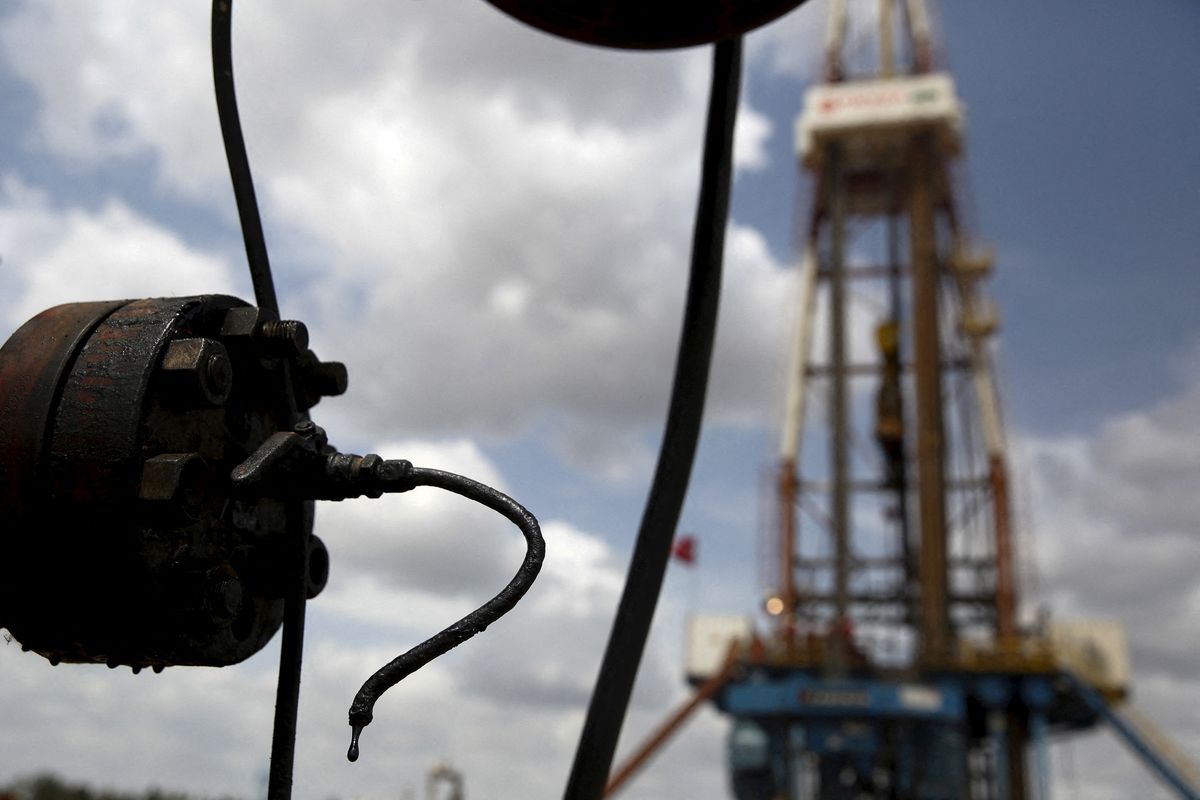
Crude oil drips from a valve at an oil well operated by Venezuela’s state oil company PDVSA, in the oil rich Orinoco belt, near Morichal at the state of Monagas April 16, 2015. Picture taken on April 16, 2015.
12:03 JST, January 11, 2026
Jan 10 (Reuters) – U.S. President Donald Trump signed an executive order aimed at blocking courts or creditors from impounding revenue tied to the sale of Venezuelan oil held in U.S. Treasury accounts, the White House said on Saturday.
The emergency order said the revenue, held in foreign government deposit funds, should be used in Venezuela to help create “peace, prosperity and stability.” The order was signed on Friday, less than a week after U.S. forces captured Venezuelan leader Nicolas Maduro in Caracas.
Several companies have longstanding claims against the country. Exxon Mobil XOM.N and ConocoPhillips COP.N, for example, left Venezuela nearly 20 years ago after their assets were nationalized. Both are still owed billions of dollars.
ConocoPhillips is the largest non-sovereign credit holder in Venezuela, its CEO Ryan Lance told U.S. President Donald Trump during a White House meeting on Friday, adding that the U.S. government has an opportunity to restore what has been lost.
Trump said ConocoPhillips will get a lot of its money back, but the U.S. would start with a clean slate. “We’re not going to look at what people lost in the past because that was their fault,” Trump said before asking Lance how much ConocoPhillips lost in Venezuela.
Lance said his company was owed $12 billion.
“Well, good write-off,” Trump remarked.
Saturday’s order does not mention any specific company. It declares that the money is the sovereign property of Venezuela held in U.S. custody for governmental and diplomatic purposes and is not subject to private claims.
“President Trump is preventing the seizure of Venezuelan oil revenue that could undermine critical U.S. efforts to ensure economic and political stability in Venezuela,” the White House said in a fact sheet.
A U.S. agreement with Venezuela’s interim leaders would provide up to 50 million barrels of crude oil to the U.S., where numerous refineries are specially equipped to refine it.
Trump cited the 1977 International Emergency Economic Powers Act and the 1976 National Emergencies Act as a legal justification.
Trump signed the order the same day he met in Washington with executives from Exxon, Conoco, Chevron CVX.N and other oil companies as part of a bid to encourage them to invest $100 billion in Venezuela’s oil industry.



Most Read
Popular articles in the past 24 hours
-
Pass Rate for Overseas Driver's License Conversion Test in Japan ...
-

Milano Cortina 2026: Ceremony for Winter Paralympic Torch Relay T...
-
Tokyo High Court Upholds Unification Church Dissolution Order
-

WBC to Begin: All the Pieces are in Place for Japan’s Second Stra...
-
How Trump Assassination Attempts Played into His Decision to Atta...
-
PM Sanae Takaichi: Iran Situation Won’t Immediately Affect Electr...
-

Japanese Speedskater Takagi Announces Retirement
-

Trump's Asian Allies Fear Iran War Will Sap Defenses against Chin...
Popular articles in the past week
-
Tokyo Spends Big on Children, Wins Over Parents
-

Japan’s Miura, Kihara Announce Withdrawal from Figure Skating Wor...
-
BOJ Keeping Eye on Economy and Takaichi's ‘Proactive Fiscal Polic...
-
South Korea Tightens Rules on Foreigners Buying Homes in Seoul Me...
-
Tokyo Measles Patient Traveled to Fukuoka Aboard JAL Planes; Susp...
-
Nidec Chairman Resigns Amid Accounting Scandal at Major Japanese ...
-

Tourists Ignore Safety Barriers Near Famous Zao ‘Snow Monsters’ i...
-
Strait of Hormuz Closure Shakes Markets; Prolonged Closure Could ...
Popular articles in the past month
-

Producer Behind Pop Group XG Arrested for Cocaine Possession
-

Japan PM Takaichi’s Cabinet Resigns en Masse
-

Man Infected with Measles Reportedly Dined at Restaurant in Tokyo...
-

Israeli Ambassador to Japan Speaks about Japan’s Role in the Reco...
-

Videos Plagiarized, Reposted with False Subtitles Claiming ‘Ryuky...
-

Prudential Life Insurance Plans to Fully Compensate for Damages C...
-

Woman with Measles Visited Hospital in Tokyo Multiple Times Befor...
-

iPS Treatments Pass Key Milestone, but Broader Applications Far f...
Top Articles in News Services
-
Survey Shows False Election Info Perceived as True
-
Hong Kong Ex-Publisher Jimmy Lai’s Sentence Raises International Outcry as China Defends It
-
Japan’s Nikkei Stock Average Falls as US-Iran Tensions Unsettle Investors (UPDATE 1)
-
Japan’s Nikkei Stock Average Touches 58,000 as Yen, Jgbs Rally on Election Fallout (UPDATE 1)
-
Japan’s Nikkei Stock Average Rises on Tech Rally and Takaichi’s Spending Hopes (UPDATE 1)
JN ACCESS RANKING
-
Producer Behind Pop Group XG Arrested for Cocaine Possession
-
Japan PM Takaichi’s Cabinet Resigns en Masse
-
Man Infected with Measles Reportedly Dined at Restaurant in Tokyo Station
-
Israeli Ambassador to Japan Speaks about Japan’s Role in the Reconstruction of Gaza
-
Videos Plagiarized, Reposted with False Subtitles Claiming ‘Ryukyu Belongs to China’; Anti-China False Information Also Posted in Japan