
As Bird Flu Pushes Egg Prices Higher, Japan’s Agriculture Ministry Plans Reserves of Frozen Liquid Egg
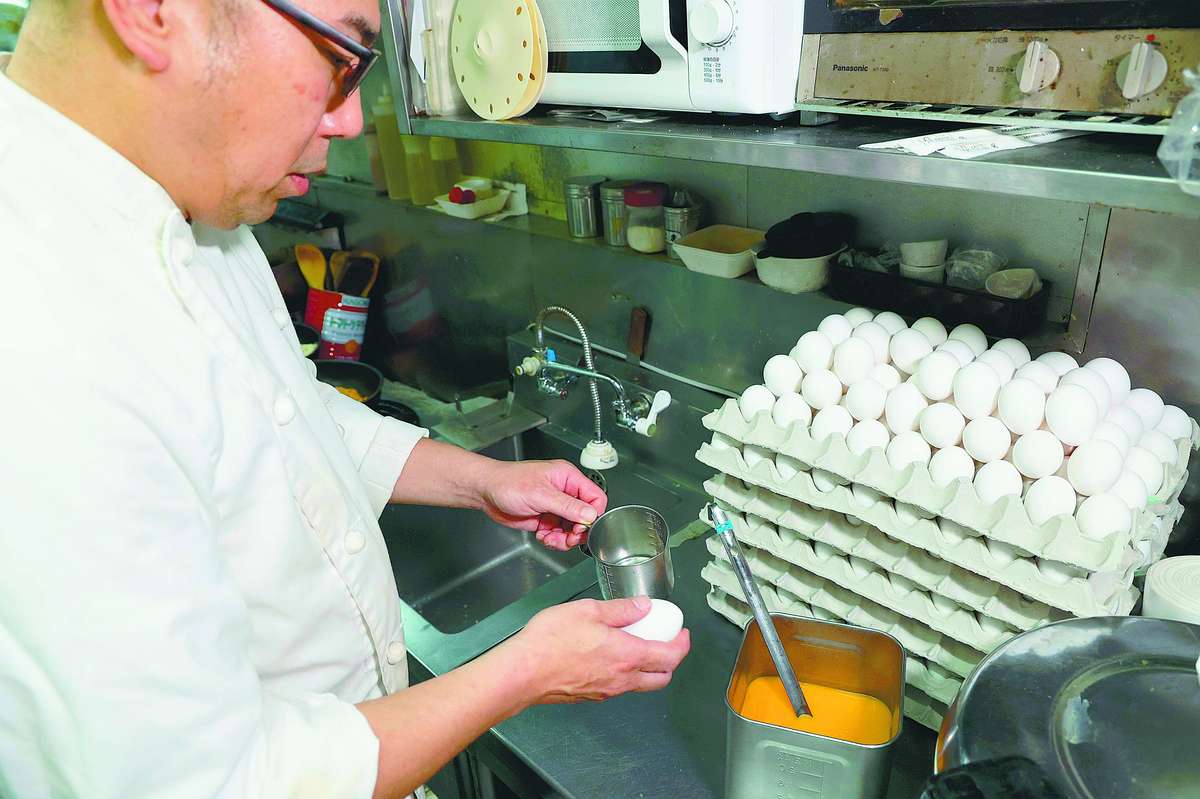
A chef cooks eggs at a restaurant in Adachi Ward, Tokyo, in early December.
2:00 JST, December 26, 2025
To brace for potential egg shortages driven by outbreaks of highly pathogenic avian influenza, the Agriculture, Forestry and Fisheries Ministry is moving to expand the use of processed eggs that can be stored for long periods. The ministry plans to freeze and keep a set volume of liquid egg — eggs without the shells, such as beaten egg — so they can be used when overall supplies fall. The initiative is also aimed at preventing sharp price increases, with implementation targeted for fiscal 2026.
Liquid egg refers to eggs in liquid form after the shells are removed; in some cases, the contents are not fully mixed. It is widely used by food processors that use large quantities of eggs, including confectionery and bread manufacturers. While refrigerated liquid egg typically only lasts several days to about a week, frozen liquid egg can be stored for roughly a year and a half, according to the ministry.
To support egg producers and liquid-egg processors, the ministry plans to subsidize up to half the cost of building and upgrading facilities needed to store frozen liquid egg. It will also encourage food manufacturers to shift to frozen liquid egg when producing items such as bread and sweets.
Egg supply is heavily influenced by the spread of avian influenza. Outbreaks from last autumn through early this year led to the culling of large numbers of chickens, contributing to a drop in egg supply this year. Even now, new cases are gradually being confirmed, heightening concern.
Curbing price increases
According to JA.Z-Tamago Co., the average egg price in the Tokyo area in November for M-size eggs was ¥340 per kilogram, the highest on record for this season. Prices remain elevated at ¥345, approaching the level seen during the “egg shock” of spring 2023, when prices hit a record ¥350.
Officials say wider use of frozen liquid egg could help prevent shortages on store shelves and curb steep price hikes even if avian influenza spreads.
The Japan Poultry Association estimates that of roughly 2.5 million tons of domestically produced eggs in 2024, about 80% were consumed as whole eggs for household and commercial use, while the remaining 20% were processed eggs, including liquid egg. Demand for eggs typically rises toward year’s end for cakes and hot-pot dishes, but tends to fall in summer. The ministry aims to build an emergency-ready supply system, such as producing liquid egg during the low-demand summer months and storing it for later use.
Photo caption:







Most Read
Popular articles in the past 24 hours
-

Director Naomi Kawase's New Film Explores Heart Transplants in Ja...
-

Milano Cortina 2026: Japan’s Mari Fukada Wins Gold in Women’s Sno...
-

Japan’s Nikkei Stock Average Rises on Tech Rally and Takaichi's S...
-

Milano Cortina 2026: Japan’s Taiga Hasegawa Wins Silver in Men’s ...
-

Japanese Man Living in Iraq Suspected of Illegally Entering U.S. ...
-

Milano Cortina 2026: Snowboarding Star Fukada Wins Gold in Hard-F...
-

Takaichi Expected to Express Desire for Constitutional Revision P...
-

Mark Zuckerberg Quizzed on Kids' Instagram Use in Social Media Tr...
Popular articles in the past week
-

Japan PM Takaichi’s Cabinet Resigns en Masse
-

Man Infected with Measles Reportedly Dined at Restaurant in Tokyo...
-

Videos Plagiarized, Reposted with False Subtitles Claiming ‘Ryuky...
-

Sanae Takaichi Elected 105th Prime Minister of Japan; Keeps All C...
-

Japan's Govt to Submit Road Map for Growth Strategy in March, PM ...
-

Milano Cortina 2026: Figure Skaters Riku Miura, Ryuichi Kihara Pa...
-

Tokyo’s New Record-Breaking Fountain Named ‘Tokyo Aqua Symphony’
-

Bus Carrying 40 Passengers Catches Fire on Chuo Expressway; All E...
Popular articles in the past month
-
Japan PM Takaichi’s Cabinet Resigns en Masse
-

Japan Institute to Use Domestic Commercial Optical Lattice Clock ...
-

Israeli Ambassador to Japan Speaks about Japan’s Role in the Reco...
-
Man Infected with Measles Reportedly Dined at Restaurant in Tokyo...
-

Man Infected with Measles May Have Come in Contact with Many Peop...
-

Prudential Life Insurance Plans to Fully Compensate for Damages C...
-
Videos Plagiarized, Reposted with False Subtitles Claiming ‘Ryuky...
-

Woman with Measles Visited Hospital in Tokyo Multiple Times Befor...
Top Articles in Society
-
Man Infected with Measles Reportedly Dined at Restaurant in Tokyo Station
-
Man Infected with Measles May Have Come in Contact with Many People in Tokyo, Went to Store, Restaurant Around When Symptoms Emerged
-
Woman with Measles Visited Hospital in Tokyo Multiple Times Before Being Diagnosed with Disease
-

Australian Woman Dies After Mishap on Ski Lift in Nagano Prefecture
-
Foreign Snowboarder in Serious Condition After Hanging in Midair from Chairlift in Nagano Prefecture
JN ACCESS RANKING
-
Japan PM Takaichi’s Cabinet Resigns en Masse
-
Japan Institute to Use Domestic Commercial Optical Lattice Clock to Set Japan Standard Time
-
Israeli Ambassador to Japan Speaks about Japan’s Role in the Reconstruction of Gaza
-
Man Infected with Measles Reportedly Dined at Restaurant in Tokyo Station
-
Man Infected with Measles May Have Come in Contact with Many People in Tokyo, Went to Store, Restaurant Around When Symptoms Emerged