To use this site, please disable the ad blocking feature and reload the page.
This website uses cookies to collect information about your visit for purposes such as showing you personalized ads and content, and analyzing our website traffic. By clicking “Accept all,” you will allow the use of these cookies.
Users accessing this site from EEA countries and UK are unable to view this site without your consent. We apologize for any inconvenience caused.
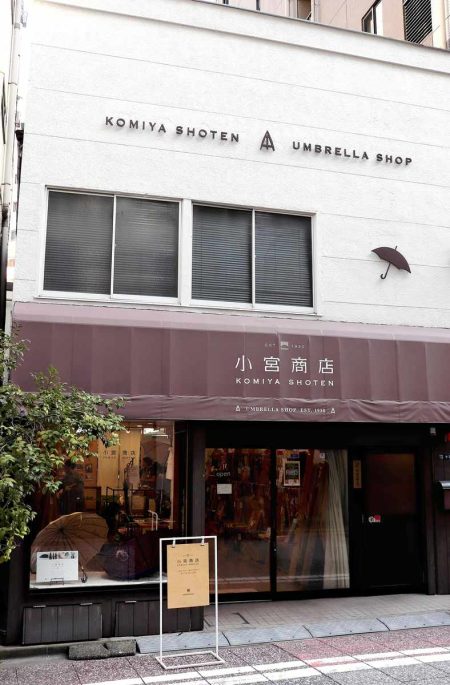
The Yomiuri Shimbun The exterior of Komiya Shoten’s building
By Shutaro Kakii / Yomiuri Shimbun Staff Writer
13:47 JST, November 10, 2025
Foot-powered, moss-green sewing machines whir away near the western bank of the Sumida River in Chuo Ward, Tokyo, stitching triangular cloth to make some of the very few Western-style umbrellas still produced in Japan.
This is the production studio of Komiya Shoten, which stands among textile wholesalers and other companies in the Higashi-Nihonbashi district of the ward. The company was established nearly 100 years ago in 1930.
With low-priced foreign-made umbrellas dominating the market, only a tiny number of umbrellas in Japan are domestically made. Komiya Shoten manufactures its products with great care, using three sewing machines that stitch cloth via the “tankan-nui” method. The method involves sewing only with upper threads.
Today, this type of sewing machine has disappeared almost entirely.
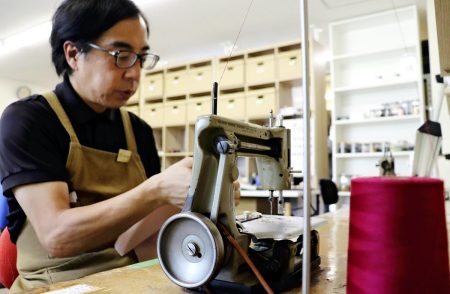
The Yomiuri Shimbun Craftsman Hiroshi Ishiyama works on a sewing machine specifically for making umbrellas.
According to craftsman Hiroshi Ishiyama, 55, “Sewing with both upper and lower threads makes cloth lose its stretchiness and the entire shape doesn’t bend neatly in the shape of an umbrella.”
Ishiyama has continued to use and maintain the very old sewing machines, which were manufactured around the middle of the 20th century. Other old tools are also essential for the work, including wooden frames for cutting cloth into triangular shapes.
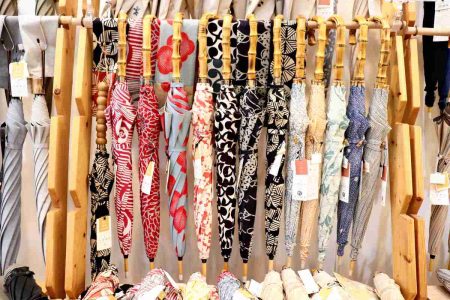
The Yomiuri Shimbun Umbrellas made with cloth for furoshiki wrappers featuring “isa monyo” patterns
Western-style umbrellas first came to Japan in the last years of the Edo period. From the start of the Meiji era (1868-1912), upper-class people favored Western-style umbrellas as a symbol of Japan’s civilization and enlightenment, and they began to be manufactured domestically.
During the postwar high economic growth period in the Showa era (1926-1989), there were more than 70 umbrella-related shops in Tokyo’s downtown area alone. However, many went under during the economic slump in the Heisei era (1989-2019). Only a few companies remain in Tokyo that manufacture Western-style umbrellas.
Umbrellas in various colors are available in Komiya Shoten’s shop, and sales staff assist customers with selecting the right item. Parasols, or sun umbrellas, are said to sell the most among both men and women. Especially popular are those usable as both rain umbrellas and parasols, and those that fold up.
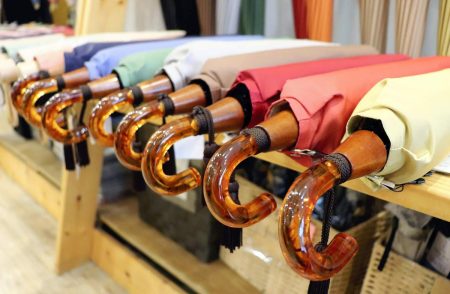
The Yomiuri Shimbun Folding umbrellas with tortoiseshell-style handles
Komiya Shoten’s lineup includes umbrellas with a retro aura, such as those with tortoiseshell-style handles and “isa monyo” patterns depicting pines and chrysanthemum.
The company’s Tokyo Yogasa brand of umbrellas, which are manufactured with traditional methods, was designated by the Tokyo metropolitan government as a local traditional craftwork in 2018.
“The number of customers from overseas has been increasing,” said Junko Kato, 57, who handles sales promotion and public relations for the company.
Perhaps due to climate change, Japan is seeing increasingly severe rain and extremely hot summer weather. But even amid those circumstances, swiftly opening a Komiya Shoten umbrella with nearly a century of history behind it will surely inspire people to remember the delicate moods of each season.
Komiya Shoten
The Yomiuri Shimbun
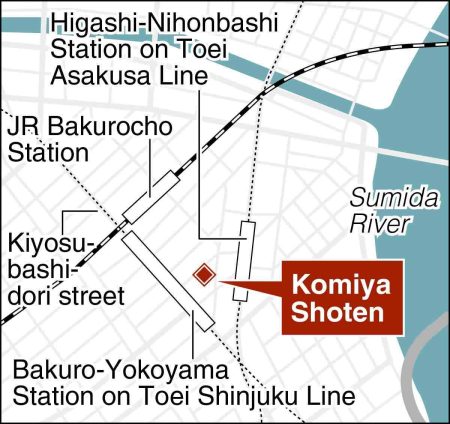
Address: 3-9-7 Higashi-Nihonbashi, Chuo Ward, Tokyo
Access: 1- to 2-minute walk from Higashi-Nihonbashi Station on the Toei Asakusa Line, Bakuro-Yokoyama Station on the Toei Shinjuku Line or JR Bakurocho Station
Hours: Open from 10 a.m. to 6 p.m. (until 8 p.m. on Wednesdays). Closed on Sundays and national holidays.