
Police to Focus on ‘Tokuryu’ Criminal Group Leaders in Fight to Eradicate Crimes Organized Via Social Media
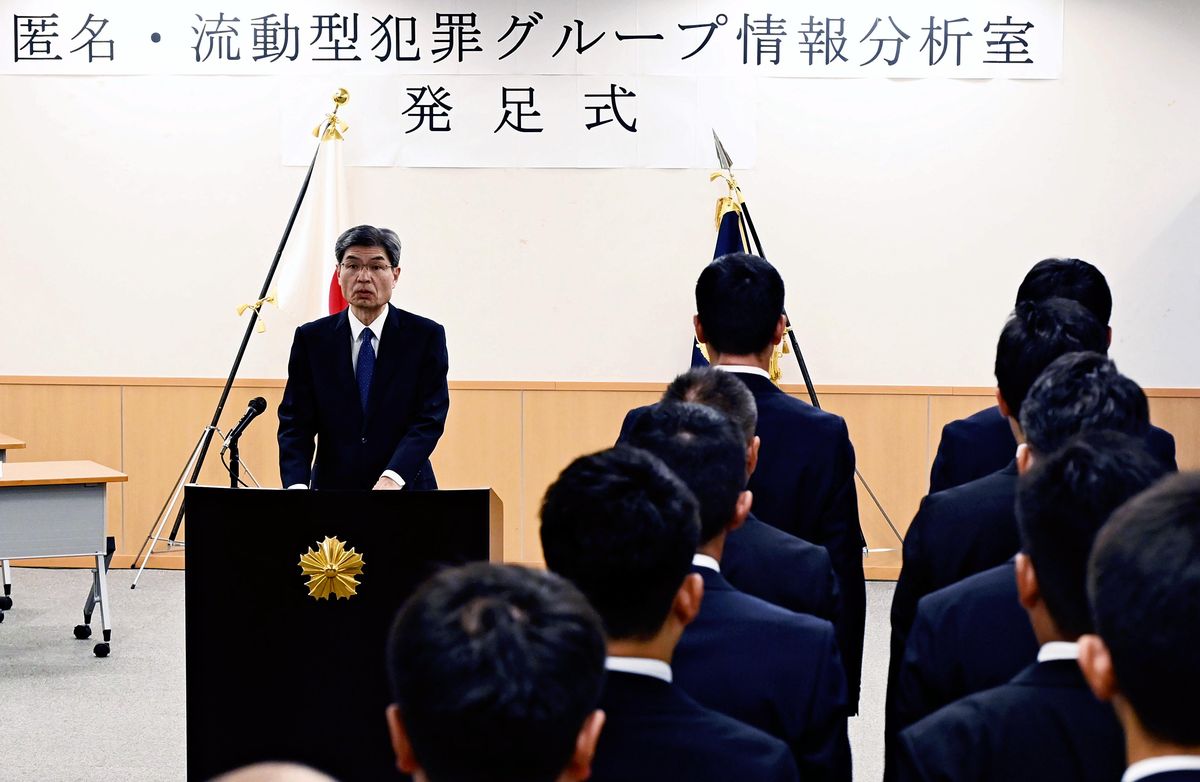
National Police Agency Commissioner General Yoshinobu Kusunoki delivers an address at the launch of the agency’s information analysis office targeting “tokuryu” criminal groups, in Chiyoda Ward, Tokyo, on Wednesday.
6:00 JST, October 3, 2025
The National Police Agency has established a new office that will serve as a command center in the fight to eradicate “tokuryu” criminal groups.
The information analysis office was launched Wednesday as part of a reorganization within the agency to tackle the anonymous and fluid groups in which members contacted via social media repeatedly come together to commit crimes and then disperse. In concert with the agency’s efforts to concentrate their investigations on tracking down tokuryu group ringleaders, about 200 officers from police forces across the nation will form a new team at the Metropolitan Police Department in an unprecedented move that will enable wide-ranging investigations into the criminal groups.
“It’s no exaggeration to say that the success or otherwise of these countermeasures will have a significant impact on our nation’s public safety,” NPA Commissioner General Yoshinobu Kusunoki said at the office’s launch. “This is a crucial moment. We will identify the key members and dismantle these illegal business models.”
According to preliminary figures, tokuryu groups were suspected of involvement in 13,213 special fraud cases between January and June this year, the highest figure recorded for that six-month period. These groups also accumulated money through a range of criminal methods including robberies committed as “dark part-time work,” unauthorized remittances and illegal gambling through online casinos.
The information analysis office will analyze from various angles investigation information provided by police forces across Japan to pinpoint the ringleaders of these groups.
Conventional investigations into organized crime syndicates focus on cracking down on the top leaders in a bid to weaken the entire organization. However, tokuryu group members are loosely connected through social media and other channels, and they are assigned separate roles such as “fund managers,” “equipment providers” and recruiters.
The agency also is considering using generative artificial intelligence to analyze materials and compile correlation diagrams for complexly intertwined tokuryu groups.
Picture still murky
The MPD will mainly handle the investigations. On Wednesday, the MPD launched a headquarters that will combat tokuryu groups by engaging in strategic planning and information analysis in cooperation with the NPA. A “tokuryu target crackdown team” comprised of investigators assembled from police forces across the nation will be based at these headquarters and respond nimbly to cases involving the groups.
The MPD’s Organized Crime Control Bureau, which has expertise in investigating organized crime groups, has been integrated into the Criminal Investigation Bureau, in which a new “special investigation division” dedicated to handling tokuryu investigations has been established.
In the first six months of 2025, police forces across Japan uncovered 5,064 suspects in tokuryu-related cases, according to a provisional count. Of these suspects, only 523, or about 10%, were considered to be masterminds or ringleaders. Finding ways to close in on group members who remain difficult to pin down will be a challenge for the police.
Aside from terrorism and some other cases, Japanese police conduct investigations within the boundaries of their jurisdiction. However, the police plan to allow MPD investigators to operate beyond these prefectural boundaries when necessary during tokuryu investigations, based on the instructions of the NPA’s commissioner general.
Data analysis
An investigation into a billing fraud scheme uncovered this year by the MPD and the Aichi prefectural police could “become a model case for tokuryu investigations,” a senior police official said.
The breakthrough came when a man who caught the MPD’s attention during an investigation following a money trail from robberies orchestrated by a ringleader known as “Luffy” was found to be the same person that was believed to have been sent money obtained through a special fraud case being investigated by the Aichi police.
Police authorities then concentrated their investigation on this man whom they believed to be a central figure in the cases. This investigation eventually led to suspicions that what nominally were “outstanding payments for a paid website” were actually part of a billing fraud scheme. The police formed an about 20-strong “analysis unit” that pored through data including the methods used and the timing of when events unfolded, which revealed about 300 similar cases had occurred across Japan.
The MPD and other police forces have arrested the man a total of seven times since April on suspicion he committed fraud and other crimes. The police believe the man was involved in about 180 fraud cases committed in 25 prefectures, and they suspect he funneled about ¥800 million to his own bank accounts.
“The police will need to share good case examples and use them in future investigations,” said Kyoto Sangyo University Prof. Masahiro Tamura, a former National Police Academy president and an expert on police administrative law. “New criminal methods are constantly being devised, so cooperation between investigative authorities alone won’t suffice. It’ll be essential to make this an effort involving the entire nation, including private-sector operators.”






Most Read
Popular articles in the past 24 hours
-
Business Hotels Expanding into Regional Areas in Japan, Aiming to...
-
Milano Cortina 2026: Japan Sees Leap in Olympic Performance Throu...
-

Milano Cortina 2026: Japan's Satoshi Furuno Places 4th in Men's S...
-

Fiji Defense Minister Hopes Japan Will Support Stabilization of P...
-
6 Injured at Naked Festival in Japan’s Okayama Prefecture; Police...
-

Milano Cortina 2026: Speed Skater Takagi Finishes 6th in the 1,50...
-

Milano Cortina 2026: Malinin Highlights Dangers of Social Media i...
-

Space One Delays Launch of No. 3 Kairos Rocket; Company to Announ...
Popular articles in the past week
-

Japan PM Takaichi’s Cabinet Resigns en Masse
-

Man Infected with Measles Reportedly Dined at Restaurant in Tokyo...
-

Sanae Takaichi Elected Prime Minister of Japan; Keeps All Cabinet...
-

Japan's Govt to Submit Road Map for Growth Strategy in March, PM ...
-

Bus Carrying 40 Passengers Catches Fire on Chuo Expressway; All E...
-

Milano Cortina 2026: Figure Skaters Riku Miura, Ryuichi Kihara Pa...
-

Japan, U.S. Name 3 Inaugural Investment Projects; Reached Agreeme...
-

U.S. Firm to Build Training Hub in Fukushima N-plant for Debris R...
Popular articles in the past month
-
Japan PM Takaichi’s Cabinet Resigns en Masse
-

Japan Institute to Use Domestic Commercial Optical Lattice Clock ...
-

Israeli Ambassador to Japan Speaks about Japan’s Role in the Reco...
-
Man Infected with Measles Reportedly Dined at Restaurant in Tokyo...
-

Videos Plagiarized, Reposted with False Subtitles Claiming ‘Ryuky...
-

Man Infected with Measles May Have Come in Contact with Many Peop...
-

Prudential Life Insurance Plans to Fully Compensate for Damages C...
-

Woman with Measles Visited Hospital in Tokyo Multiple Times Befor...
Top Articles in Society
-
Man Infected with Measles Reportedly Dined at Restaurant in Tokyo Station
-
Man Infected with Measles May Have Come in Contact with Many People in Tokyo, Went to Store, Restaurant Around When Symptoms Emerged
-
Woman with Measles Visited Hospital in Tokyo Multiple Times Before Being Diagnosed with Disease
-
Australian Woman Dies After Mishap on Ski Lift in Nagano Prefecture
-
Foreign Snowboarder in Serious Condition After Hanging in Midair from Chairlift in Nagano Prefecture
JN ACCESS RANKING
-
Japan PM Takaichi’s Cabinet Resigns en Masse
-
Japan Institute to Use Domestic Commercial Optical Lattice Clock to Set Japan Standard Time
-
Israeli Ambassador to Japan Speaks about Japan’s Role in the Reconstruction of Gaza
-
Man Infected with Measles Reportedly Dined at Restaurant in Tokyo Station
-
Videos Plagiarized, Reposted with False Subtitles Claiming ‘Ryukyu Belongs to China’; Anti-China False Information Also Posted in Japan