
Noda’s New CDPJ Leadership Lineup with Azumi as Secretary General Draws Mixed Reactions
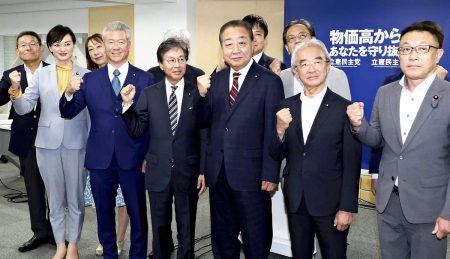
Constitutional Democratic Party of Japan President Yoshihiko Noda, third from right, and CDPJ Secretary General Jun Azumi, fourth from right, pose with other CDPJ executives after the new lineup was announced at party headquarters Thursday.
1:00 JST, September 13, 2025
The new leadership lineup announced by Constitutional Democratic Party of Japan President Yoshihiko Noda has drawn a mixed reaction within the main opposition party.
Noda named Jun Azumi, chairperson of the House of Representatives Budget Committee, as the CDPJ’s new secretary general in a move that aims to capitalize on Azumi’s strong connections with ruling and opposition parties to achieve policy goals under the current minority government. Although Noda selected several younger members to add fresh blood to the CDPJ, grumbling about the new list of executives is already emerging within the party.
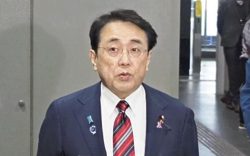
The new team was unveiled at a general meeting of CDPJ lawmakers from both Diet chambers Thursday. After the meeting, Noda explained the reasoning behind Azumi’s appointment as secretary general.
“He’s a colleague who has been with me through thick and thin,” Noda said. “His skills are recognized by ruling and opposition parties alike.”
Azumi served as finance minister while Noda was prime minister from 2011 to 2012, and he spent many years as head of the CDPJ Diet Affairs Committee. This experience has enabled Azumi to build up a wide network of contacts in government ministries and agencies, and in parties across the political spectrum.
Discussions between the ruling and opposition blocs have ground to a halt over issues including whether to end the so-called provisional gasoline tax by the end of this year, and whether to prohibit or continue allowing political donations by companies and organizations. Noda has high hopes Azumi will be able to get the wheels turning again.
“I want him to use his connections to help us implement policies,” Noda said.
Noda was prime minister and Azumi was finance minister when, in 2012, their now-defunct Democratic Party of Japan agreed with the Liberal Democratic Party and Komeito to pass legislation for comprehensive reform of social security and taxes, under which the consumption tax rate would be increased in two steps to 10%. That was one major reason why the DPJ was ousted from power in that year’s lower house election. Consequently, some CDPJ members have criticized Azumi’s appointment.
“He’s dogged by his reputation for increasing taxes,” one former CDPJ executive told The Yomiuri Shimbun. “This flies in the face of the public support for lower taxes expressed in this year’s House of Councillors election.”
Noda named Sumio Mabuchi, who served as land, infrastructure, transport and tourism minister while the DPJ was in power, as an executive deputy president. This move also has caused some furrowed brows. “It looks like we’re bringing back all those old faces,” a mid-ranking CDPJ member complained.
However, Noda also named several lawmakers who have been elected just twice to the lower house. Given that the CDPJ won only 22 of the seats that were contested in July’s upper house election, Noda recognized the need for a generational change. He plucked out Satoshi Honjo to be Policy Research Committee head, and So Watanabe to chair a newly established public relations committee. Harumi Yoshida, who ran in last autumn’s party leadership election, also got the nod to be an executive deputy president.
One veteran CDPJ lawmaker complained that Noda was “entrusting too many positions to close aides,” but Noda remains aware that he needs to build party unity.
Shoichi Kondo, who was head of the CDPJ’s largest intraparty group, called Sanctuary, was chosen as an executive deputy president, and Seiji Osaka, another member of the group, was tapped for chairman of the Election Strategy Committee. Masayo Tanabu, secretary general of the CDPJ caucus in the upper house and a lawmaker close to former party leader Kenta Izumi, was added as a new party executive member.
Intraparty groups that missed out on top posts were quick to lash out over their omissions.
CDPJ member Ichiro Ozawa, who left the DPJ after blasting the consumption tax increase promoted by Noda, held a discreet meeting with fellow member Kenji Eda in the Diet on Thursday evening. Both men shared the view that the “party’s survival was at stake.”
Discontent is simmering among young and mid-ranking lawmakers affiliated with groups headed by Ozawa and Eda, and even Noda’s close aides are unable to conceal their apprehension over how the situation might unfold.
“I don’t know if these personnel appointments will help to rebuild the party,” one aide admitted.







Most Read
Popular articles in the past 24 hours
-

Tokyo Skytree's Elevator Stops, Trapping 20 People; All Rescued (...
-

China, India Tapping into Promising African Market; Beijing Annou...
-

Milano Cortina 2026: Miura-Kihara Duo, Other Japanese Figure Skat...
-

Japan’s Major Real Estate Firms Expanding Overseas Businesses to ...
-

Reciprocal Tariffs Ruled Illegal: Judiciary Would Not Tolerate Pr...
-
‘Storytellers’ Being Dispatched Overseas to Promote Japan; Events...
-

Japan, Pacific Island Nations to Work on Deepening Cooperation
-

Space One Delays Launch of No. 3 Kairos Rocket; Company to Announ...
Popular articles in the past week
-

Japan PM Takaichi’s Cabinet Resigns en Masse
-

Man Infected with Measles Reportedly Dined at Restaurant in Tokyo...
-

Sanae Takaichi Elected Prime Minister of Japan; Keeps All Cabinet...
-

Japan's Govt to Submit Road Map for Growth Strategy in March, PM ...
-

Bus Carrying 40 Passengers Catches Fire on Chuo Expressway; All E...
-

Milano Cortina 2026: Figure Skaters Riku Miura, Ryuichi Kihara Pa...
-
Japan, U.S. Name 3 Inaugural Investment Projects; Reached Agreeme...
-

U.S. Firm to Build Training Hub in Fukushima N-plant for Debris R...
Popular articles in the past month
-
Japan PM Takaichi’s Cabinet Resigns en Masse
-

Japan Institute to Use Domestic Commercial Optical Lattice Clock ...
-

Israeli Ambassador to Japan Speaks about Japan’s Role in the Reco...
-
Man Infected with Measles Reportedly Dined at Restaurant in Tokyo...
-

Videos Plagiarized, Reposted with False Subtitles Claiming ‘Ryuky...
-

Man Infected with Measles May Have Come in Contact with Many Peop...
-

Prudential Life Insurance Plans to Fully Compensate for Damages C...
-

Woman with Measles Visited Hospital in Tokyo Multiple Times Befor...
Top Articles in Politics
-
Japan PM Takaichi’s Cabinet Resigns en Masse
-
Sanae Takaichi Elected Prime Minister of Japan; Keeps All Cabinet Appointees from Previous Term
-
Japan’s Govt to Submit Road Map for Growth Strategy in March, PM Takaichi to Announce in Upcoming Policy Speech
-

LDP Wins Historic Landslide Victory
-

LDP Wins Landslide Victory, Secures Single-party Majority; Ruling Coalition with JIP Poised to Secure Over 300 seats (UPDATE 1)
JN ACCESS RANKING
-
Japan PM Takaichi’s Cabinet Resigns en Masse
-
Japan Institute to Use Domestic Commercial Optical Lattice Clock to Set Japan Standard Time
-
Israeli Ambassador to Japan Speaks about Japan’s Role in the Reconstruction of Gaza
-
Man Infected with Measles Reportedly Dined at Restaurant in Tokyo Station
-
Videos Plagiarized, Reposted with False Subtitles Claiming ‘Ryukyu Belongs to China’; Anti-China False Information Also Posted in Japan