
South Korean President Emphasizes Consistency Toward Japan, Cites ‘Responsibility’ to Adhere to Previous Agreements
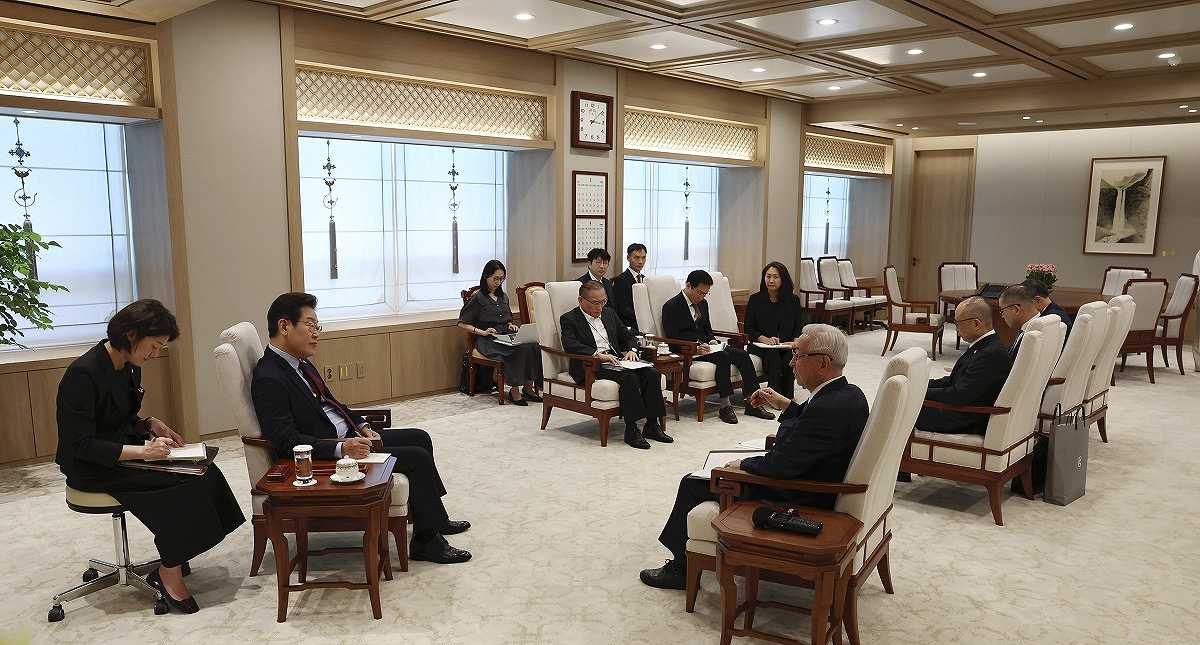
South Korean President Lee Jae Myung, second from left, speaks with Shoichi Oikawa, front right, Editor-in-chief and representative director of The Yomiuri Shimbun Holdings, as reporters listen on in Seoul on Tuesday.
17:51 JST, August 21, 2025
SEOUL — South Korean President Lee Jae Myung considers policy consistency toward Japan to be vital and insists his administration has a “responsibility” to adhere to previous bilateral agreements – even one he opposed before he became president.
During an exclusive interview with The Yomiuri Shimbun in Seoul on Tuesday, Lee did not seek to make historical issues a source of conflict in Japan-South Korea relations, and indicated a willingness to expand cooperation in economic, security and other fields.
Nevertheless, Lee said the issues of so-called comfort women and former wartime requisitioned workers from the Korean Peninsula were “heartbreaking” for the South Korean people, and indicated his hopes that the Japanese side would show consideration for these feelings.
Lee indicated his government would stand by the measures worked out in 2023 by the administration of his predecessor, Yoon Suk Yeol, to resolve the issue of lawsuits involving former requisitioned workers. “Previous presidents also were representatives of the nation selected by the people,” Lee said. “I cannot reverse agreements that they made or policies that have already been implemented.”
Lee explained that his approach sets great store on underlining maintaining consistency in policies and the credibility of his nation. “The damage to our nation would be immense if others felt that we couldn’t be trusted because we overturn our agreements when there’s a change in administration,” Lee said during the interview at the presidential palace.
In a bid to resolve the issue of lawsuits related to former wartime requisitioned workers, the Yoon administration compiled a plan to have a foundation under the government’s umbrella pay the plaintiffs compensation equivalent to the amount that South Korean courts had ordered defendant Japanese companies to pay.
Lee was a leader of a left-leaning opposition party at the time. He slammed this policy as “a path to becoming a subordinate of Japan” and took a noticeably harder line toward Japan.
Many members of the Japanese government were concerned that a change in South Korea’s government from a conservative camp to a left-wing Lee administration could result in historical issues being dredged up again. However, Lee emphasized that his stance is to uphold the agreements reached with Japan.
“We needed to take up the cudgels when we were an opposition party. But now we have a responsibility in our position as a ruling party,” Lee said.
Lee’s switch to a more pragmatic approach comes as the global landscape is changing due to factors including the return to office of U.S. President Donald Trump. Lee appears to have reaffirmed the importance of cooperation between Japan and South Korea, which are both U.S. allies and democracies.
Since assuming the presidency in June, Lee has indicated his intention to push ahead with a “two-track” approach to relations with Tokyo that separates cooperation in economic and other fields from potential disagreements such as historical issues.
During the interview, Lee praised the 1998 Japan-South Korea Joint Declaration issued by the administrations of then Prime Minister Keizo Obuchi and then South Korean leader Kim Dae Jung, which started establishing a framework for a future-oriented bilateral relationship. In that statement, which Lee described as “the ultimate form of an official announcement on historical issues,” Obuchi expressed his “deep remorse and heartfelt apology” for Japan’s colonial rule of the Korean Peninsula.
However, Lee expressed discontent over the Japanese government’s subsequent perception of historical issues. “It changed haphazardly. It even retreated,” Lee said. “Many South Korean people think that Japan’s attitude to saying sorry may be: ‘We apologized once. Why must we apologize again?’”
In 2015, the administration of then Prime Minister Shinzo Abe and then South Korean President Park Guen-hye reached an agreement confirming that the so-called comfort women issue had been resolved. However, Abe’s comment that he was “not even remotely considering” sending a letter to former comfort women, sparked a wider backlash in South Korea. Lee’s remark was apparently made with such events in mind.
Lee also indicated he was aware of Japanese criticism that South Korea “moves the goalposts” on contentious historical issues. “It’s been said that South Korea’s position on historical issues shifts whenever there’s a change in administration, and there certainly has been a tendency to do that,” Lee admitted.
On the topic of bilateral historical issues, Lee added, “If a dispute emerges, it should be confirmed through an objective and fair process. There’s no need to argue over where it was true or not by engaging in a battle of attrition.”
A source close to Lee explained, “His comments reflected his desire for there to be greater understanding of the South Korean people’s feelings regarding those historical issues.”






Most Read
Popular articles in the past 24 hours
-
Seeking Nuclear Waste Site, Japan Eyes Remote Island of Minami-To...
-
Japan Ministry Asks to Conduct Nuclear Waste Disposal-related Sur...
-
Artisans from Disaster-Hit Areas Work Together to Keep Memories o...
-
Japan Tourist Spot's Capsule Toys Made from Recycled Materials Pr...
-

CARTOON OF THE DAY (March 4)
-

Japan’s Space One Kairos 3rd Flight Rocket Launched, but Mission ...
-

Men Compete in Fierce Tug-of-War for Aomori Festival
-
International Students Experience Sake Brewing in Japan's Akita P...
Popular articles in the past week
-
Tokyo Spends Big on Children, Wins Over Parents
-

South Korea Tightens Rules on Foreigners Buying Homes in Seoul Me...
-
Japan’s Miura, Kihara Announce Withdrawal from Figure Skating Wor...
-
BOJ Keeping Eye on Economy and Takaichi's ‘Proactive Fiscal Polic...
-
Nidec Chairman Resigns Amid Accounting Scandal at Major Japanese ...
-

Strait of Hormuz Closure Shakes Markets; Prolonged Closure Could ...
-
2 Unpublished Early Novellas by Japan's Kenzaburo Oe Discovered, ...
-
Tourists Ignore Safety Barriers Near Famous Zao ‘Snow Monsters’ i...
Popular articles in the past month
-

Producer Behind Pop Group XG Arrested for Cocaine Possession
-

Japan PM Takaichi’s Cabinet Resigns en Masse
-

Man Infected with Measles Reportedly Dined at Restaurant in Tokyo...
-

Israeli Ambassador to Japan Speaks about Japan’s Role in the Reco...
-

Videos Plagiarized, Reposted with False Subtitles Claiming ‘Ryuky...
-

Prudential Life Insurance Plans to Fully Compensate for Damages C...
-

Woman with Measles Visited Hospital in Tokyo Multiple Times Befor...
-

iPS Treatments Pass Key Milestone, but Broader Applications Far f...
Top Articles in World
-
Israeli Ambassador to Japan Speaks about Japan’s Role in the Reconstruction of Gaza
-
Videos Plagiarized, Reposted with False Subtitles Claiming ‘Ryukyu Belongs to China’; Anti-China False Information Also Posted in Japan
-

Nepal Bus Crash Kills 19 People, Injures 25 Including One Japanese National
-
South Korea Tightens Rules on Foreigners Buying Homes in Seoul Metro Area
-

Ukrainian Ambassador Closely Watching Japan’s Revision of Defense Export Rules, Hopes for Future Arms Support
JN ACCESS RANKING
-
Producer Behind Pop Group XG Arrested for Cocaine Possession
-
Japan PM Takaichi’s Cabinet Resigns en Masse
-
Man Infected with Measles Reportedly Dined at Restaurant in Tokyo Station
-
Israeli Ambassador to Japan Speaks about Japan’s Role in the Reconstruction of Gaza
-
Videos Plagiarized, Reposted with False Subtitles Claiming ‘Ryukyu Belongs to China’; Anti-China False Information Also Posted in Japan