
Walls Close in around Ishiba at LDP’s General Meeting, Leaving PM Facing Ouster
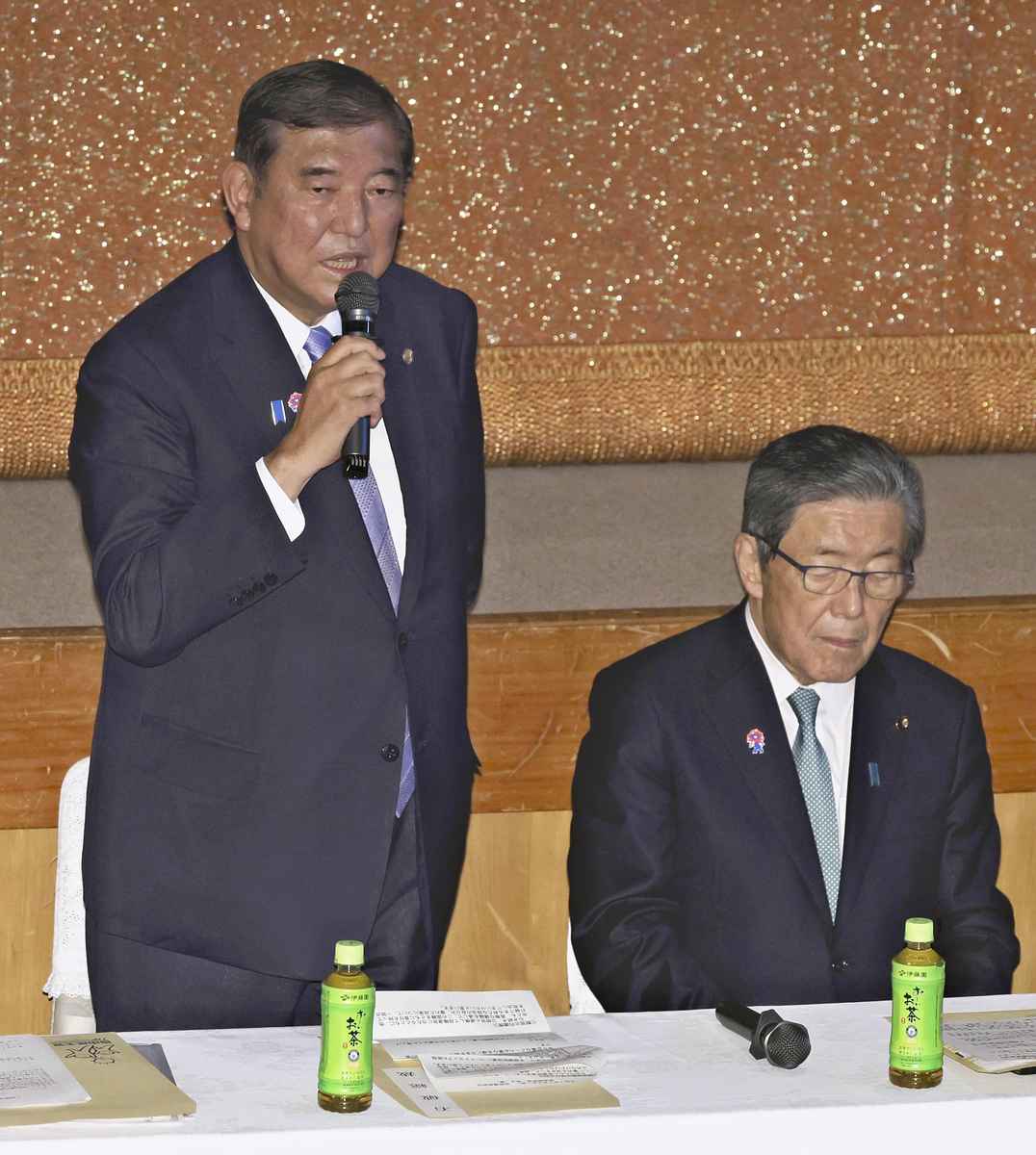
Prime Minister Shigeru Ishiba speaks at Friday’s general meeting of Liberal Democratic Party lawmakers at the party’s headquarters.
17:26 JST, August 9, 2025
Members of the Liberal Democratic Party are moving quickly to oust Prime Minister Shigeru Ishiba, leaving Ishiba, who is also LDP president, in an even more difficult situation as he continues put off announcing his resignation.
Ishiba did not mention resigning at Friday’s general meeting of LDP Diet members, teeing up a decision on whether to hold the party’s presidential election early, based on the fourth paragraph of Article 6 of the LDP Constitution, which has never been used.
At the beginning of the meeting at the LDP’s headquarters, Ishiba raised the response to U.S. tariffs, agricultural policies and disaster prevention as issues that need addressing.
“I will continue to take responsibility for Japan,” he said, asking for understanding about his decision to remain in office for the time being. He also repeatedly said that he would “listen humbly and sincerely” to the opinions of the attending lawmakers.
According to one attendee, the meeting quickly became tense once discussions began behind closed doors.
“If we are going to unite the party, it is important that we hold a proper presidential election,” said Hiroaki Tabata, a member of the House of Representatives. Many attendees voiced similar opinions, calling for an early presidential race or for Ishiba to step down on his own. Only a few people pushed for Ishiba to remain in office.
Debate on presidential race
In response, Haruko Arimura, the meeting’s chairperson, announced that the session would focus on whether to hold an early presidential election.
A number of attendees then voiced their support for moving up the race. And in response, the meeting moved toward asking the presidential election administration committee, which has authority over presidential elections, to take the next step toward an early presidential election.
Despite being urged to speak several times by Arimura, Ishiba only said, “I want to resolve the tariff issue.”
Ultimately, a majority voted to approve the request to the committee, a decision that was met with applause. With the walls closing in around Ishiba, the meeting adjourned as scheduled after two hours.
Totally unprepared
Plotters against Ishiba prepared for three scenarios and coordinated with party executives as well as those engaged in clerical work. Ichiro Aisawa, who heads the presidential election committee and handles requests for early presidential elections, read off a prepared note at the meeting, suggesting that the gathering proceeded according to one of these scenarios.
An LDP member who has served in one of the party’s three executive posts said Friday’s developments must have come as “a bolt from the blue” for Ishiba. “The groundwork had already been laid before the meeting began,” the lawmaker said. The member added, “Surely he will announce his resignation before a decision is made on holding the presidential race early.”
To some extent, Ishiba has brought this situation on himself. He has remained vague about when he will step down, citing the potential impact on his diplomatic schedule and on domestic issues.
The party showed some understanding in this respect. However, recently, without consulting others in his party, Ishiba approached Yoshihiko Noda, the president of the Constitutional Democratic Party of Japan, about more strictly regulating corporate and group donations, contrary to LDP policy. The move was seen as a ploy by Ishiba to prolong his stay in power, and it sparked a backlash of distrust in the LDP.
Without precedent
According to the fourth paragraph of Article 6 of the LDP’s Constitution, if more than half of an electorate comprised of the party’s Diet members and one representative from each prefectural party chapter requests a presidential election before the term of the president expires, the election shall be held as if the president vacated their seat during their term.
That means that to trigger an early presidential race, a motion would need 172 people in agreement — a majority of 342 LDP members, or 295 Diet members and 47 representatives from the party’s prefectural chapters.
“The current mood makes it clear what the verdict will be,” said a mid-ranking LDP member, expressing a view widely shared within the party.
“I hope he will resign honorably before the de facto recall provision is applied,” said a person close to Ishiba.
As the LDP’s Constitution does not lay out detailed rules for moving up an election, there will likely be some guesswork along the way, such as about how to confirm members’ views on the matter.
The presidential election committee, which normally has 11 members, first needs to fill six vacancies that mainly resulted from election losses, and then after the Bon holiday period, it will decide on when and how to ascertain members’ views.






Most Read
Popular articles in the past 24 hours
-
Tokyo Skytree's Elevator Stops, Trapping 20 People; All Rescued (...
-

China, India Tapping into Promising African Market; Beijing Annou...
-

Japan’s Major Real Estate Firms Expanding Overseas Businesses to ...
-

Ukrainian Ambassador Closely Watching Japan’s Revision of Defense...
-
Emperor Turns 66 Ahead of Disaster Milestones
-

Milano Cortina 2026: There Were Cheers across the Country, after ...
-
Tokyo Skytree to Close on Monday for Safety Checks after 20 Peopl...
-
Luna Sea Drummer Shinya Dies at 56; Powerful Drummer Behind ‘Desi...
Popular articles in the past week
-

Japan PM Takaichi’s Cabinet Resigns en Masse
-

Man Infected with Measles Reportedly Dined at Restaurant in Tokyo...
-

Sanae Takaichi Elected Prime Minister of Japan; Keeps All Cabinet...
-

Japan's Govt to Submit Road Map for Growth Strategy in March, PM ...
-

Bus Carrying 40 Passengers Catches Fire on Chuo Expressway; All E...
-

Milano Cortina 2026: Figure Skaters Riku Miura, Ryuichi Kihara Pa...
-
Japan, U.S. Name 3 Inaugural Investment Projects; Reached Agreeme...
-
U.S. Firm to Build Training Hub in Fukushima N-plant for Debris R...
Popular articles in the past month
-
Japan PM Takaichi’s Cabinet Resigns en Masse
-

Japan Institute to Use Domestic Commercial Optical Lattice Clock ...
-

Israeli Ambassador to Japan Speaks about Japan’s Role in the Reco...
-
Man Infected with Measles Reportedly Dined at Restaurant in Tokyo...
-

Videos Plagiarized, Reposted with False Subtitles Claiming ‘Ryuky...
-

Man Infected with Measles May Have Come in Contact with Many Peop...
-

Prudential Life Insurance Plans to Fully Compensate for Damages C...
-

Woman with Measles Visited Hospital in Tokyo Multiple Times Befor...
Top Articles in Politics
-
Japan PM Takaichi’s Cabinet Resigns en Masse
-
Sanae Takaichi Elected Prime Minister of Japan; Keeps All Cabinet Appointees from Previous Term
-
Japan’s Govt to Submit Road Map for Growth Strategy in March, PM Takaichi to Announce in Upcoming Policy Speech
-

LDP Wins Historic Landslide Victory
-

LDP Wins Landslide Victory, Secures Single-party Majority; Ruling Coalition with JIP Poised to Secure Over 300 seats (UPDATE 1)
JN ACCESS RANKING
-
Japan PM Takaichi’s Cabinet Resigns en Masse
-
Japan Institute to Use Domestic Commercial Optical Lattice Clock to Set Japan Standard Time
-
Israeli Ambassador to Japan Speaks about Japan’s Role in the Reconstruction of Gaza
-
Man Infected with Measles Reportedly Dined at Restaurant in Tokyo Station
-
Videos Plagiarized, Reposted with False Subtitles Claiming ‘Ryukyu Belongs to China’; Anti-China False Information Also Posted in Japan