
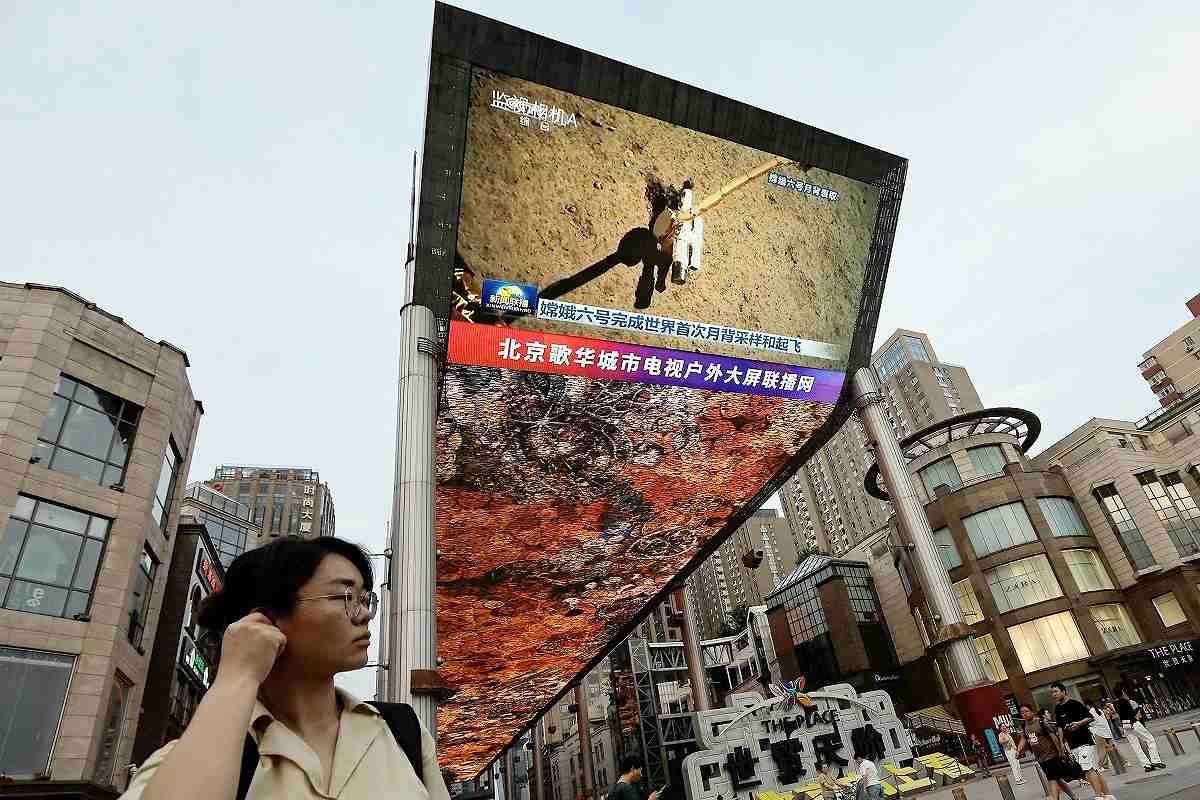
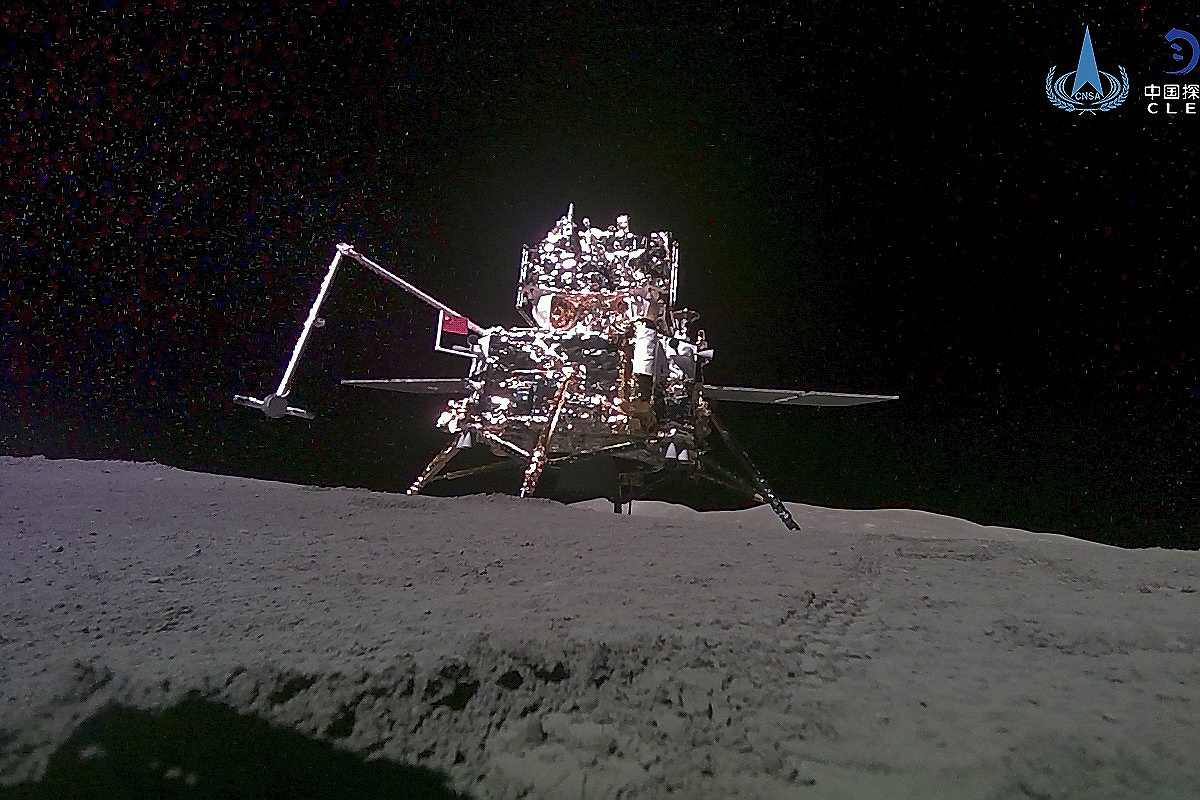
Left: A large screen shows news footage of China’s Chang’e-6 lunar probe collecting a sample from the far side of the moon, in Beijing on June 4. Right: A picture of the lander-ascender combination of the Chang’e-6 probe taken by a mini rover after it landed on the lunar surface, on June 4
17:14 JST, November 20, 2024
NEW YORK (AP) — Volcanoes were erupting on the mysterious far side of the moon billions of years ago just like on the side that we can see, new research confirms.
Researchers analyzed lunar soil brought back by China’s Chang’e-6, the first spacecraft to return with a haul of rocks and dirt from the little-explored far side.
Two separate teams found fragments of volcanic rock that were about 2.8 billion years old. One piece was even more ancient, dating back 4.2 billion years.
“To obtain a sample from this area is really important because it’s an area that otherwise we have no data for,” said Christopher Hamilton, a planetary volcano expert at the University of Arizona who was not involved with the research.
Scientists know there were active volcanoes on the near side, the part of the moon seen from Earth, dating back to a similar time frame. Previous studies, including data from NASA’s Lunar Reconnaissance Orbiter, suggested the far side might also have had a volcanic past. The first samples from the region facing away from Earth confirm an active history.
The results were published on Nov. 15 in the journals Nature and Science.
China has launched several spacecraft to the moon. In 2020, the Chang’e-5 spacecraft returned moon rocks from the near side, the first since those collected by NASA’s Apollo astronauts and Soviet Union spacecraft in the 1970s. The Chang’e-4 spacecraft became the first to visit the moon’s far side in 2019.
The moon’s far side is pockmarked by craters and has fewer of the near side’s flat, dark plains carved by lava flows. Why the two halves are so different remains a mystery, said study coauthor Qiu-Li Li from the Chinese Academy of Sciences.
Li said the new findings reveal over 1 billion years of volcanic eruptions on the lunar far side. Future research will determine how the activity lasted so long.






Most Read
Popular articles in the past 24 hours
-

Business Hotels Expanding into Regional Areas in Japan, Aiming to...
-

Milano Cortina 2026: Japan Sees Leap in Olympic Performance Throu...
-

Milano Cortina 2026: Japan's Satoshi Furuno Places 4th in Men's S...
-

6 Injured at Naked Festival in Japan’s Okayama Prefecture; Police...
-

Fiji Defense Minister Hopes Japan Will Support Stabilization of P...
-

Milano Cortina 2026: Malinin Highlights Dangers of Social Media i...
-

Space One Delays Launch of No. 3 Kairos Rocket; Company to Announ...
-

3rd Japan Pacific Islands Defense Dialogue to Begin in Tokyo on S...
Popular articles in the past week
-

Japan PM Takaichi’s Cabinet Resigns en Masse
-

Man Infected with Measles Reportedly Dined at Restaurant in Tokyo...
-

Sanae Takaichi Elected Prime Minister of Japan; Keeps All Cabinet...
-

Japan's Govt to Submit Road Map for Growth Strategy in March, PM ...
-

Bus Carrying 40 Passengers Catches Fire on Chuo Expressway; All E...
-

Milano Cortina 2026: Figure Skaters Riku Miura, Ryuichi Kihara Pa...
-

Japan, U.S. Name 3 Inaugural Investment Projects; Reached Agreeme...
-

U.S. Firm to Build Training Hub in Fukushima N-plant for Debris R...
Popular articles in the past month
-
Japan PM Takaichi’s Cabinet Resigns en Masse
-

Japan Institute to Use Domestic Commercial Optical Lattice Clock ...
-

Israeli Ambassador to Japan Speaks about Japan’s Role in the Reco...
-
Man Infected with Measles Reportedly Dined at Restaurant in Tokyo...
-

Videos Plagiarized, Reposted with False Subtitles Claiming ‘Ryuky...
-

Man Infected with Measles May Have Come in Contact with Many Peop...
-

Prudential Life Insurance Plans to Fully Compensate for Damages C...
-

Woman with Measles Visited Hospital in Tokyo Multiple Times Befor...
Top Articles in Science & Nature
-
Japan Institute to Use Domestic Commercial Optical Lattice Clock to Set Japan Standard Time
-
Japan to Face Shortfall of 3.39 Million Workers in AI, Robotics in 2040; Clerical Workers Seen to Be in Surplus
-

Record 700 Startups to Gather at SusHi Tech Tokyo in April; Event Will Center on Themes Like Artificial Intelligence and Robotics
-

iPS Treatments Pass Key Milestone, but Broader Applications Far from Guaranteed
-
iPS Cell Products for Parkinson’s, Heart Disease OK’d for Commercialization by Japan Health Ministry Panel
JN ACCESS RANKING
-
Japan PM Takaichi’s Cabinet Resigns en Masse
-
Japan Institute to Use Domestic Commercial Optical Lattice Clock to Set Japan Standard Time
-
Israeli Ambassador to Japan Speaks about Japan’s Role in the Reconstruction of Gaza
-
Man Infected with Measles Reportedly Dined at Restaurant in Tokyo Station
-
Videos Plagiarized, Reposted with False Subtitles Claiming ‘Ryukyu Belongs to China’; Anti-China False Information Also Posted in Japan