
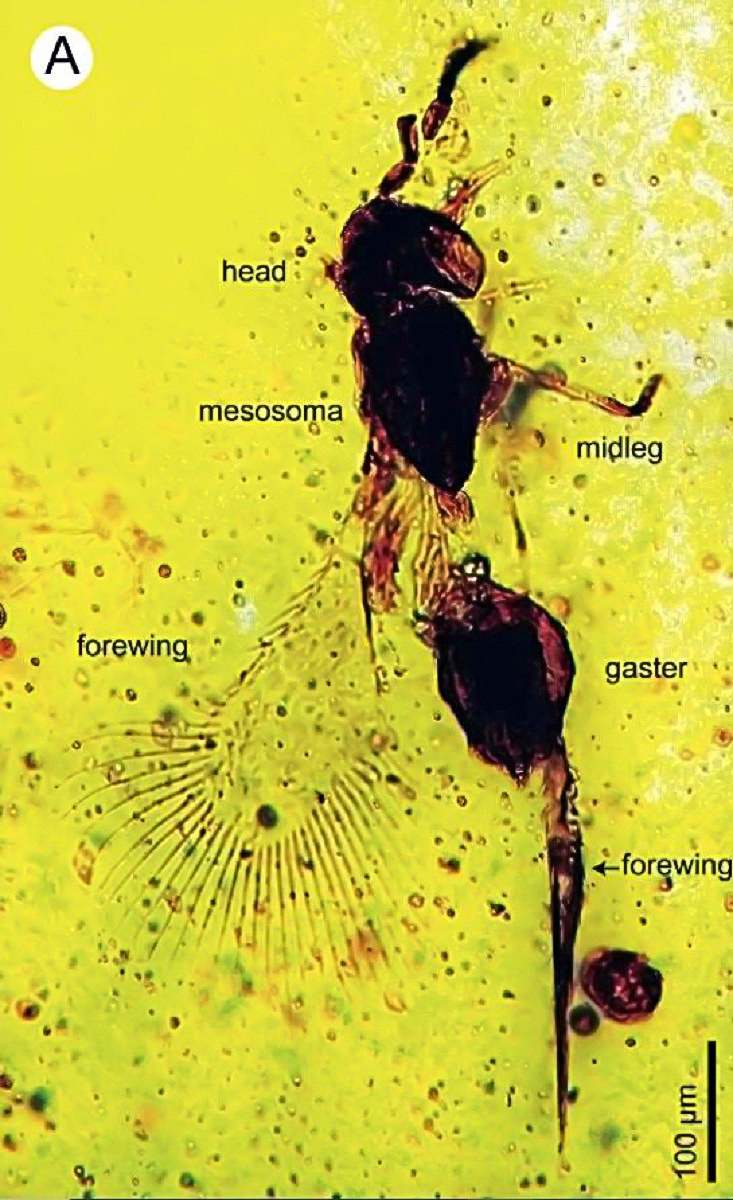
A fossil of a new species of wasp called Archaeromma chisatoi
13:51 JST, September 5, 2024
FUKUSHIMA (Jiji Press) — Fossils of insects found in amber excavated from a geological formation dating back to the Late Cretaceous period in the city of Iwaki have been identified as a new species of false fairy wasp.
The finding was published in the international journal of the Paleontological Society of Japan in July by a joint research team including a member from the Fukushima Museum.
A male specimen and a female, each measuring about 0.4 millimeters, were found almost perfectly preserved in the amber from the formation dating back 86.3 million to 88 million years. The team stressed the importance of the finding in understanding the ecology of insects that were alive at the time.
The fossils were found at the Tamayama Formation’s Futaba Group in the Fukushima Prefecture city of Iwaki, a major amber producing area. From the group, many fossils of dinosaurs and other prehistoric animals have been found.
Local fossil enthusiast Chisato Suzuki, 75, found the fossil-containing amber over 20 years ago. The amber, however, went without undergoing academic analysis for a long time.
Suzuki donated the amber to the research team, which spent a year analyzing it.
The team found the insects trapped inside to be a new species of the genus Archaeromma in the family Mymarommatidae, considering that features on their heads and wings were not found in other fossils of 10 Archaeromma species already known in the world.
The new species was named Archaeromma chisatoi, in honor of Suzuki.
The chairman of a noodle manufacturer in Iwaki, Suzuki has spent 60 years or so digging for fossils. The new false fairy wasp marks the third time a new species of a creature was named after him.
“I’m extremely honored,” Suzuki said. “I’d like to thank my family for supporting my excavations.”
Hiroaki Inose, a research team member from the Fukushima Museum, said that a fossil of a flowering plant, which was rare at the time, has been found in a nearby formation.
“We hope that the discoveries help us unravel the origins of a symbiotic relationship between plants and insects that has continued to this day,” Inose said.





Most Read
Popular articles in the past 24 hours
-

Business Hotels Expanding into Regional Areas in Japan, Aiming to...
-

Milano Cortina 2026: Japan Sees Leap in Olympic Performance Throu...
-

6 Injured at Naked Festival in Japan’s Okayama Prefecture; Police...
-

Fiji Defense Minister Hopes Japan Will Support Stabilization of P...
-

Milano Cortina 2026: Malinin Highlights Dangers of Social Media i...
-

Space One Delays Launch of No. 3 Kairos Rocket; Company to Announ...
-

3rd Japan Pacific Islands Defense Dialogue to Begin in Tokyo on S...
-

Reciprocal Tariffs Ruled Illegal: Judiciary Would Not Tolerate Pr...
Popular articles in the past week
-

Japan PM Takaichi’s Cabinet Resigns en Masse
-

Man Infected with Measles Reportedly Dined at Restaurant in Tokyo...
-

Sanae Takaichi Elected Prime Minister of Japan; Keeps All Cabinet...
-

Japan's Govt to Submit Road Map for Growth Strategy in March, PM ...
-

Bus Carrying 40 Passengers Catches Fire on Chuo Expressway; All E...
-

Milano Cortina 2026: Figure Skaters Riku Miura, Ryuichi Kihara Pa...
-

Japan, U.S. Name 3 Inaugural Investment Projects; Reached Agreeme...
-

U.S. Firm to Build Training Hub in Fukushima N-plant for Debris R...
Popular articles in the past month
-
Japan PM Takaichi’s Cabinet Resigns en Masse
-

Japan Institute to Use Domestic Commercial Optical Lattice Clock ...
-

Israeli Ambassador to Japan Speaks about Japan’s Role in the Reco...
-
Man Infected with Measles Reportedly Dined at Restaurant in Tokyo...
-

Videos Plagiarized, Reposted with False Subtitles Claiming ‘Ryuky...
-

Man Infected with Measles May Have Come in Contact with Many Peop...
-

Prudential Life Insurance Plans to Fully Compensate for Damages C...
-

Woman with Measles Visited Hospital in Tokyo Multiple Times Befor...
Top Articles in Science & Nature
-
Japan Institute to Use Domestic Commercial Optical Lattice Clock to Set Japan Standard Time
-
Japan to Face Shortfall of 3.39 Million Workers in AI, Robotics in 2040; Clerical Workers Seen to Be in Surplus
-
Record 700 Startups to Gather at SusHi Tech Tokyo in April; Event Will Center on Themes Like Artificial Intelligence and Robotics
-

iPS Treatments Pass Key Milestone, but Broader Applications Far from Guaranteed
-
iPS Cell Products for Parkinson’s, Heart Disease OK’d for Commercialization by Japan Health Ministry Panel
JN ACCESS RANKING
-
Japan PM Takaichi’s Cabinet Resigns en Masse
-
Japan Institute to Use Domestic Commercial Optical Lattice Clock to Set Japan Standard Time
-
Israeli Ambassador to Japan Speaks about Japan’s Role in the Reconstruction of Gaza
-
Man Infected with Measles Reportedly Dined at Restaurant in Tokyo Station
-
Videos Plagiarized, Reposted with False Subtitles Claiming ‘Ryukyu Belongs to China’; Anti-China False Information Also Posted in Japan