
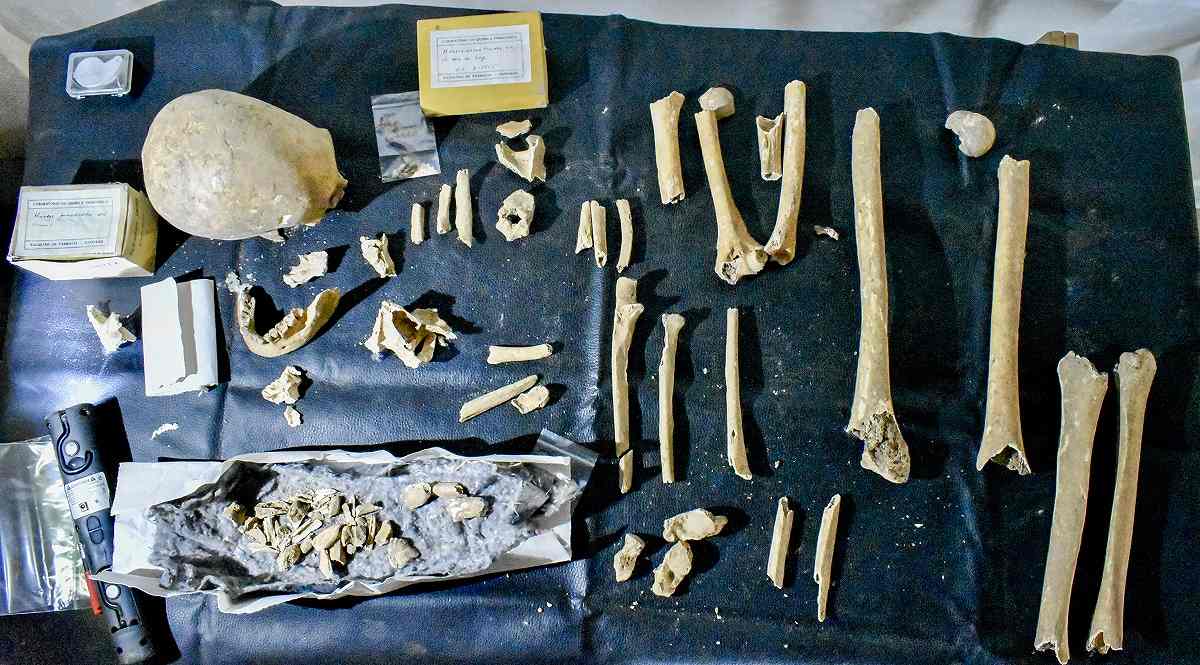
Human remains found in a tomb in northwestern Spain are seen in Santiago de Compostela, Spain in November 2019.
16:56 JST, August 29, 2024
MADRID (Reuters) — Remains found in a tomb in northwestern Spain are likely to belong to a ninth-century bishop believed to have helped create the Camino de Santiago, one of Christianity’s most popular pilgrimages, a new study has found.
A combination of bone analysis, carbon dating, stable isotope analysis and DNA testing yielded data that “supports the possibility” that the human bones found in 1955 are those of Bishop Thedomir, according to a paper published on Aug. 13 in the journal “Antiquity.”
Oral tradition, later written down, has it that Theodomir discovered the tomb of St. James the Apostle between 820 and 830 following a divine revelation in what is now Santiago de Compostela, the capital of the Galicia region.
News of the discovery reached King Alfonso II of the neighboring region of Asturias, who marched with his court from Oviedo to Santiago.
The 146 kilometer royal pilgrimage established what is today known as the “Primitive Way,” the oldest path used by pilgrims of the Camino, or Way of St. James.
Theodomir’s existence had been hotly debated until 1955, when Spanish archaeologist Manuel Chamoso Lamas discovered a tombstone underneath Santiago de Compostela’s cathedral inscribed with his name.
An initial study of the bones concluded that they probably came from an elderly adult male, but three decades later a new assessment based on photographs of the site proclaimed them to belong to a woman aged between 50 and 70.
The newest study, led by Patxi Perez-Ramallo of the Norwegian University of Science and Technology, combined different analytical methods in a bid to recreate the individual’s life story.
The carbon-14 dating shows the person died after the age of 45, and the bones’ features suggest they had a weak build and performed little physical work during their lifetime, which is consistent with the lifestyle of high clergy during the period.
Perez-Ramallo told El Pais newspaper that there was a “98% likelihood of it being Theodomir.”






Most Read
Popular articles in the past 24 hours
-

Business Hotels Expanding into Regional Areas in Japan, Aiming to...
-

Milano Cortina 2026: Japan Sees Leap in Olympic Performance Throu...
-

6 Injured at Naked Festival in Japan’s Okayama Prefecture; Police...
-

Fiji Defense Minister Hopes Japan Will Support Stabilization of P...
-

Milano Cortina 2026: Malinin Highlights Dangers of Social Media i...
-

Space One Delays Launch of No. 3 Kairos Rocket; Company to Announ...
-

3rd Japan Pacific Islands Defense Dialogue to Begin in Tokyo on S...
-

Reciprocal Tariffs Ruled Illegal: Judiciary Would Not Tolerate Pr...
Popular articles in the past week
-

Japan PM Takaichi’s Cabinet Resigns en Masse
-

Man Infected with Measles Reportedly Dined at Restaurant in Tokyo...
-

Sanae Takaichi Elected Prime Minister of Japan; Keeps All Cabinet...
-

Japan's Govt to Submit Road Map for Growth Strategy in March, PM ...
-

Bus Carrying 40 Passengers Catches Fire on Chuo Expressway; All E...
-

Milano Cortina 2026: Figure Skaters Riku Miura, Ryuichi Kihara Pa...
-

Japan, U.S. Name 3 Inaugural Investment Projects; Reached Agreeme...
-

U.S. Firm to Build Training Hub in Fukushima N-plant for Debris R...
Popular articles in the past month
-
Japan PM Takaichi’s Cabinet Resigns en Masse
-

Japan Institute to Use Domestic Commercial Optical Lattice Clock ...
-

Israeli Ambassador to Japan Speaks about Japan’s Role in the Reco...
-
Man Infected with Measles Reportedly Dined at Restaurant in Tokyo...
-

Videos Plagiarized, Reposted with False Subtitles Claiming ‘Ryuky...
-

Man Infected with Measles May Have Come in Contact with Many Peop...
-

Prudential Life Insurance Plans to Fully Compensate for Damages C...
-

Woman with Measles Visited Hospital in Tokyo Multiple Times Befor...
Top Articles in Science & Nature
-
Japan Institute to Use Domestic Commercial Optical Lattice Clock to Set Japan Standard Time
-
Japan to Face Shortfall of 3.39 Million Workers in AI, Robotics in 2040; Clerical Workers Seen to Be in Surplus
-

Record 700 Startups to Gather at SusHi Tech Tokyo in April; Event Will Center on Themes Like Artificial Intelligence and Robotics
-

iPS Treatments Pass Key Milestone, but Broader Applications Far from Guaranteed
-
iPS Cell Products for Parkinson’s, Heart Disease OK’d for Commercialization by Japan Health Ministry Panel
JN ACCESS RANKING
-
Japan PM Takaichi’s Cabinet Resigns en Masse
-
Japan Institute to Use Domestic Commercial Optical Lattice Clock to Set Japan Standard Time
-
Israeli Ambassador to Japan Speaks about Japan’s Role in the Reconstruction of Gaza
-
Man Infected with Measles Reportedly Dined at Restaurant in Tokyo Station
-
Videos Plagiarized, Reposted with False Subtitles Claiming ‘Ryukyu Belongs to China’; Anti-China False Information Also Posted in Japan