
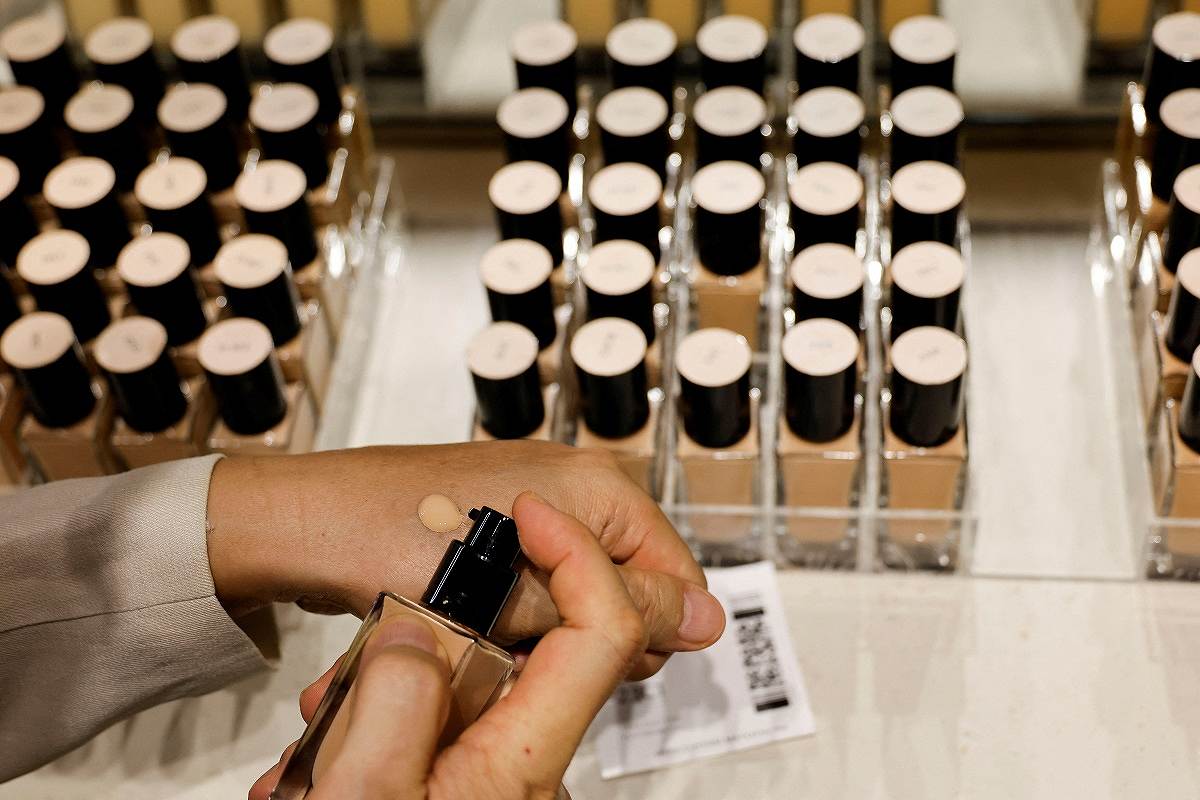
Lee Young-jin, a Ph.D in engineering and adviser for AmorePacific’s custom beauty business, applies AI recommended foundation shade, during a demonstration at Amore Seongsu in Seoul, South Korea, June 7, 2024.
18:06 JST, July 12, 2024
SEOUL, July 11 (Reuters) – Customers have booked out South Korean cosmetics giant AmorePacific’s 090430.KS new artificial intelligence (AI) beauty lab, where robots custom mix face products and the latest technology recommends the most suitable lipstick colors.
“Everyone has their own specific skin tone, but usually they buy the most common color available over-the-counter,” said Kwon You-jin, a 32-year-old customer at the firm’s bespoke skin cosmetics service.
“Knowing more data about my own skin, and seeing the before-and-after firsthand, is a very good experience,” she said, after receiving an AI-generated report on the condition of her skin.
A robot then mixed a foundation that perfectly matched her skin tone.
More cosmetics firms are embracing AI to boost sales, with global brands such as L’Oréal S.A. OREP.PA and LVMH-owned LVMH.PA Sephora using it to tailor products to customers’ needs.
Global beauty industry sales including cosmetics hit $625.6 billion in 2023, climbing steadily annually since dipping in 2020 during COVID-19 according to Statista Market Insights.
AmorePacific said it uses AI to recommend the best choices for a customer from 205 different skin foundations or 366 different lip product colors.
“We used deep learning, machine learning techniques to take the process that experts use to evaluate data from many peoples’ skins into an (automated) service,” said engineer Lee Young-jin, an adviser for AmorePacific’s custom beauty business.
Analysts said using AI instead of human consultants could speed up product development and reduce variables.
“No matter how professional an expert is, individual deviations can be large, and evaluating cosmetics by consulting 30 to 40 experts all the time is difficult,” said Yang Yong Suk, principal researcher at South Korea’s Electronics and Telecommunications Research Institute (ETRI) who co-developed a deep learning model for a cosmetic product’s texture.
“These days, product development time has shortened, and an ever-larger amount of new products are launched faster,” Yang added. “Combining AI technologies could lower hurdles further.”
The market for using AI in beauty and cosmetics industries is forecast to more than double from $3.27 billion in 2023 to $8.1 billion in 2028 as services such as personalized beauty recommendations, skin analysis and diagnostics, and virtual makeup artists expand, analysis provider Business Research Company said in January.





Most Read
Popular articles in the past 24 hours
-
BOJ Keeping Eye on Economy and Takaichi's ‘Proactive Fiscal Polic...
-

University of Tsukuba Hospital to Introduce Working Dog Next Year...
-

Record 167 Elementary School Students Harmed Via Social Media in ...
-
Mizuho Bank May Have Lost Data on Thousands of Clients
-

Japan’s Hikonyan Cat Mascot to Celebrate 20th Birthday with Party...
-
Japan's Kairos Rocket Set to Launch on Sunday After Delays
-
Humbert Humbert: Husband-Wife Vocal Duo Brings Cheerful Singing t...
-

Mizuho to Cut Up to 5,000 Administrative Jobs with AI-Driven Oper...
Popular articles in the past week
-

Producer Behind Pop Group XG Arrested for Cocaine Possession
-

iPS Treatments Pass Key Milestone, but Broader Applications Far f...
-

Tokyo Skytree's Elevator Stops, Trapping 20 People; All Rescued (...
-

Nepal Bus Crash Kills 19 People, Injures 25 Including One Japanes...
-
Milano Cortina 2026: Japanese Gold Medalist Figure Skater Miura S...
-

Japan’s Major Real Estate Firms Expanding Overseas Businesses to ...
-

Milano Cortina 2026: Japanese Figure Skater Kaori Sakamoto’...
-

Reciprocal Tariffs Ruled Illegal: Judiciary Would Not Tolerate Pr...
Popular articles in the past month
-
Producer Behind Pop Group XG Arrested for Cocaine Possession
-

Japan PM Takaichi’s Cabinet Resigns en Masse
-

Japan Institute to Use Domestic Commercial Optical Lattice Clock ...
-

Man Infected with Measles Reportedly Dined at Restaurant in Tokyo...
-

Israeli Ambassador to Japan Speaks about Japan’s Role in the Reco...
-

Videos Plagiarized, Reposted with False Subtitles Claiming ‘Ryuky...
-

Man Infected with Measles May Have Come in Contact with Many Peop...
-

Prudential Life Insurance Plans to Fully Compensate for Damages C...
Top Articles in News Services
-
Survey Shows False Election Info Perceived as True
-
Hong Kong Ex-Publisher Jimmy Lai’s Sentence Raises International Outcry as China Defends It
-

Japan’s Nikkei Stock Average Touches 58,000 as Yen, Jgbs Rally on Election Fallout (UPDATE 1)
-
Japan’s Nikkei Stock Average Falls as US-Iran Tensions Unsettle Investors (UPDATE 1)
-

Trump Names Former Federal Reserve Governor Warsh as the Next Fed Chair, Replacing Powell
JN ACCESS RANKING
-
Producer Behind Pop Group XG Arrested for Cocaine Possession
-
Japan PM Takaichi’s Cabinet Resigns en Masse
-
Man Infected with Measles Reportedly Dined at Restaurant in Tokyo Station
-
Israeli Ambassador to Japan Speaks about Japan’s Role in the Reconstruction of Gaza
-
Videos Plagiarized, Reposted with False Subtitles Claiming ‘Ryukyu Belongs to China’; Anti-China False Information Also Posted in Japan