
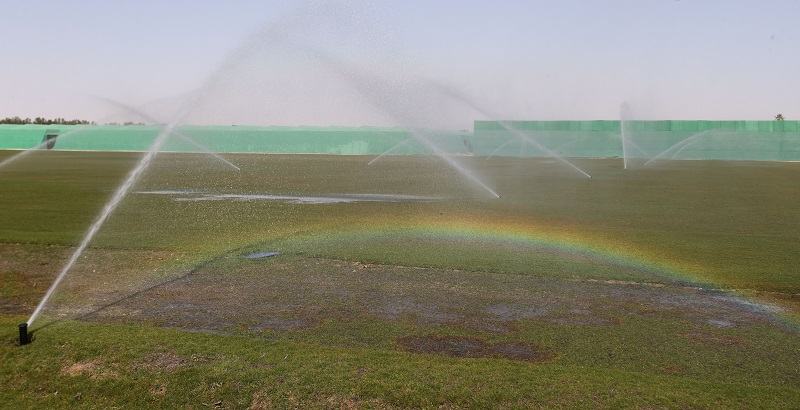
A general view of a turf nursery at the Umm Slal, in Doha on Feb. 3
20:47 JST, March 31, 2022
DOHA (Reuters) — Winter will come early to soccer stadiums in baking-hot Qatar when groundskeepers blast chilled air starting in September to ensure pitch turf thrives in the desert country for the World Cup.
Mimicking winter in the Gulf state, where temperatures can swelter at 40 C in the fall, is just one trick experts have introduced over the last 14 years to improve turf quality and increase the number of soccer pitches.
An elite corps of groundskeepers now maintains 144 green, lush fields — eight stadium pitches and 136 training grounds. They blast chilled air through nozzles directly at the turf, tending luxuriant patches of green dotted amid the dun or grey of Qatar’s desert and concrete.
“The weather condition and the climate together with the level of performance criteria we have set for ourselves makes it extremely challenging to develop the product we need. But we succeeded,” said Haitham Al Shareef, a Sudanese civil engineer who has worked on Qatar’s pitches since 2007.
Preparing turf for the World Cup, being held for the first time in the Middle East, is environmentally costly.
Qatar flies in about 140 tons of grass seed annually from the United States on climate-controlled aircraft, Al Shareef said, and pitches are watered with desalinated seawater, in an energy-intensive process burning the country’s wealth of natural gas.
Each pitch requires 10,000 liters of desalinated water daily in winter and 50,000 liters in the summer, he added.
Wear and tear
The 28-day event begins in November at perhaps the most challenging time of year for durable turf, as Qatar’s weather transitions from searing summer to mild winter.
Some grass varieties turn dormant as temperatures rise and winter ryegrass takes root, making adequate growth a challenge between matches.
“When you have wear and tear, you want the grass to keep growing to recover,” Al Shareef said. “If you seed the pitch too early, you will have germination, but the winter grass will not really grow, it will actually die because it’s too warm.”
So groundskeepers trigger winter in September, seeding pitches with ryegrass in a practice that has over the last three years yielded durable pitches.
Qatar has also countered the risk of fungus and disease outbreaks with a maintenance regime involving chemical cocktails, grass mowers that vacuum debris and an underground system that sucks excess moisture, said a UEFA pitch consultant.
“You’re one disease outbreak from failure,” said consultant Dean Gilasbey, who has trained groundskeepers around the world.
Qatar said it is is prepared for any turf emergency.
A 425,000-square-meter reserve of grass — some 40 soccer pitches worth — is growing at a farm north of Doha.
It can be harvested, trucked to a stadium and layed down ready for play in as little as eight hours, said Mohamed Al Atwaan, who worked as a project manager on Stadium 974.







Most Read
Popular articles in the past 24 hours
-
Japan Tourist Spot's Capsule Toys Made from Recycled Materials Pr...
-

Space One's No. 3 Kairos Rocket Terminates Mid-Flight
-

Former Unification Church: Proceed Steadily with Liquidation to P...
-
Japan’s Space One Kairos 3rd Flight Rocket Launched, but Mission ...
-

NTT Docomo to Discontinue 3G Service in March
-

Person Apparently Caught in Avalanche on Mt. Kamifurano in Hokkai...
-

LCC Greater Bay Airlines to Launch Regular Service on Fukuoka-Hon...
-
CARTOON OF THE DAY (March 5)
Popular articles in the past week
-
Tokyo Spends Big on Children, Wins Over Parents
-

South Korea Tightens Rules on Foreigners Buying Homes in Seoul Me...
-
Japan’s Miura, Kihara Announce Withdrawal from Figure Skating Wor...
-
2 Unpublished Early Novellas by Japan's Kenzaburo Oe Discovered, ...
-

Strait of Hormuz Closure Shakes Markets; Prolonged Closure Could ...
-
Nidec Chairman Resigns Amid Accounting Scandal at Major Japanese ...
-
Tourists Ignore Safety Barriers Near Famous Zao ‘Snow Monsters’ i...
-

Iran Situation: Japan Must Exert Diplomatic Efforts without Merel...
Popular articles in the past month
-

Producer Behind Pop Group XG Arrested for Cocaine Possession
-

Japan PM Takaichi’s Cabinet Resigns en Masse
-

Man Infected with Measles Reportedly Dined at Restaurant in Tokyo...
-

Israeli Ambassador to Japan Speaks about Japan’s Role in the Reco...
-

Videos Plagiarized, Reposted with False Subtitles Claiming ‘Ryuky...
-

Prudential Life Insurance Plans to Fully Compensate for Damages C...
-
Woman with Measles Visited Hospital in Tokyo Multiple Times Befor...
-

iPS Treatments Pass Key Milestone, but Broader Applications Far f...
Top Articles in News Services
-

Survey Shows False Election Info Perceived as True
-
Hong Kong Ex-Publisher Jimmy Lai’s Sentence Raises International Outcry as China Defends It
-

Japan’s Nikkei Stock Average Falls as US-Iran Tensions Unsettle Investors (UPDATE 1)
-
Japan’s Nikkei Stock Average Touches 58,000 as Yen, Jgbs Rally on Election Fallout (UPDATE 1)
-
Japan’s Nikkei Stock Average Rises on Tech Rally and Takaichi’s Spending Hopes (UPDATE 1)
JN ACCESS RANKING
-
Producer Behind Pop Group XG Arrested for Cocaine Possession
-
Japan PM Takaichi’s Cabinet Resigns en Masse
-
Man Infected with Measles Reportedly Dined at Restaurant in Tokyo Station
-
Israeli Ambassador to Japan Speaks about Japan’s Role in the Reconstruction of Gaza
-
Videos Plagiarized, Reposted with False Subtitles Claiming ‘Ryukyu Belongs to China’; Anti-China False Information Also Posted in Japan