
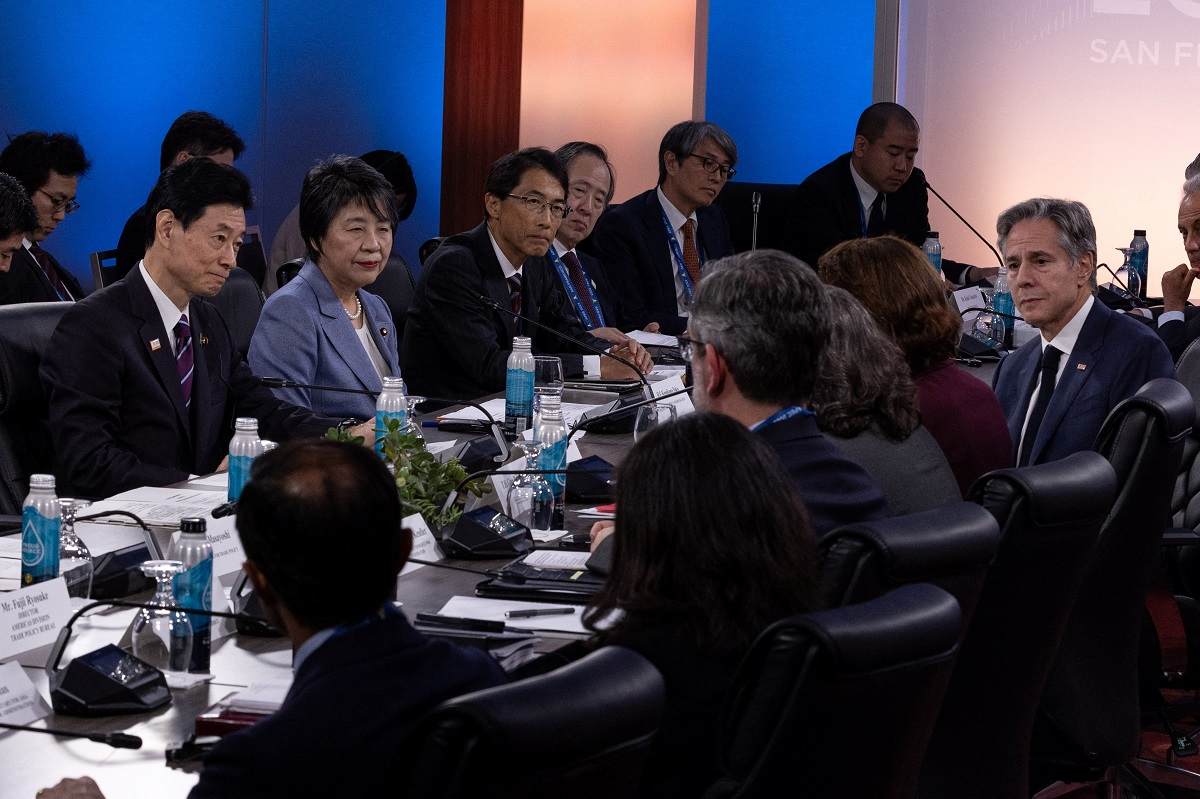
U.S. Secretary of State Antony Blinken, right, is seen during a meeting with Foreign Minister Yoko Kamikawa, second from left, and Economy, Trade and Industry Minister Yasutoshi Nishimura in San Francisco on Tuesday.
16:08 JST, November 16, 2023
SAN FRANCISCO — Japan and the United States agreed to work together to strengthen supply chains of critical technologies during a two-plus-two meeting of foreign and economic ministers in San Francisco on Tuesday.
The two countries aim to counter China and Russia, which have been making increasingly authoritarian moves. Tokyo and Washington plan to set up a working committee to consider specific measures.
It was the second time since July last year for talks to be held under the framework of the Japan-U.S. Economic Policy Consultative Committee, the so-called economic two-plus-two.
Foreign Minister Yoko Kamikawa and Economy, Trade and Industry Minister Yasutoshi Nishimura, and their U.S. counterparts — Secretary of State Antony Blinken and Secretary of Commerce Gina Raimondo — attended the gathering.
A joint statement released after the meeting said, “We intend to work together to formulate transparent, resilient and sustainable supply chain strategies.”
The working group is expected to discuss concrete support measures that Japan and the United States will implement in a concerted manner, such as providing subsidies and tax breaks in such fields as semiconductors, batteries for electric vehicles and other critical items.
Speaking at a press conference, Nishimura said, “It is hoped that Japan and the United States will take the initiative in strengthening supply chains for like-minded countries” that share values.
In the joint statement, the ministers also affirmed cooperation to combat “economic coercion” — an action used to pressurize other countries through the use of trade restrictions — and counter “non-market policies and practices,” such as excessive subsidies that distort markets.
On artificial intelligence, the two countries agreed to compare and analyze their guidelines and align their operational policies to ensure proper use and management.
The two sides also emphasized the need to use scientific evidence when imposing trade restrictions on food and agricultural products.
With China and Russia in mind, the statement stated that “restrictions on the imports of Japanese food products should be immediately rescinded.”



Most Read
Popular articles in the past 24 hours
-

Trump Fires Homeland Security Secretary Noem after Mounting Criti...
-
Japanese Nationals in 4 Gulf Countries to Be Evacuated with Chart...
-

China’s National People’s Congress Opens: Military Expansion Cont...
-
Hanamaruki to Sell Liquid 'Shio-Koji' Seasoning to U.S. Consumers
-

Strawberry Prince’s Rinu Discusses His Dream of Voice Acting, Suc...
-

CARTOON OF THE DAY (March 6)
-
Japan Foreign Minister Confirms Two Japanese Detained in Iran
-
Donald Keene’s Drinking Buddy and Translator Yukio Kakuchi Pays T...
Popular articles in the past week
-

South Korea Tightens Rules on Foreigners Buying Homes in Seoul Me...
-
2 Unpublished Early Novellas by Japan's Kenzaburo Oe Discovered, ...
-

Strait of Hormuz Closure Shakes Markets; Prolonged Closure Could ...
-

Iran Situation: Japan Must Exert Diplomatic Efforts without Merel...
-

Amid Strait of Hormuz Blockade, Shipping Companies Scramble to Ge...
-
Measles Patient Visited Hospital in Bunkyo Ward, Tokyo, Metropoli...
-

Ibaraki Pref.'s 1st Foreign Bus Driver Hired in Tsukuba
-

Tokyo’s ‘Strawberry War’ Intensifies as Producers Vie to Become ‘...
Popular articles in the past month
-

Producer Behind Pop Group XG Arrested for Cocaine Possession
-

Japan PM Takaichi’s Cabinet Resigns en Masse
-

Man Infected with Measles Reportedly Dined at Restaurant in Tokyo...
-

Videos Plagiarized, Reposted with False Subtitles Claiming ‘Ryuky...
-

Prudential Life Insurance Plans to Fully Compensate for Damages C...
-

Woman with Measles Visited Hospital in Tokyo Multiple Times Befor...
-

iPS Treatments Pass Key Milestone, but Broader Applications Far f...
-

Sanae Takaichi Elected Prime Minister of Japan; Keeps All Cabinet...
Top Articles in Politics
-
Japan PM Takaichi’s Cabinet Resigns en Masse
-
Sanae Takaichi Elected Prime Minister of Japan; Keeps All Cabinet Appointees from Previous Term
-

Japan’s Govt to Submit Road Map for Growth Strategy in March, PM Takaichi to Announce in Upcoming Policy Speech
-

LDP Wins Landslide Victory, Secures Single-party Majority; Ruling Coalition with JIP Poised to Secure Over 300 seats (UPDATE 1)
-

LDP Wins Historic Landslide Victory
JN ACCESS RANKING
-
Producer Behind Pop Group XG Arrested for Cocaine Possession
-
Japan PM Takaichi’s Cabinet Resigns en Masse
-
Man Infected with Measles Reportedly Dined at Restaurant in Tokyo Station
-
Videos Plagiarized, Reposted with False Subtitles Claiming ‘Ryukyu Belongs to China’; Anti-China False Information Also Posted in Japan
-
Prudential Life Insurance Plans to Fully Compensate for Damages Caused by Fraudulent Actions Without Waiting for Third-Party Committee Review