
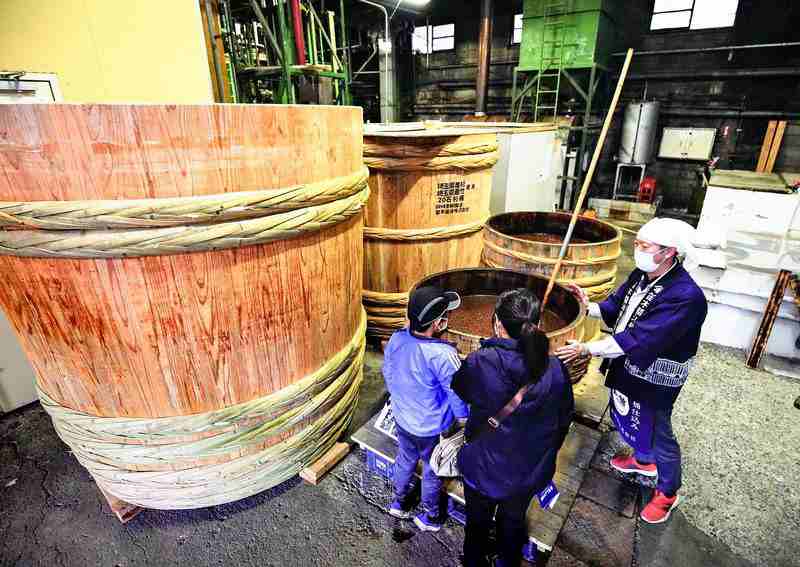
Next to a 2-meter-high wooden barrel, Fueki Shoyu President Kichigoro Fueki, right, explains moromi to participants in a tour.
15:07 JST, February 1, 2022
KAWAJIMA, Saitama — Surrounded by the Arakawa and Oppegawa rivers, the rural town of Kawajima in central Saitama Prefecture long prospered as the breadbasket of the region’s Kawagoe clan during the Edo period (1603-1867).
Blessed with a fresh water supply, there were many soy sauce breweries in the town, but only Fueki Shoyu Ltd. remains today. Founded in 1789, the company renovated its three breweries and opened Kinbue Shoyu Park in 2019, which introduces its traditional production process.
A tour of the breweries serves as a highlight of the park. The tour begins with the mae-gura, a brewery built in 1883. The building is dim and cool and serves as a storehouse for soybeans in bags.
Soybeans move through pipes to the adjacent koji-gura brewery to be boiled in a pressure cooker.
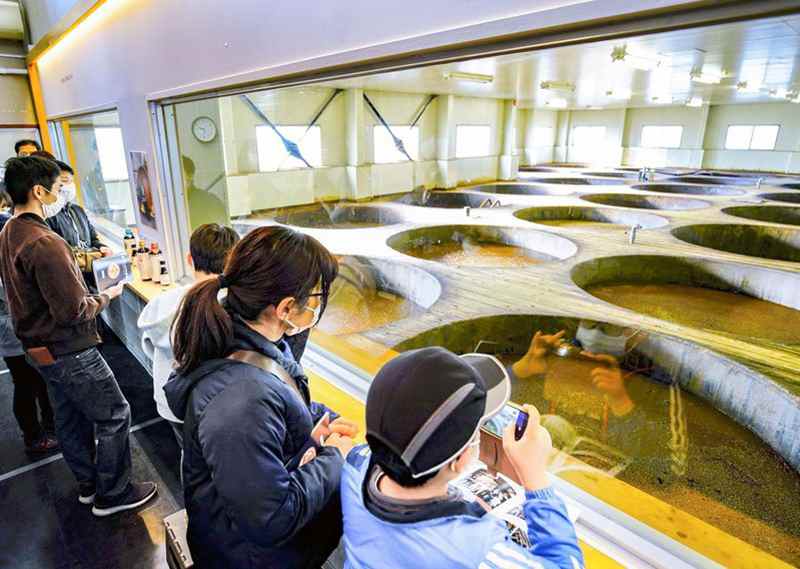
Visitors view the 38 wooden tubs of the shikomi-gura brewery.
A mixture of steamed and softened soybeans with roasted and crushed wheat is sprinkled with bacteria to become koji (rice malt). Koji is left for three days and mixed with salt water to become a substance called moromi.
Moromi is kept in huge wooden barrels, each 2 meters in height and diameter. The moromi inside is brown and thick, like miso paste, and the brewery is filled with a savory and appetizing smell.
The tour goes on to the last brewery called shikomi-gura, which has 38 wooden tubs viewable through a glass window. Moromi is left in the tubs for about two years. The longer it sits, the darker it becomes as it shrinks due to evaporation.
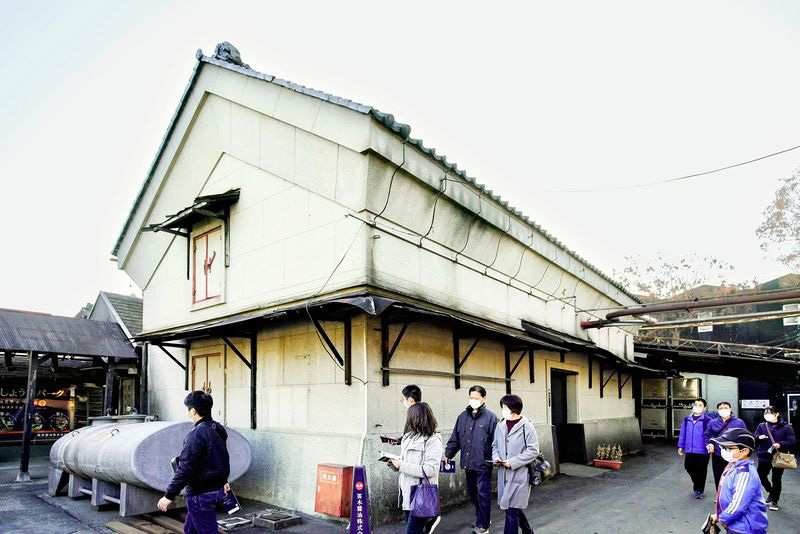
The mae-gura brewery where soybeans are stored
“We could shorten the aging process by accelerating fermentation through temperature control,” said Kichigoro Fueki, 12th-generation president, who guides the tour. “However, we give it time so the soy sauce can have a mild, rich flavor.”
After these processes, moromi is heated to adjust the taste and aroma before being filtered to become soy sauce.
There is said to have been about 6,000 soy sauce manufacturers nationwide after World War II, but that number is down to about 1,100 today. With the advent of mechanization, few makers are practicing natural brewing like Fueki.
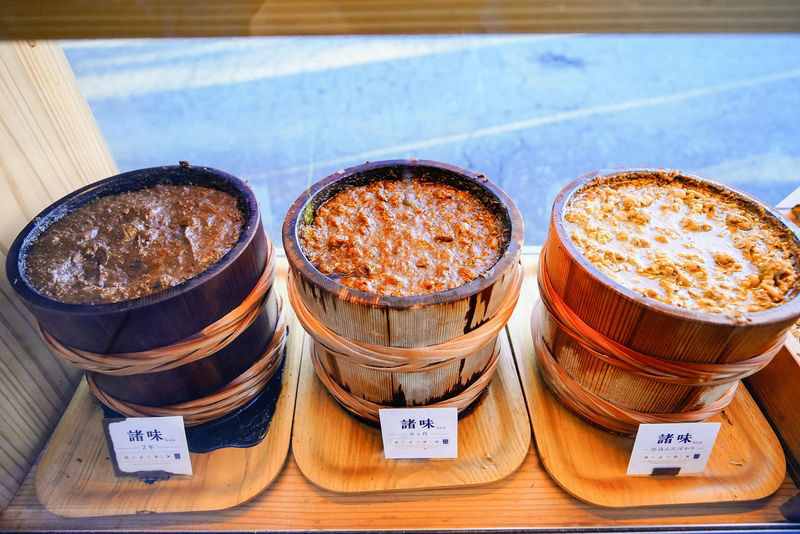
From right: Freshly made moromi, a tub that has sat for six months and one that has sat for two years
“We want this park to get people interested in the history and taste of soy sauce,” said Fueki, 41.
His words during the tour are filled with pride and love for the soy sauce he is making.
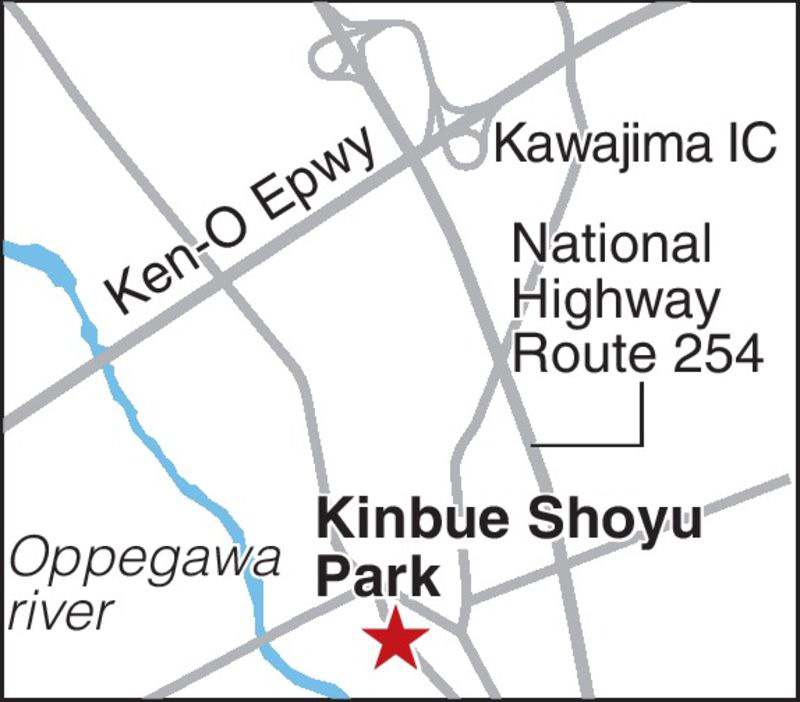
Kinbue Shoyu Park: 660 Kamiigusa, Kawajima, Saitama Prefecture


Related Tags



Most Read
Popular articles in the past 24 hours
-

Director Naomi Kawase's New Film Explores Heart Transplants in Ja...
-

Japan’s Nikkei Stock Average Rises on Tech Rally and Takaichi's S...
-
Takaichi Expected to Express Desire for Constitutional Revision P...
-

Security Services Law Unconstitutional: Do Not Restrict Career Ch...
-
Japanese Man Living in Iraq Suspected of Illegally Entering U.S. ...
-
New Leader of Japan's CRA Opposition Party Faces Challenge of For...
-

Milano Cortina 2026: Snowboarding Star Fukada Wins Gold in Hard-F...
-

Tokyo Exhibition Featuring VR Walk Through 2025 Osaka-Kansai Expo...
Popular articles in the past week
-

Japan PM Takaichi’s Cabinet Resigns en Masse
-

Man Infected with Measles Reportedly Dined at Restaurant in Tokyo...
-

Videos Plagiarized, Reposted with False Subtitles Claiming ‘Ryuky...
-

Sanae Takaichi Elected 105th Prime Minister of Japan; Keeps All C...
-

Japan's Govt to Submit Road Map for Growth Strategy in March, PM ...
-

Milano Cortina 2026: Figure Skaters Riku Miura, Ryuichi Kihara Pa...
-
Tokyo’s New Record-Breaking Fountain Named ‘Tokyo Aqua Symphony’
-

Bus Carrying 40 Passengers Catches Fire on Chuo Expressway; All E...
Popular articles in the past month
-
Japan PM Takaichi’s Cabinet Resigns en Masse
-

Japan Institute to Use Domestic Commercial Optical Lattice Clock ...
-

Israeli Ambassador to Japan Speaks about Japan’s Role in the Reco...
-
Man Infected with Measles Reportedly Dined at Restaurant in Tokyo...
-

Man Infected with Measles May Have Come in Contact with Many Peop...
-

Prudential Life Insurance Plans to Fully Compensate for Damages C...
-
Videos Plagiarized, Reposted with False Subtitles Claiming ‘Ryuky...
-

Woman with Measles Visited Hospital in Tokyo Multiple Times Befor...
Top Articles in Features
-
Sapporo Snow Festival Opens with 210 Snow and Ice Sculptures at 3 Venues in Hokkaido, Features Huge Dogu
-
Tokyo’s New Record-Breaking Fountain Named ‘Tokyo Aqua Symphony’
-

Tourists Flock to Ice Dome Lodge at Resort in Hokkaido, Japan; Facility Invites Visitors to Sleep on Beds Made of Ice
-
High-Hydration Bread on the Rise, Seeing Increase in Specialty Shops, Recipe Searches
-
Heirs to Kyoto Talent: Craftsman Works to Keep Tradition of ‘Kinran’ Brocade Alive Through Initiatives, New Creations
JN ACCESS RANKING
-
Japan PM Takaichi’s Cabinet Resigns en Masse
-
Japan Institute to Use Domestic Commercial Optical Lattice Clock to Set Japan Standard Time
-
Israeli Ambassador to Japan Speaks about Japan’s Role in the Reconstruction of Gaza
-
Man Infected with Measles Reportedly Dined at Restaurant in Tokyo Station
-
Man Infected with Measles May Have Come in Contact with Many People in Tokyo, Went to Store, Restaurant Around When Symptoms Emerged