
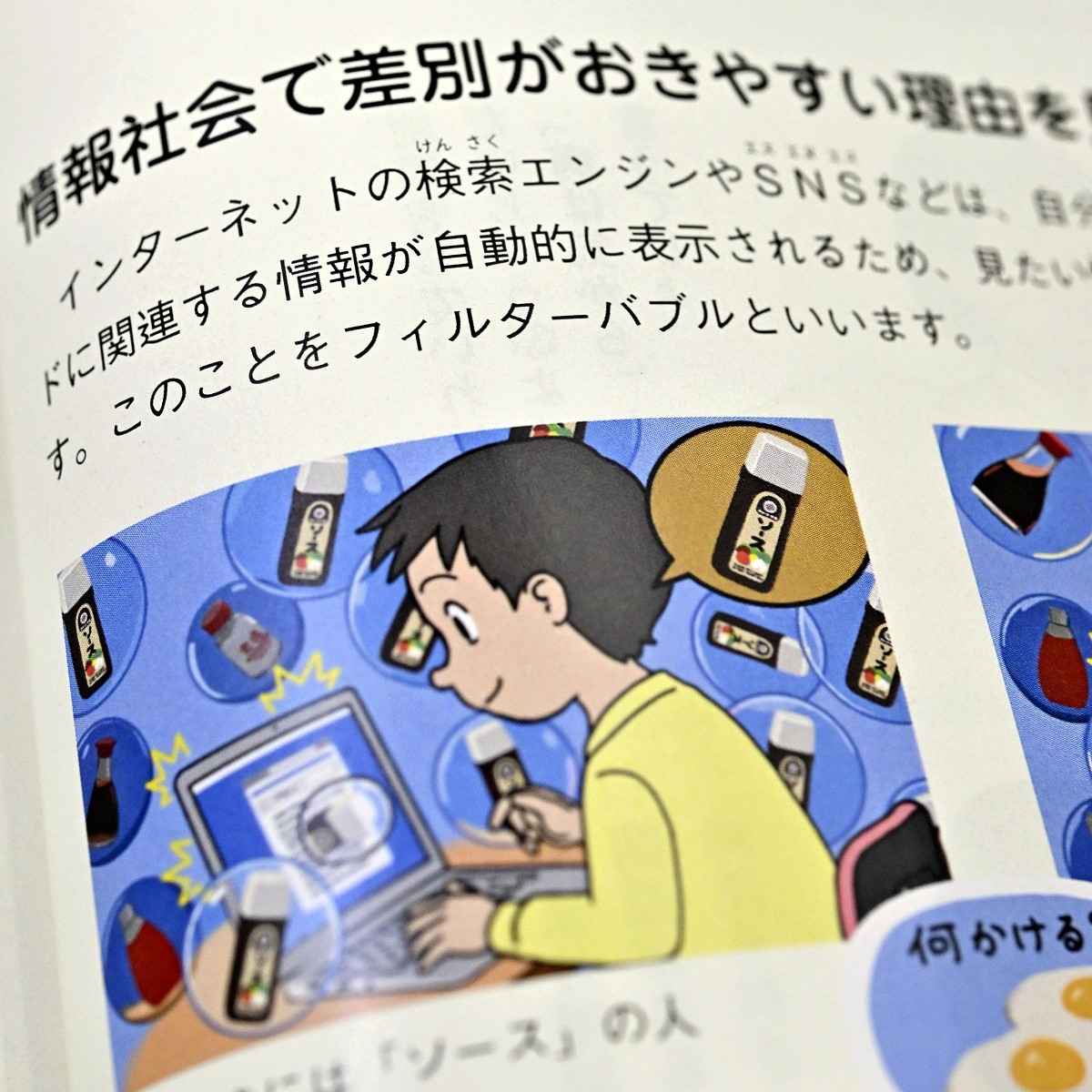
A page explaining issues that arise on the internet is seen in a school textbook.
1:00 JST, May 9, 2023
Textbooks to be used in schools from next spring will give a balanced view of the internet, flagging its convenience but also warning of its potential dangers.
The internet can be used to spread discrimination and reinforce prejudice via social media.
In its ethics textbook for sixth-grade elementary school students, Tokyo Shoseki Co. writes about “filter bubbles,” in which users of social media end up surrounded solely by information they want to see, and about “echo chambers,” in which only opinions that they agree with are shown.
In the textbook, a girl living amid the COVID-19 pandemic thinks to herself: “Those who were infected [with the virus] are to blame. They failed to take countermeasures and had no willpower.” The story is aimed at showing how it is possible to only encounter similar opinions on social media and assume that “everyone is thinking the same way.”
The company included this story in response to a comment from an information morality expert who said that “students in the upper grades come into contact with biased statements and ideas on the internet.”
An official of the publishing firm said, “We thought elementary school students should know how discrimination can come about from online information.”
By the 2020 school year, elementary and junior high school students across the country had each been provided with a digital device, allowing them to become more familiar with the internet.
However, schools have registered adverse effects, too, such as students slandering each other through chat functions on their devices and browsing websites unrelated to classes.
In response, publishers have included in their content related to the internet and digital literacy in their moral, social and health education texts.
Some textbooks have thorough descriptions of gaming and internet addiction. Gakken Holdings Co. was the first publisher to mention video game addiction in its ethics textbook for first-grade elementary school students.
“Because students are each provided with a digital device, we concluded it was best to address the issue from an early stage,” a Gakken official said.
Taishukan Publishing Co.’s health education textbooks for fifth and sixth-grade elementary school students include advice about taking care on the internet, such as by not posting personal information.







Most Read
Popular articles in the past 24 hours
-

LDP Wins Historic Landslide Victory
-

Ruling Coalition of LDP, JIP Secures Two-Thirds Majority, Enablin...
-

Milano Cortina 2026: Japan Finishes 2nd in Figure Skating Team Co...
-

LDP Secures ‘Absolute Majority,’ Enabling It to Dominate All Comm...
-

Japan’s CRA Suffers Crushing Defeat; Coleader Yoshihiko Noda Hint...
-

Milano Cortina 2026: Tsubaki Miki Misses Medal in Women’s S...
-

Milano Cortina 2026: Japan Takes Silver Medal in Team Figure Skat...
-

Japanese Communist Party Unable to Halt Decline in Election; ‘The...
Popular articles in the past week
-

Man Infected with Measles May Have Come in Contact with Many Peop...
-

Israeli Ambassador to Japan Speaks about Japan’s Role in the Reco...
-

BTS to Hold Comeback Concert in Seoul on March 21; Popular Boy Ba...
-
LDP Wins Historic Landslide Victory
-
Sapporo Snow Festival Opens with 210 Snow and Ice Sculptures at 3...
-
Green Tea Exports Hit Record High in 2025 Amid Growing Demand, Li...
-
U.N. Plans to Set Safety Regulation Standards on Automated Drivin...
-

LDP Wins Landslide Victory, Secures Single-party Majority; Ruling...
Popular articles in the past month
-
Univ. in Japan, Tokyo-Based Startup to Develop Satellite for Disa...
-

Japan Institute to Use Domestic Commercial Optical Lattice Clock ...
-
JAL, ANA Cancel Flights During 3-day Holiday Weekend due to Blizz...
-

China Eyes Rare Earth Foothold in Malaysia to Maintain Dominance,...
-
Man Infected with Measles May Have Come in Contact with Many Peop...
-

Japan, Qatar Ministers Agree on Need for Stable Energy Supplies; ...
-
Australian Woman Dies After Mishap on Ski Lift in Nagano Prefectu...
-

Japan, Italy to Boost LNG Cooperation; Aimed at Diversifying Japa...
Top Articles in Society
-
Man Infected with Measles May Have Come in Contact with Many People in Tokyo, Went to Store, Restaurant Around When Symptoms Emerged
-
Australian Woman Dies After Mishap on Ski Lift in Nagano Prefecture
-
Foreign Snowboarder in Serious Condition After Hanging in Midair from Chairlift in Nagano Prefecture
-
Record-Breaking Snow Cripples Public Transport in Hokkaido; 7,000 People Stay Overnight at New Chitose Airport
-
Train Services in Tokyo Resume Following Power Outage That Suspended Yamanote, Keihin-Tohoku Lines (Update 4)
JN ACCESS RANKING
-
Japan Institute to Use Domestic Commercial Optical Lattice Clock to Set Japan Standard Time
-
China Eyes Rare Earth Foothold in Malaysia to Maintain Dominance, Counter Japan, U.S.
-
Man Infected with Measles May Have Come in Contact with Many People in Tokyo, Went to Store, Restaurant Around When Symptoms Emerged
-
Japan, Qatar Ministers Agree on Need for Stable Energy Supplies; Motegi, Qatari Prime Minister Al-Thani Affirm Commitment to Cooperation
-
Australian Woman Dies After Mishap on Ski Lift in Nagano Prefecture