
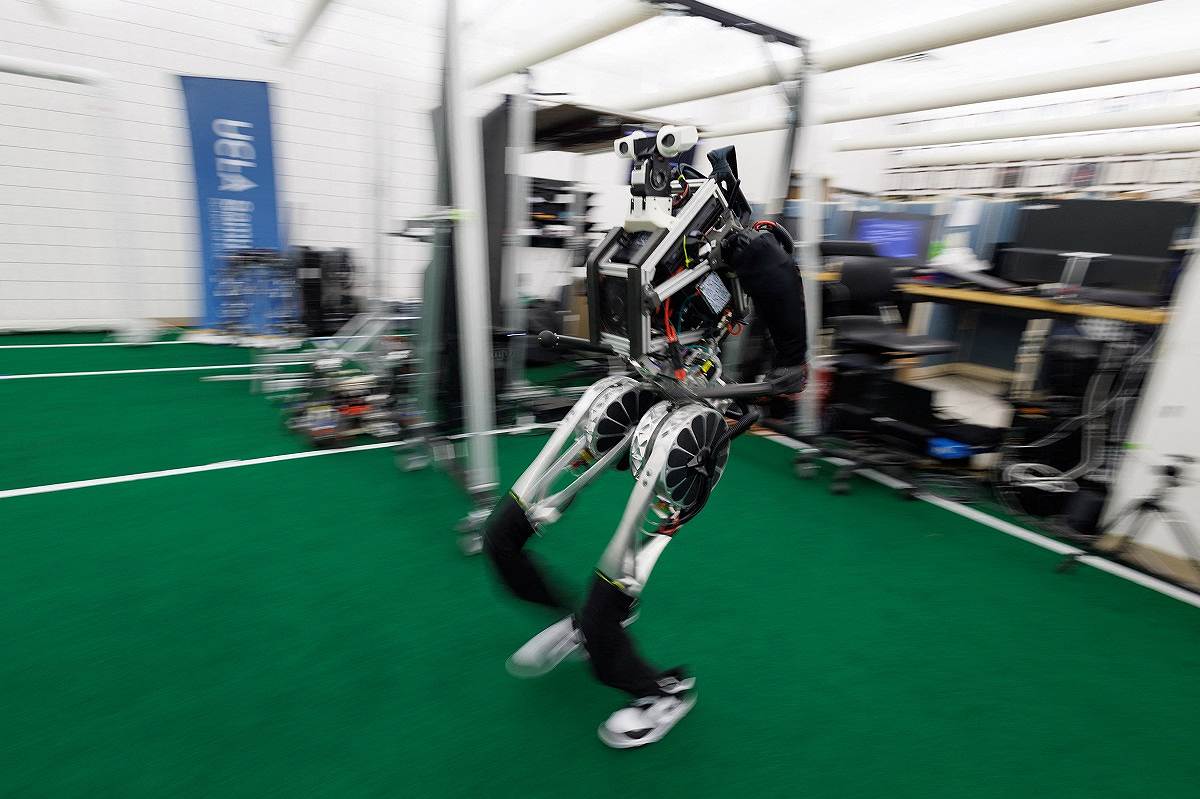
ARTEMIS moves through a school lab after students at UCLA Samueli School of Engineering developed the robot in Los Angeles, on April 13.
16:17 JST, April 28, 2023
Watch out, Lionel Messi. ARTEMIS is here.
Standing at 142 centimeters tall and weighing 38 kilograms, ARTEMIS is a first-of-its-kind robot that University of California Los Angeles (UCLA) mechanical engineers developed, and it is ready for the field.
Using cutting-edge technology, ARTEMIS, which stands for Advanced Robotic Technology for Enhanced Mobility and Improved Stability, can maintain its balance against heavy kicks and shoves, withstand objects being thrown at it and is capable of running. But what sets ARTEMIS apart on top of that is its ability to kick a ball.
“If your robot cannot even play a game of soccer, how would you be able to use these robots for more important things, such as saving people’s lives?” said Dennis Hong, professor of mechanical and aerospace engineering and director of the Robotics and Mechanisms Laboratory (RoMeLa) at UCLA, which developed ARTEMIS.
The technologies used for soccer-playing robots are also being used for other applications like firefighting and disaster relief, said Hong.
While ARTEMIS may not be at the next FIFA World Cup, Hong’s team will be unveiling its full soccer capabilities at RoboCup in Bordeaux, France, in July.
The robot’s major innovation is that the engineers custom-designed its actuators — devices that generate motion from energy — to behave like biological muscles. They are springy and force-controlled, rather than the rigid, position-controlled actuators that most robots have.
ARTEMIS’ actuators are also unique in that they are electrically driven, rather than controlled by hydraulics. That means it is quieter and operates more efficiently, while also being cleaner, because hydraulic systems are notorious for leaking fluids.
RoMeLa student Justin Quan said his personal goal is engineering robots that improve people’s lives.
“Seeing these robots helping push the robot technology to that next level is really rewarding because you’re like, oh, the dream, it gets closer,” he said.







Most Read
Popular articles in the past 24 hours
-

Milano Cortina 2026: Figure Skaters Riku Miura, Ryuichi Kihara Pa...
-

Young People in Japan Grapple with Social Media Addiction
-
Ruling Coalition Calls for Opposition Participation in ‘National ...
-

Japan’s Updated ‘Free and Open Indo-Pacific’ Initiative to Streng...
-
Takaichi Chats with Tunku Tunku, Interactive Mascot for Internati...
-

Myaku-Myaku Fan Event Held in Osaka; ‘Its Butt is so Cute!’ Says ...
-

“The Tale of Genji” Back-Translation Project Led to Touching Enco...
-

Japan’s Nikkei Stock Average Slips as Post-Earnings and Election ...
Popular articles in the past week
-

Videos Plagiarized, Reposted with False Subtitles Claiming ‘Ryuky...
-

Woman with No Overseas Travel History Infected with Measles in Na...
-

Milano Cortina 2026: Kokomo Murase Comes Out on Top After Overcom...
-

CRA Leadership Election Will Center on Party Rebuilding; Lower Ho...
-

Tokyo’s New Record-Breaking Fountain Named ‘Tokyo Aqua Symphony’
-

Crime in Japan Ticks Up for 4th Straight Year
-
Milano Cortina 2026: Figure Skaters Riku Miura, Ryuichi Kihara Pa...
-

Japanese Constitutional Revision Debate Expected to be Revived Af...
Popular articles in the past month
-

Japan Institute to Use Domestic Commercial Optical Lattice Clock ...
-

Israeli Ambassador to Japan Speaks about Japan’s Role in the Reco...
-

Man Infected with Measles May Have Come in Contact with Many Peop...
-

China Eyes Rare Earth Foothold in Malaysia to Maintain Dominance,...
-

Prudential Life Insurance Plans to Fully Compensate for Damages C...
-

Woman with Measles Visited Hospital in Tokyo Multiple Times Befor...
-

Australian Woman Dies After Mishap on Ski Lift in Nagano Prefectu...
-

Foreign Snowboarder in Serious Condition After Hanging in Midair ...
Top Articles in Science & Nature
-
Japan Institute to Use Domestic Commercial Optical Lattice Clock to Set Japan Standard Time
-

Space Mission Demonstrates Importance of International Cooperation, Astronaut Kimiya Yui Says
-

Japan to Face Shortfall of 3.39 Million Workers in AI, Robotics in 2040; Clerical Workers Seen to Be in Surplus
-
Record 700 Startups to Gather at SusHi Tech Tokyo in April; Event Will Center on Themes Like Artificial Intelligence and Robotics
JN ACCESS RANKING
-
Japan Institute to Use Domestic Commercial Optical Lattice Clock to Set Japan Standard Time
-
Israeli Ambassador to Japan Speaks about Japan’s Role in the Reconstruction of Gaza
-
Man Infected with Measles May Have Come in Contact with Many People in Tokyo, Went to Store, Restaurant Around When Symptoms Emerged
-
Prudential Life Insurance Plans to Fully Compensate for Damages Caused by Fraudulent Actions Without Waiting for Third-Party Committee Review
-
Woman with Measles Visited Hospital in Tokyo Multiple Times Before Being Diagnosed with Disease