
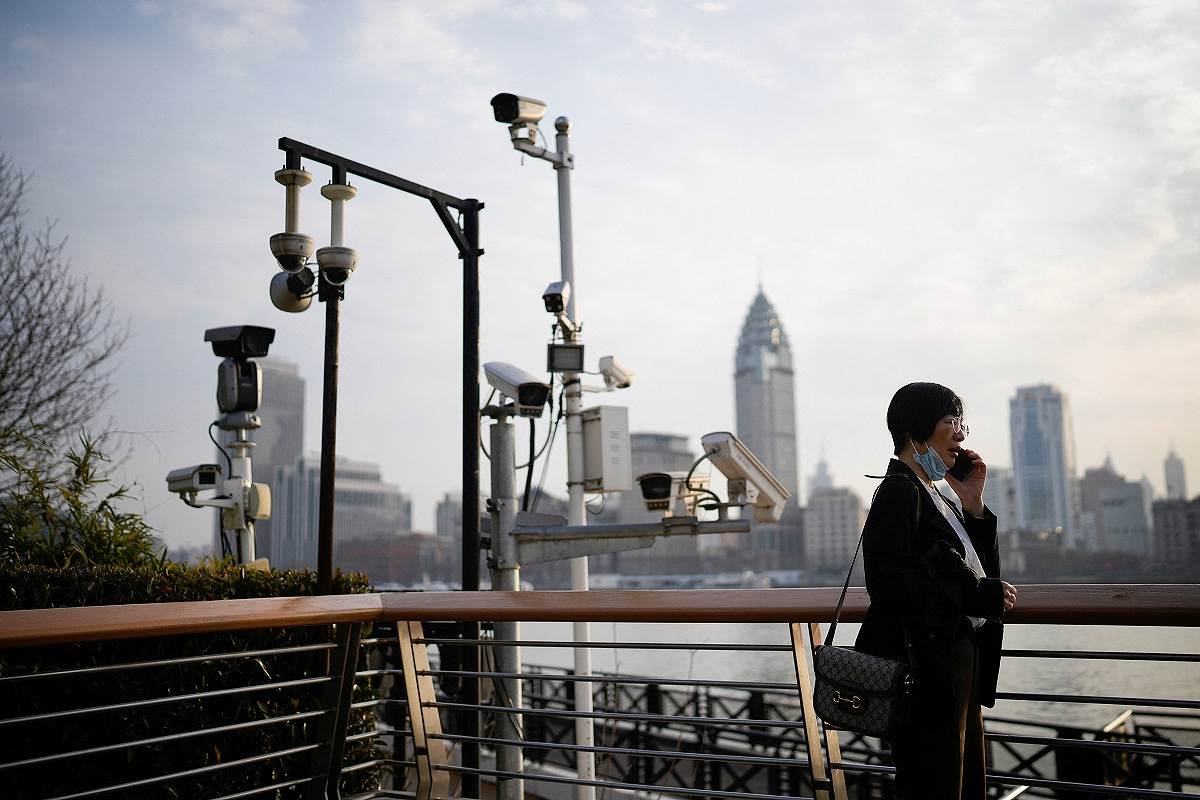
A woman talks on a phone under surveillance cameras on a riverside, during the National People’s Congress (NPC) in Shanghai, China, March 7, 2023.
15:04 JST, March 28, 2023
The government intends to join an international framework for controlling the export of technology that might be used to violate human rights, such as AI-based facial recognition systems and surveillance cameras, according to government sources.
The aim is to prevent such technology from falling into the hands of authoritarian regimes like China and Russia.
Formally called the Export Controls and Human Rights Initiative, the framework was launched at the first Summit for Democracy hosted by the United States in December 2021. Japan will inform the United States of its intention to join the initiative in time for the second summit scheduled for March 29-30.
The United States envisions the framework also covering spyware-related technology that extracts information from smartphones, in light of such actions as China’s reported use of surveillance technology to suppress the Uyghur minority.
Participating countries have been working to formulate a code of conduct that will serve as a guideline for export controls. The announcement of the code will be coordinated with the timing with the second summit.
The code of conduct will not be legally binding, and will not specify specific items to be regulated or export destinations to be banned. The participating countries intend to discuss, based on the code of conduct, whether they can also agree on a list of restricted items.
Based on talks with other participating countries, the Japanese government is expected to consider a proposal that would make the export of technologies that could be misused subject to a permit system under the Foreign Exchange and Foreign Trade Law. The proposal also calls for strict screening of exports to countries where technologies could be used for human rights abuses.
Japan already regulates the export of materials and technologies that could be converted into weapons of mass destruction under the Foreign Exchange and Foreign Trade Law.
Nearly 10 countries are expected to participate in the framework, mainly from the Group of Seven, including the United Kingdom, France, Germany and Canada.
Japan, as the president of G7 this year, has decided that it needs to demonstrate its emphasis on human rights.



Most Read
Popular articles in the past 24 hours
-

McDonald's Japan Raises Prices; Big Mac to Cost ¥500, Double Chee...
-

Nepal Bus Crash Kills 19 People, Injures 25 Including One Japanes...
-

Japan’s Nikkei Stock Average Rises as AI-Related Stocks Shine; Co...
-

Aggression against Ukraine: Malignant Precedent Must Not Be Set t...
-

Joruri Bunraku Narrative Performed in Honor of Donald Keene by La...
-

Kanto's 1st Spring Wind Blows as Tokyo Sees Unseasonably High Tem...
-

Early-Blooming Kawazu Cherry Blossoms Create Sea of Pink at Park ...
-

Astellas Collaborates with Vir to Develop Its Experimental Prosta...
Popular articles in the past week
-

Producer Behind Pop Group XG Arrested for Cocaine Possession
-

Japan PM Takaichi’s Cabinet Resigns en Masse
-

Sanae Takaichi Elected Prime Minister of Japan; Keeps All Cabinet...
-

Japan's Govt to Submit Road Map for Growth Strategy in March, PM ...
-

Bus Carrying 40 Passengers Catches Fire on Chuo Expressway; All E...
-

Japan, U.S. Name 3 Inaugural Investment Projects; Reached Agreeme...
-

Riku-Ryu Pair Wins Gold Medal: Their Strong Bond Leads to Major C...
-

iPS Treatments Pass Key Milestone, but Broader Applications Far f...
Popular articles in the past month
-
Producer Behind Pop Group XG Arrested for Cocaine Possession
-
Japan PM Takaichi’s Cabinet Resigns en Masse
-

Japan Institute to Use Domestic Commercial Optical Lattice Clock ...
-

Man Infected with Measles Reportedly Dined at Restaurant in Tokyo...
-

Israeli Ambassador to Japan Speaks about Japan’s Role in the Reco...
-

Videos Plagiarized, Reposted with False Subtitles Claiming ‘Ryuky...
-

Man Infected with Measles May Have Come in Contact with Many Peop...
-

Prudential Life Insurance Plans to Fully Compensate for Damages C...
Top Articles in Politics
-
Japan PM Takaichi’s Cabinet Resigns en Masse
-
Sanae Takaichi Elected Prime Minister of Japan; Keeps All Cabinet Appointees from Previous Term
-
Japan’s Govt to Submit Road Map for Growth Strategy in March, PM Takaichi to Announce in Upcoming Policy Speech
-

LDP Wins Historic Landslide Victory
-

LDP Wins Landslide Victory, Secures Single-party Majority; Ruling Coalition with JIP Poised to Secure Over 300 seats (UPDATE 1)
JN ACCESS RANKING
-
Producer Behind Pop Group XG Arrested for Cocaine Possession
-
Japan PM Takaichi’s Cabinet Resigns en Masse
-
Man Infected with Measles Reportedly Dined at Restaurant in Tokyo Station
-
Israeli Ambassador to Japan Speaks about Japan’s Role in the Reconstruction of Gaza
-
Videos Plagiarized, Reposted with False Subtitles Claiming ‘Ryukyu Belongs to China’; Anti-China False Information Also Posted in Japan