
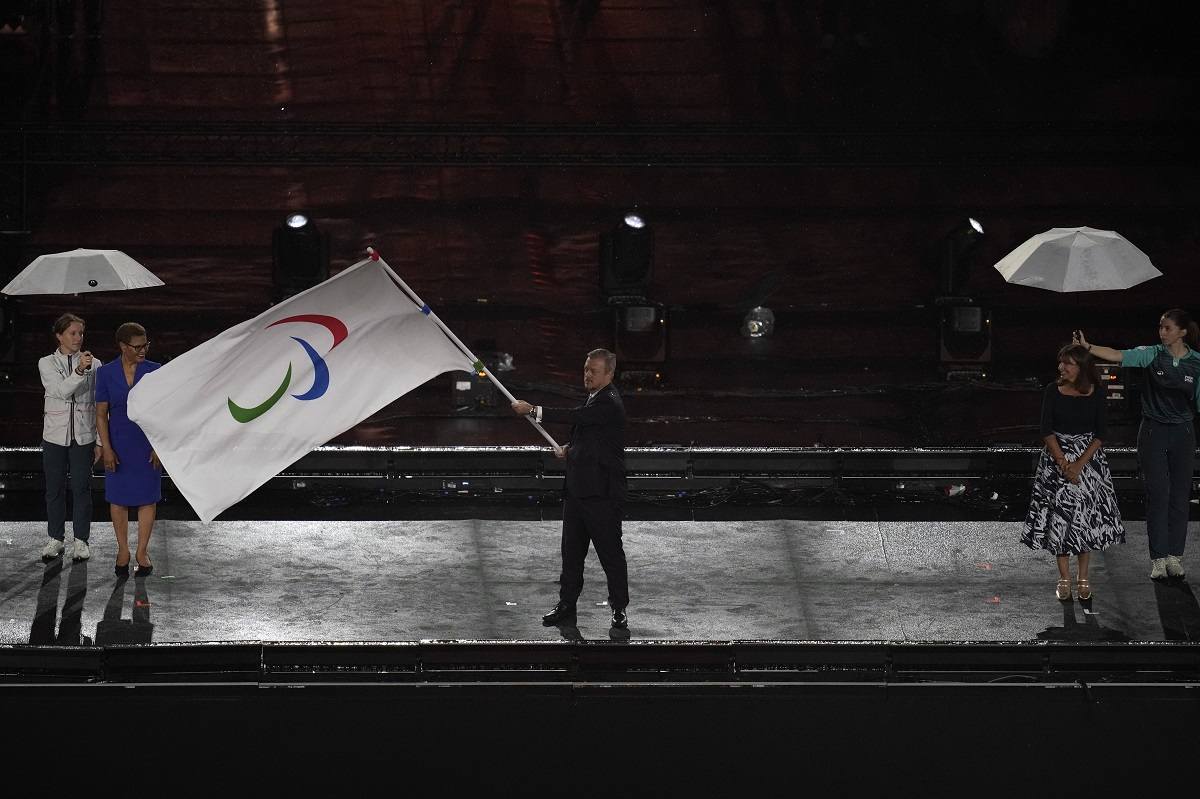
President of the International Paralympic Committee Andrew Parsons passes the Paralympic flag to Mayor of Los Angeles Karen Bass, second left, after receiving it from Mayor of Paris Anne Hidalgo, second right, during the closing ceremony of the 2024 Paralympics, Sunday, Sept. 8, 2024, in Paris, France.
11:56 JST, September 9, 2024
The Paris Paralympics were the “greatest ever” according to one former IOC marketing executive while another told AFP it “delivered in spades” the thing that people relate most to in sport — emotion.
Mainly packed stadia, iconic venues and the feelgood factor derived from the Olympics that came before them turned the Paralympics into a festival of sport, according to Michael Payne, a former head of marketing at the International Olympic Committee.
Its counterpart the International Paralympic Committee can breathe a sigh of relief after Rio was widely criticised for its hosting in 2016 and the Tokyo edition was deprived of spectators due to Covid restrictions.
“Paris built on the magic of the Olympic Games and delivered a spectacular Paralympic Games — to my mind the greatest ever,” Payne told AFP.
“All the ingredients that made the Olympics so special have been carried forward to the Paras, delivering an incredible atmosphere.”
His fellow former IOC marketing executive Terrence Burns said in his 30-plus years of experience of Paralympics there was no comparison “in both fan and commercial interest.”
“In so many ways I believe the Paralympics are truly coming into their own as a separate yet complementary ‘product’ from the Olympics,” Burns told AFP.
“I give the IOC full marks for working hard to make the Paralympics a product that brands want not only to support, but to market.
“(It is) a difference with a profound distinction.”
For Payne, who in nearly two decades at the IOC was credited with modernising the organisation’s brand and improving its finances through sponsorship, the high profile of the Paralympics had hugely positive ramifications.
“The Paralympics provides a massive boost worldwide to the disabled movement — bringing the issue of disability front and centre,” said the 66-year-old Irishman.
“(There is) a real legacy from general accessibility to a broader debate and awareness about disability throughout society.”
He said that before Paralympic Games became mainstream, “disability was often hidden and rarely talked about”.
‘Emotion’
Payne said the athletes were the main actors in making the Paralympics the spectacle they are, with a knock-on positive impact for disabled people back in their own countries.
“The stories of what some refer to as ‘the super humans’ provides an inspirational platform that is impossible to ignore,” he said.
“Everyone recognises the incredible challenges that each Paralympic athlete has had to overcome — and watching their performances in Paris, you look on totally awestruck.”
Burns also said the athletes drove the narrative.
“I think people react and relate to sport through a single prism: emotion,” he said.
“The Paras deliver on that in spades.
“Increased coverage and exposure means more fans can experience it.”
British amputee sprinter Jonnie Peacock is one who would like that exposure to be even greater.
The two-time 100m champion made an impassioned plea to World Athletics that Paralympic athletes be included in the main televised section of the elite Diamond League meetings.
Payne thinks his argument holds water, but says though the Commonwealth Games combines both para and able-bodied events it would be a no go for the Olympics to follow suit.
“Including Para sports events in individual world championships could well work for certain sports,” he said.
“But a total integration into the Olympics would not work to my mind.
“Both events are now so big, they each need their own stage… and frankly I think Paralympics are better served on the stage by themselves.”
Burns, who since leaving the IOC has assisted five successful Olympic bid city campaigns, says Peacock does have a point.
“I would also argue that mixing might dilute the focus on Paralympic sport, though (it is) worth experimenting with.”
Burns said the only real downside is the “confusing classifications system”.
Payne praised the organisation of the Paralympics.
“Some joke that the Olympics are just a ‘test event’ for the real thing, giving the local organisers the time to iron out all the small operational problems!”





Most Read
Popular articles in the past 24 hours
-

Business Hotels Expanding into Regional Areas in Japan, Aiming to...
-

Milano Cortina 2026: Japan Sees Leap in Olympic Performance Throu...
-
Milano Cortina 2026: Japan's Satoshi Furuno Places 4th in Men's S...
-
Fiji Defense Minister Hopes Japan Will Support Stabilization of P...
-
6 Injured at Naked Festival in Japan’s Okayama Prefecture; Police...
-
Milano Cortina 2026: Speed Skater Takagi Finishes 6th in the 1,50...
-
Milano Cortina 2026: Malinin Highlights Dangers of Social Media i...
-

Space One Delays Launch of No. 3 Kairos Rocket; Company to Announ...
Popular articles in the past week
-

Japan PM Takaichi’s Cabinet Resigns en Masse
-

Man Infected with Measles Reportedly Dined at Restaurant in Tokyo...
-

Sanae Takaichi Elected Prime Minister of Japan; Keeps All Cabinet...
-
Japan's Govt to Submit Road Map for Growth Strategy in March, PM ...
-

Bus Carrying 40 Passengers Catches Fire on Chuo Expressway; All E...
-

Milano Cortina 2026: Figure Skaters Riku Miura, Ryuichi Kihara Pa...
-

Japan, U.S. Name 3 Inaugural Investment Projects; Reached Agreeme...
-

U.S. Firm to Build Training Hub in Fukushima N-plant for Debris R...
Popular articles in the past month
-
Japan PM Takaichi’s Cabinet Resigns en Masse
-

Japan Institute to Use Domestic Commercial Optical Lattice Clock ...
-

Israeli Ambassador to Japan Speaks about Japan’s Role in the Reco...
-
Man Infected with Measles Reportedly Dined at Restaurant in Tokyo...
-

Videos Plagiarized, Reposted with False Subtitles Claiming ‘Ryuky...
-

Man Infected with Measles May Have Come in Contact with Many Peop...
-

Prudential Life Insurance Plans to Fully Compensate for Damages C...
-

Woman with Measles Visited Hospital in Tokyo Multiple Times Befor...
Top Articles in Sports
-
Milano Cortina 2026: Figure Skaters Riku Miura, Ryuichi Kihara Pair Win Gold; Dramatic Comeback from 5th Place in SP
-
Milano Cortina 2026: Kokomo Murase Comes Out on Top After Overcoming Obstacles, Aiming for Greater Heights in Competition
-
Milano Cortina 2026: Riku Miura, Ryuichi Kihara Clinch Japan’s 1st Gold in Pairs Figure Skating, Rebounding from Disappointing Short Program
-

Milano Cortina 2026: Olympics-Torch Arrives in Co-Host Cortina on Anniversary of 1956 Games
-
Milano Cortina 2026: Japan’s Athletes Arrive in Italy for Milano Cortina Winter Olympics; Other Athletes to Arrive from Now
JN ACCESS RANKING
-
Japan PM Takaichi’s Cabinet Resigns en Masse
-
Japan Institute to Use Domestic Commercial Optical Lattice Clock to Set Japan Standard Time
-
Israeli Ambassador to Japan Speaks about Japan’s Role in the Reconstruction of Gaza
-
Man Infected with Measles Reportedly Dined at Restaurant in Tokyo Station
-
Videos Plagiarized, Reposted with False Subtitles Claiming ‘Ryukyu Belongs to China’; Anti-China False Information Also Posted in Japan