
Social Media and Elections: Outdated System / Outdated System: Campaign Broadcasts Misused to Attract Customers
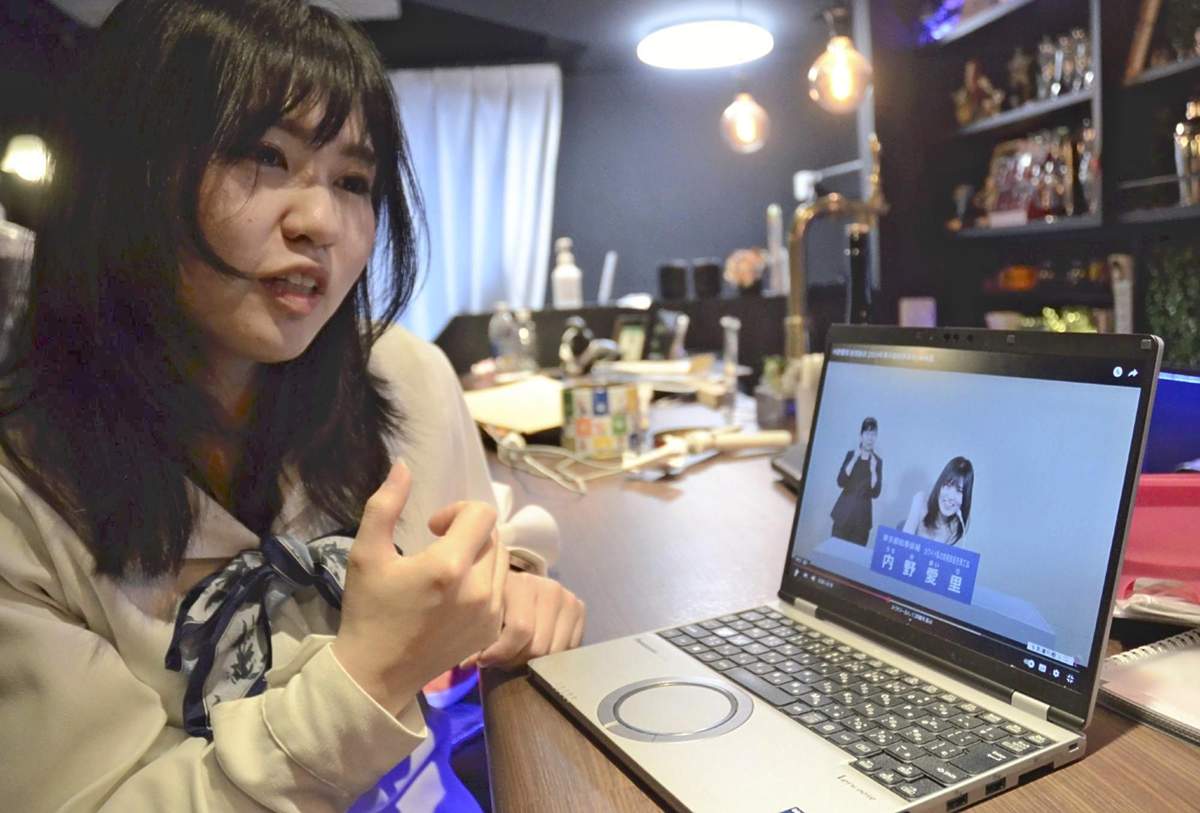
Airi Uchino speaks in Nakano Ward, Tokyo, on April 16, about the time when she ran for the governor of Tokyo, while watching one of her campaign broadcasts that spread on social media.
6:40 JST, May 5, 2025
This is the second installment in a series of articles that examines the challenges faced by the nation’s election system, which has been criticized as outdated.
***
“It’s so hot, I hate it,” said Airi Uchino, 32, a candidate in the Tokyo gubernatorial election held in July last year, in her recorded official campaign speech that aired on TV. She then suddenly took off her shirt to reveal a tube top that almost exposed her cleavage. In the 5 minute and 30 second broadcast, she did not talk about her political views at all. Instead, she just repeated her name and asked many times for viewers to “add me as a friend on your Line app.”
Uchino runs a bar in Tokyo. She is also an active YouTuber. Knowing that some candidates in the past had behaved in a prankish manner in their campaign broadcasts, she thought that she might be able to attract the public by taking off some of her clothes. Just before the gubernatorial election, she founded her political organization, called “Kawaii watashi no seiken hoso o mitene” (I’m cute. Watch my campaign broadcasts), and ran for office.
When she posted her campaign broadcasts on her YouTube channel, they quickly spread through social media. She started receiving Line friend requests one after another, which quickly reached the maximum limit of 5,000, up from about 300 in the past. In response to messages she received, she replied, “I’ll be waiting for you at my bar.” Her broadcasts were also a big hit overseas, attracting many visitors from Asia, Europe and the United States to her bar.
She had also expressed her political views in street speeches about improving the working environment for workers and supporting child-rearing, but they were drowned out by the sensation caused by the broadcasts.
“People wouldn’t pay attention to me if they didn’t recognize my name, so I acted in an eccentric way,” Uchino said, calmly looking back on the time. “As a result, I wasn’t able to convey my awareness of the issues.”
Law requires integrity
Campaign broadcasts are opportunities for candidates to make their political views and backgrounds known to voters on TV and the radio. The Public Offices Election Law stipulates that campaign broadcasts shall be aired just as they were recorded, while requiring candidates to maintain appropriate integrity in their content.
For example, in 1969, when the then Home Affairs Ministry began airing campaign speeches on TV, it required candidates not to wear gaudy makeup and not to make excessive gestures. However, as the decency provision did not include penalties, some candidates still wore fancy costumes or said or did things that had nothing to do with their election.
This trend started to intensify when the use of the internet in election campaigns was permitted in 2013. Candidates were allowed to post their recorded campaign broadcasts on social media, driving many more of them to act in extreme ways.
In the 2021 Chiba gubernatorial election, a candidate wore clown-like white makeup and another candidate made a public marriage proposal in their respective campaign broadcasts.
The Chiba prefectural election administration committee was inundated with complaints that making the broadcasts was a “waste of taxpayers’ money” and a “mockery of the people of the prefecture.”
Although the issue of what broadcasts of candidates’ views should be like has often been discussed in the Diet, there has been no momentum to review the existing system.
NHK, which records the candidates’ speeches for broadcasting, explains the details of the decency provision to all candidates in advance. Although the broadcaster has in the past deleted discriminatory remarks against the physically challenged from some recordings before broadcasting, it does not intervene or edit in principle.
NHK said: “Candidates are responsible for deciding the content of their campaign broadcasts. The future of such broadcasts should be discussed in the Diet.”
Selling allotted space
In last year’s Tokyo gubernatorial election, candidates from the NHK Party political group said in their campaign broadcasts that the group would “open up its election poster board space” and told the public “to take this opportunity if you have a poster board near your place” and “to visit the NHK Party’s website for details.”
On its website, the group was in effect selling its allotted spaces on these boards.
Although the Public Offices Election Law prohibits advertising specific products and running business promotions in campaign broadcasts, it has no provision that penalizes conducting sales activities to viewers who are directed to social media sites outside of campaign broadcasts.
“If candidates act as billboards and misuse campaign broadcasts for advertising and business, voters’ trust in the election system may be shaken,” said Ikuo Gonoi, a professor at Takachiho University and an expert on the election system. “This could lead the public to becoming politically apathetic.”




Most Read
Popular articles in the past 24 hours
-
Japan's Opposition Parties Largely Absent from Social Security-Re...
-
Tourists Ignore Safety Barriers Near Famous Zao ‘Snow Monsters’ i...
-
Showa-era Towers in Kansai’s Big Cities Become Social Media Sensa...
-

Tokyo’s ‘Strawberry War’ Intensifies as Producers Vie to Become ‘...
-

Fukui: Effort to Grow Bananas in Snow Bears Fruit; Japanese Farme...
-

Neil Sedaka, The Singer-Songwriter Behind Dozens of Hits of The 1...
-

Portable Stuffed Wolf Robot Designed to Drive Away Bears While Hi...
-
Japan's Budget May Be Passed Within FY25, as Ruling Parties Prepa...
Popular articles in the past week
-

Producer Behind Pop Group XG Arrested for Cocaine Possession
-

Nepal Bus Crash Kills 19 People, Injures 25 Including One Japanes...
-
Tokyo Skytree's Elevator Stops, Trapping 20 People; All Rescued (...
-
Milano Cortina 2026: Japanese Gold Medalist Figure Skater Miura S...
-

Japan’s Major Real Estate Firms Expanding Overseas Businesses to ...
-

Reciprocal Tariffs Ruled Illegal: Judiciary Would Not Tolerate Pr...
-
Milano Cortina 2026: Miura-Kihara Duo, Other Japanese Figure Skat...
-
6 Injured at Naked Festival in Japan’s Okayama Prefecture; Police...
Popular articles in the past month
-
Producer Behind Pop Group XG Arrested for Cocaine Possession
-

Japan PM Takaichi’s Cabinet Resigns en Masse
-

Man Infected with Measles Reportedly Dined at Restaurant in Tokyo...
-

Israeli Ambassador to Japan Speaks about Japan’s Role in the Reco...
-

Videos Plagiarized, Reposted with False Subtitles Claiming ‘Ryuky...
-

Man Infected with Measles May Have Come in Contact with Many Peop...
-

Prudential Life Insurance Plans to Fully Compensate for Damages C...
-

Woman with Measles Visited Hospital in Tokyo Multiple Times Befor...
Top Articles in Society
-
Producer Behind Pop Group XG Arrested for Cocaine Possession
-
Man Infected with Measles Reportedly Dined at Restaurant in Tokyo Station
-
Man Infected with Measles May Have Come in Contact with Many People in Tokyo, Went to Store, Restaurant Around When Symptoms Emerged
-
Woman with Measles Visited Hospital in Tokyo Multiple Times Before Being Diagnosed with Disease
-
Australian Woman Dies After Mishap on Ski Lift in Nagano Prefecture
JN ACCESS RANKING
-
Producer Behind Pop Group XG Arrested for Cocaine Possession
-
Japan PM Takaichi’s Cabinet Resigns en Masse
-
Man Infected with Measles Reportedly Dined at Restaurant in Tokyo Station
-
Israeli Ambassador to Japan Speaks about Japan’s Role in the Reconstruction of Gaza
-
Videos Plagiarized, Reposted with False Subtitles Claiming ‘Ryukyu Belongs to China’; Anti-China False Information Also Posted in Japan