
Social Media and Elections: Outdated System / Candidates Identified only by Internet Aliases Running in Japanese Elections, Puzzling Voters
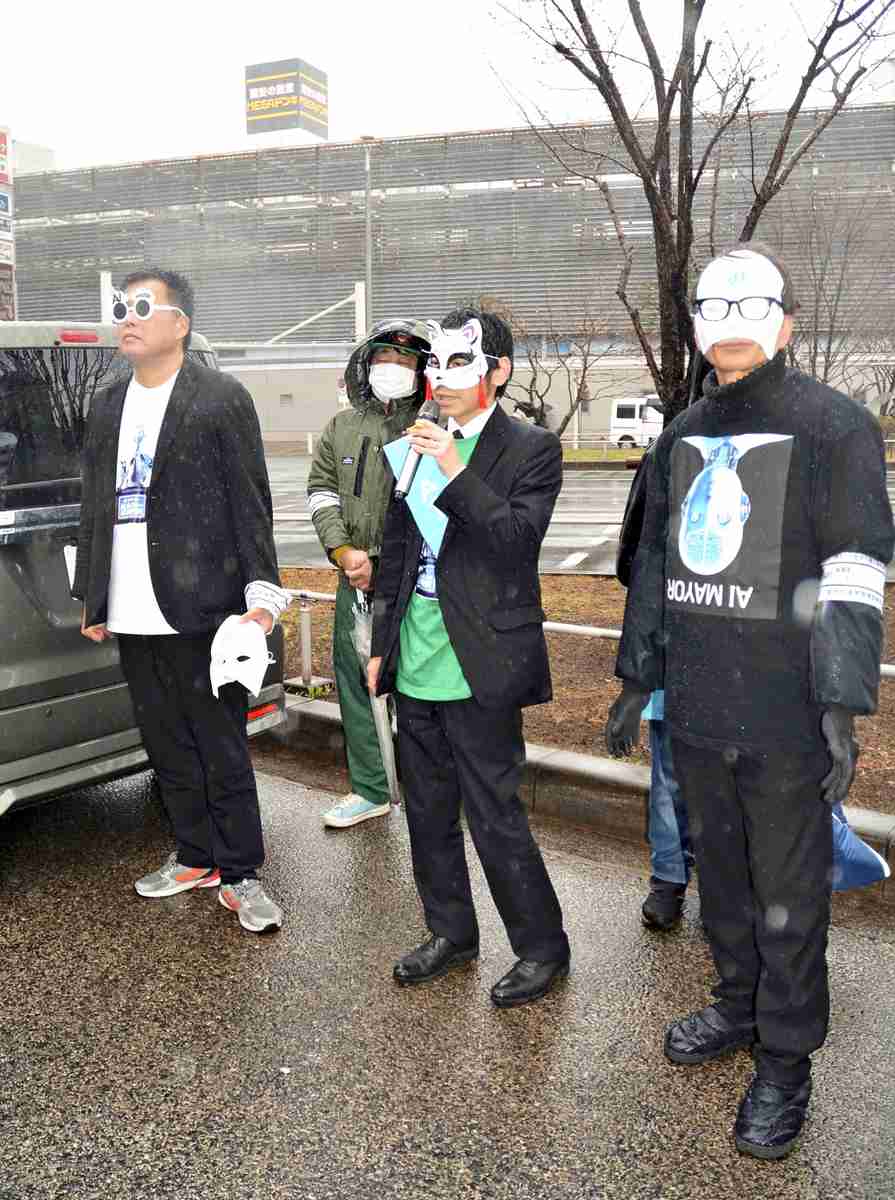
AI Mayor Nigo (No. 2), center, delivers a street campaign speech for a city assembly election in Koganei, Tokyo, on March 16.
10:26 JST, May 4, 2025
Twelve years have passed since the lifting of a ban on using the internet for election campaigning in Japan, and unanticipated forms of political activity using social media to exploit flaws in the election system are rampant, including candidates who are only identified by their aliases. This is the first installment in a series of articles that examines the challenges faced by the nation’s election system, which has been criticized as outdated.
***
On March 16, following the announcement of a city assembly election in Koganei, Tokyo, a candidate calling himself “AI Mayor Nigo (No. 2)” delivered a speech near JR Musashi-Koganei Station.
“My name is AI Mayor Nigo, and I’m not telling you who I am or where I’m from,” the candidate, whose face was concealed by a mask, told passersby.
His name is derived from another person called AI Mayor: the leader of the AI Party, a political organization that supported the candidate during the election campaign.
The passersby had puzzled expressions on their faces as they watched the strange scene.
AI Mayor Nigo had previously run in a different city assembly election using his real name. It was a bitter experience, as his family members were strongly opposed to his candidacy.
Eventually, he started to think about running again. That was when an AI Party catchphrase caught his attention: “You can run in elections without disclosing your name, face or job.”
Under the Public Offices Election Law, an application to run in an election will not be accepted by the election administration commission unless the candidate uses the name they have registered in the family register system.
However, if the commission recognizes that the candidate’s alias is more widely known than their real name, the candidate is permitted to use it in the election.
In August last year, AI Mayor Nigo made an account on X under his alias following advice from the party leader. He then got the name AI Mayor Nigo included in a sports newspaper after the paper ran an article about his appearance at a press conference. With that, he submitted an application to run in the election as AI Mayor Nigo.
Before the announcement of the start of the campaigning period, he had posted only about a dozen messages on his X account and had only about 30 followers.
Nevertheless, the city’s election administration commission allowed him to use the alias, saying that the name AI Mayor Nigo was more widely known than his real name.
“People all over the world can see his X account,” said an official of the commission. “We couldn’t insist that his alias was less known than his real name, so it was difficult to turn down his request.”
AI Mayor Nigo ended up failing to win a seat in the election. Undeterred, the AI Party went on to support a different candidate in another city’s mayoral election. That candidate also did not disclose his real name, running instead as AI Mayor Yongo (No. 4).
“I’ve received inquiries from about 300 people who want to run in elections anonymously,” said the leader of the party. “I want to keep on fielding candidates until we get to 100.”
Numbers as a aliases
A similar issue has occurred in the past.
In a 1963 House of Representatives election, 27 people ran in electoral districts in Tokyo and Chiba Prefecture using aliases that included numbers ranging from one to 27, resulting in such names as Eighteen Takada (or Eighteen Takata) and Twenty-Seven Tsukada.
The candidates were referred to as “uniform number candidates.”
The Diet at that time criticized a political group alleged to have “let people with odd names run in the election, an abuse of the rule allowing aliases to be used.”
In 1964, the year following that troublesome election, the enforcement ordinance of the Public Offices Election Law was revised to include stipulations for the first time about the use of aliases. The revision states that a candidate’s alias can be used if it is more widely known than their real name and clarifies election commissions’ procedures for putting them on the ballot. The aim of the revision was to eliminate a repeat of the abuse of aliases in elections.
For years, aliases have been used in elections by a limited range of people, such as former sports stars, like Antonio Inoki, entertainers and those who go by their maiden names.
But with the spread of social media, the stance of many election administration commissions is starting to change.
Nowadays, it has become common for an ordinary citizen to use an alias for their social media handle, and a user can casually interact with many people without ever meeting them in person.
As a result, an increasing number of candidates are demanding permission to run in elections under their aliases, insisting they are better known by their social media handles than their real names.
If election commissions do not allow the use of aliases, they may be sued for infringing on the potential candidates’ freedom to run in elections.
“People’s awareness about privacy has risen and made society more tolerant of anonymity, so election administration commissions tend to easily allow aliases to be used,” said Takushoku University Prof. Kazunori Kawamura, an expert in political studies.
Traceability of politicians
There are also candidates who use different names each time they run in an election.
A man who had served for one term as a city assembly member using his real name ran in last year’s Tokyo gubernatorial election using his social media handle.
If a candidate changes their name, voters lose an opportunity to know the kind of political thinking and credentials the candidate exhibited in previous activities.
Fukushima Gakuin University Prof. Go Seon Gyu, an expert in studies on participation in politics, said candidates in South Korea are obliged to use their real names in elections.
Even very famous people who are primarily known by their aliases can only display the aliases in brackets beside their real names on election posters and other media.
“If candidates are allowed to use their aliases too easily, voters will be unable to cast their ballots based on accurate information,” Prof. Go said. “Politicians represent ordinary citizens, so a voter’s right to be informed should be prioritized over [a candidate’s] privacy.”








Most Read
Popular articles in the past 24 hours
-

Tokyo Spends Big on Children, Wins Over Parents
-
Japan’s Miura, Kihara Announce Withdrawal from Figure Skating Wor...
-

Japan's Opposition Parties Largely Absent from Social Security-Re...
-
Tourists Ignore Safety Barriers Near Famous Zao ‘Snow Monsters’ i...
-
Showa-era Towers in Kansai’s Big Cities Become Social Media Sensa...
-

Tokyo’s ‘Strawberry War’ Intensifies as Producers Vie to Become ‘...
-

Neil Sedaka, The Singer-Songwriter Behind Dozens of Hits of The 1...
-

Fukui: Effort to Grow Bananas in Snow Bears Fruit; Japanese Farme...
Popular articles in the past week
-

Producer Behind Pop Group XG Arrested for Cocaine Possession
-

Nepal Bus Crash Kills 19 People, Injures 25 Including One Japanes...
-

Tokyo Skytree's Elevator Stops, Trapping 20 People; All Rescued (...
-
Milano Cortina 2026: Japanese Gold Medalist Figure Skater Miura S...
-

Japan’s Major Real Estate Firms Expanding Overseas Businesses to ...
-

Reciprocal Tariffs Ruled Illegal: Judiciary Would Not Tolerate Pr...
-

Milano Cortina 2026: Miura-Kihara Duo, Other Japanese Figure Skat...
-
6 Injured at Naked Festival in Japan’s Okayama Prefecture; Police...
Popular articles in the past month
-
Producer Behind Pop Group XG Arrested for Cocaine Possession
-

Japan PM Takaichi’s Cabinet Resigns en Masse
-

Man Infected with Measles Reportedly Dined at Restaurant in Tokyo...
-

Israeli Ambassador to Japan Speaks about Japan’s Role in the Reco...
-

Videos Plagiarized, Reposted with False Subtitles Claiming ‘Ryuky...
-

Man Infected with Measles May Have Come in Contact with Many Peop...
-

Prudential Life Insurance Plans to Fully Compensate for Damages C...
-

Woman with Measles Visited Hospital in Tokyo Multiple Times Befor...
Top Articles in Society
-
Producer Behind Pop Group XG Arrested for Cocaine Possession
-
Man Infected with Measles Reportedly Dined at Restaurant in Tokyo Station
-
Man Infected with Measles May Have Come in Contact with Many People in Tokyo, Went to Store, Restaurant Around When Symptoms Emerged
-
Woman with Measles Visited Hospital in Tokyo Multiple Times Before Being Diagnosed with Disease
-
Australian Woman Dies After Mishap on Ski Lift in Nagano Prefecture
JN ACCESS RANKING
-
Producer Behind Pop Group XG Arrested for Cocaine Possession
-
Japan PM Takaichi’s Cabinet Resigns en Masse
-
Man Infected with Measles Reportedly Dined at Restaurant in Tokyo Station
-
Israeli Ambassador to Japan Speaks about Japan’s Role in the Reconstruction of Gaza
-
Videos Plagiarized, Reposted with False Subtitles Claiming ‘Ryukyu Belongs to China’; Anti-China False Information Also Posted in Japan