
In Japan, Embalming Becoming More Common Practice as Relatives Desire Final Opportunity to See Loved Ones
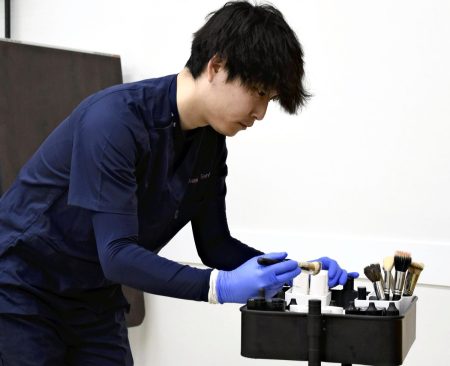
Yoshihiro Naoshima uses a mortuary makeup kit in Kanazawa on Aug. 8.
13:36 JST, September 22, 2025
Embalming the deceased is increasingly common in Japan, and experts say far more trained professionals are needed.
The procedure uses a combination of disinfection, preservation and cosmetic restoration, offering families one more opportunity to see their loved one as they were in life.
“It is our duty to restore the deceased’s likeness,” said Yoshihiro Naoshima, a 33-year-old embalmer at Hokuriku Embalming Service in Kanazawa who has handled around 1,500 cases.
While Naoshima was in the final year of high school, his father, 42, died suddenly from an aortic dissection. This tragedy ultimately spurred his decision to enter the funeral industry.
Unable to accept the reality of his father’s death, he had found comfort from a funeral home employee who took the time to listen to him talk about his father. The experience left a lasting impression on him, and he realized that being involved in funerals meant supporting people emotionally and spiritually.
Naoshima joined a funeral company in Osaka at the age of 23.
An experience that left a strong impression on Naoshima as an embalmer was the case of a mother of two who had died after being hit by a car. Her body was severely damaged, with multiple facial wounds and fractures. The father was reluctant to let his two young children see their mother in that condition.
Naoshima used cotton and other materials to restore the shape of the face. He sutured the wounds, making sure that the stitches could not be seen, and smoothed out the texture of the skin.
The father wept when he saw the body, telling Naoshima: “I’m so glad I can let my children see her. Thank you.”
The two children quietly placed letters addressed “To Mom” inside the casket.
This experience for Naoshima affirmed him in his role as an embalmer. “I have a responsibility to ensure that the bereaved have no regrets about their final farewell,” he said.
According to the International Funeral Science Association in Japan (IFSA), the number of embalming cases in Japan first exceeded 10,000 in fiscal 2000, up from 191 in fiscal 1988 when the first facility was established. This increase was partly due to the attention embalming received after the 1995 Great Hanshin Earthquake.
The number surged to 53,041 in fiscal 2020 amid the COVID-19 pandemic, as it helped prevent the transmission of viruses to family members. By fiscal 2024, the number had further climbed to 82,068, and the number of facilities had increased from 48 to 90 in just 10 years.
However, there is still a shortage of practicing embalmers. To become certified, one must either attend a two-year vocational school and pass the IFSA certification exam or obtain a license overseas.
As of April, the number of actively working embalmers stood at just 237, out of a total of 350 people who are certified. “Considering the number of [embalming] procedures, we ideally need twice as many people,” IFSA Secretary General Yuji Kato said.
“Embalming allows the bereaved to say their final goodbyes for as long as they need to. It also helps people cope with their sadness,” Naoshima said.
According to the Health, Labor and Welfare Ministry, the number of deaths in Japan reached about 1.576 million in 2023, a 50% increase over 20 years. In Ishikawa Prefecture, the number of deaths followed this trend — rising from about 10,000 in 2003 to about 15,000 in 2023.







Most Read
Popular articles in the past 24 hours
-
Milano Cortina 2026: Japanese Gold Medalist Figure Skater Miura S...
-

Yokohama to Test Out Renewable-Powered Offshore Floating Data Cen...
-
Ishinomaki Man Plush Toy Offers Hope to Children in Times of Disa...
-
Japan Authorities Begin On-site Inspection of Japanese Microsoft ...
-

Nikkei Tops 59,000 for First Time
-

Microsoft Japan Raided by Antitrust Watchdog for Allegedly Blocki...
-
Japan Eyes Introducing Prescreening System for Foreign Travelers,...
-

Dodgers' Roki Sasaki Erratic in First Spring Training Outing, Giv...
Popular articles in the past week
-

Producer Behind Pop Group XG Arrested for Cocaine Possession
-

iPS Treatments Pass Key Milestone, but Broader Applications Far f...
-

Japan, U.S. Name 3 Inaugural Investment Projects; Reached Agreeme...
-
Tokyo Skytree's Elevator Stops, Trapping 20 People; All Rescued (...
-

Japan’s Major Real Estate Firms Expanding Overseas Businesses to ...
-
Milano Cortina 2026: Japanese Gold Medalist Figure Skater Miura S...
-

Baby Monkey Punch Captures Hearts at Chiba Pref. Zoo, on Social M...
-

Nepal Bus Crash Kills 19 People, Injures 25 Including One Japanes...
Popular articles in the past month
-
Producer Behind Pop Group XG Arrested for Cocaine Possession
-

Japan PM Takaichi’s Cabinet Resigns en Masse
-

Japan Institute to Use Domestic Commercial Optical Lattice Clock ...
-

Man Infected with Measles Reportedly Dined at Restaurant in Tokyo...
-

Israeli Ambassador to Japan Speaks about Japan’s Role in the Reco...
-

Videos Plagiarized, Reposted with False Subtitles Claiming ‘Ryuky...
-

Man Infected with Measles May Have Come in Contact with Many Peop...
-

Prudential Life Insurance Plans to Fully Compensate for Damages C...
Top Articles in Society
-
Producer Behind Pop Group XG Arrested for Cocaine Possession
-
Man Infected with Measles Reportedly Dined at Restaurant in Tokyo Station
-
Man Infected with Measles May Have Come in Contact with Many People in Tokyo, Went to Store, Restaurant Around When Symptoms Emerged
-

Woman with Measles Visited Hospital in Tokyo Multiple Times Before Being Diagnosed with Disease
-

Australian Woman Dies After Mishap on Ski Lift in Nagano Prefecture
JN ACCESS RANKING
-
Producer Behind Pop Group XG Arrested for Cocaine Possession
-
Japan PM Takaichi’s Cabinet Resigns en Masse
-
Man Infected with Measles Reportedly Dined at Restaurant in Tokyo Station
-
Israeli Ambassador to Japan Speaks about Japan’s Role in the Reconstruction of Gaza
-
Videos Plagiarized, Reposted with False Subtitles Claiming ‘Ryukyu Belongs to China’; Anti-China False Information Also Posted in Japan