
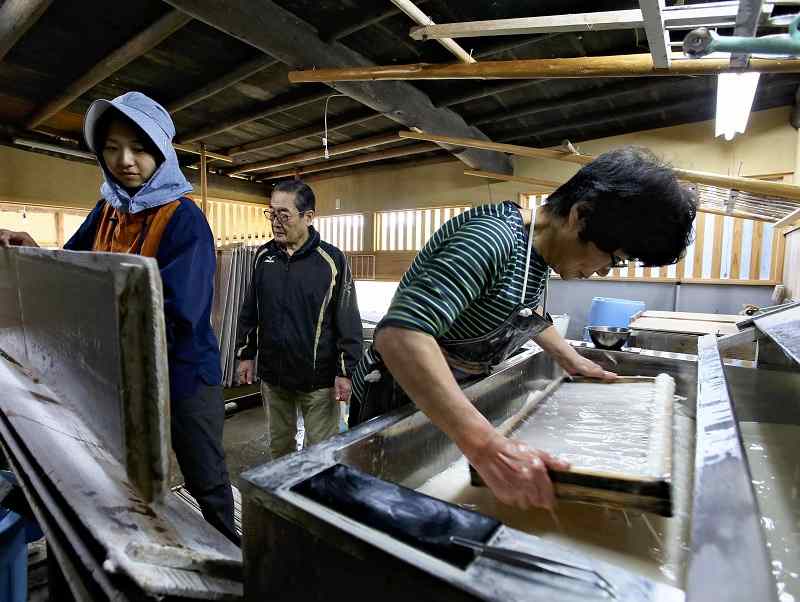
Artisans screen handmade “Misugami,” a traditional Japanese paper used to repair cultural properties, in Yoshino, Nara Prefecture in 2020.
12:20 JST, June 7, 2021
The Cultural Affairs Agency plans to step up efforts to protect a trove of precious paintings, Buddhist statuary, and archival manuscripts from the ravages of age and natural disasters, through an initiative that aims to equip a new generation of conservators with the tools to preserve the nation’s ancient cultural properties for posterity from next fiscal year, it has been learned
Dubbed the “Takumi Project,” the two-pronged initiative calls for the stockpiling of material needed for the restoration of cultural properties and the training of a cohort of “takumi” (artisans) in the traditional techniques that are essential for the artefacts’ upkeep and repair.
Over 30 skilled craftspeople in the Kansai region will be tapped as “restoration examiners” to lead the training program.
Greater support for the production of traditional materials used in restoration will also be provided under the plan, which calls for expansion of the scope of government grants from the current five to a total of 25 niche industries, including turban shells and nikawa glue, by fiscal 2024.
The agency also hopes to establish a “center for the preservation and repair of decorative arts,” within the premises of the Kyoto National Museum. Envisioned as a world-class nexus for restoration, the center will be tasked with furthering instruction in the repair of cultural properties, as well as materials research. In preparation for floods and other natural disasters, the center will also be equipped with a state-of-the-art industrial vacuum drier capable of rescuing large artefacts from water damage. The agency will demand survey expenses for the center in the next fiscal year’s budget.
The plans coincide with the Cultural Affairs Agency’s own upcoming relocation to Kyoto next fiscal year. From its new perch in the old capital, the agency aims to retool conservation efforts by partnering more closely with institutional stewards, including the Imperial Household Agency’s Sannomaru Shozokan (Museum of the Imperial Collections) in Tokyo, which houses treasures passed down through the imperial household, from generation to generation.





Most Read
Popular articles in the past 24 hours
-
Business Hotels Expanding into Regional Areas in Japan, Aiming to...
-
6 Injured at Naked Festival in Japan’s Okayama Prefecture; Police...
-

Fiji Defense Minister Hopes Japan Will Support Stabilization of P...
-

Space One Delays Launch of No. 3 Kairos Rocket; Company to Announ...
-

Milano Cortina 2026: Malinin Highlights Dangers of Social Media i...
-

Reciprocal Tariffs Ruled Illegal: Judiciary Would Not Tolerate Pr...
-
3rd Japan Pacific Islands Defense Dialogue to Begin in Tokyo on S...
-

Japanese Film, Anymart, Wins Critics’ Award at International Film...
Popular articles in the past week
-

Japan PM Takaichi’s Cabinet Resigns en Masse
-

Man Infected with Measles Reportedly Dined at Restaurant in Tokyo...
-

Sanae Takaichi Elected Prime Minister of Japan; Keeps All Cabinet...
-
Japan's Govt to Submit Road Map for Growth Strategy in March, PM ...
-

Bus Carrying 40 Passengers Catches Fire on Chuo Expressway; All E...
-

Milano Cortina 2026: Figure Skaters Riku Miura, Ryuichi Kihara Pa...
-

Japan, U.S. Name 3 Inaugural Investment Projects; Reached Agreeme...
-

U.S. Firm to Build Training Hub in Fukushima N-plant for Debris R...
Popular articles in the past month
-
Japan PM Takaichi’s Cabinet Resigns en Masse
-

Japan Institute to Use Domestic Commercial Optical Lattice Clock ...
-

Israeli Ambassador to Japan Speaks about Japan’s Role in the Reco...
-
Man Infected with Measles Reportedly Dined at Restaurant in Tokyo...
-

Videos Plagiarized, Reposted with False Subtitles Claiming ‘Ryuky...
-

Man Infected with Measles May Have Come in Contact with Many Peop...
-

Prudential Life Insurance Plans to Fully Compensate for Damages C...
-

Woman with Measles Visited Hospital in Tokyo Multiple Times Befor...
Top Articles in Society
-
Man Infected with Measles Reportedly Dined at Restaurant in Tokyo Station
-
Man Infected with Measles May Have Come in Contact with Many People in Tokyo, Went to Store, Restaurant Around When Symptoms Emerged
-
Woman with Measles Visited Hospital in Tokyo Multiple Times Before Being Diagnosed with Disease
-
Australian Woman Dies After Mishap on Ski Lift in Nagano Prefecture
-
Foreign Snowboarder in Serious Condition After Hanging in Midair from Chairlift in Nagano Prefecture
JN ACCESS RANKING
-
Japan PM Takaichi’s Cabinet Resigns en Masse
-
Japan Institute to Use Domestic Commercial Optical Lattice Clock to Set Japan Standard Time
-
Israeli Ambassador to Japan Speaks about Japan’s Role in the Reconstruction of Gaza
-
Man Infected with Measles Reportedly Dined at Restaurant in Tokyo Station
-
Videos Plagiarized, Reposted with False Subtitles Claiming ‘Ryukyu Belongs to China’; Anti-China False Information Also Posted in Japan