
Former Death Row Inmate Hakamata Files Damages Lawsuit Against Police, Presecutors, Courts
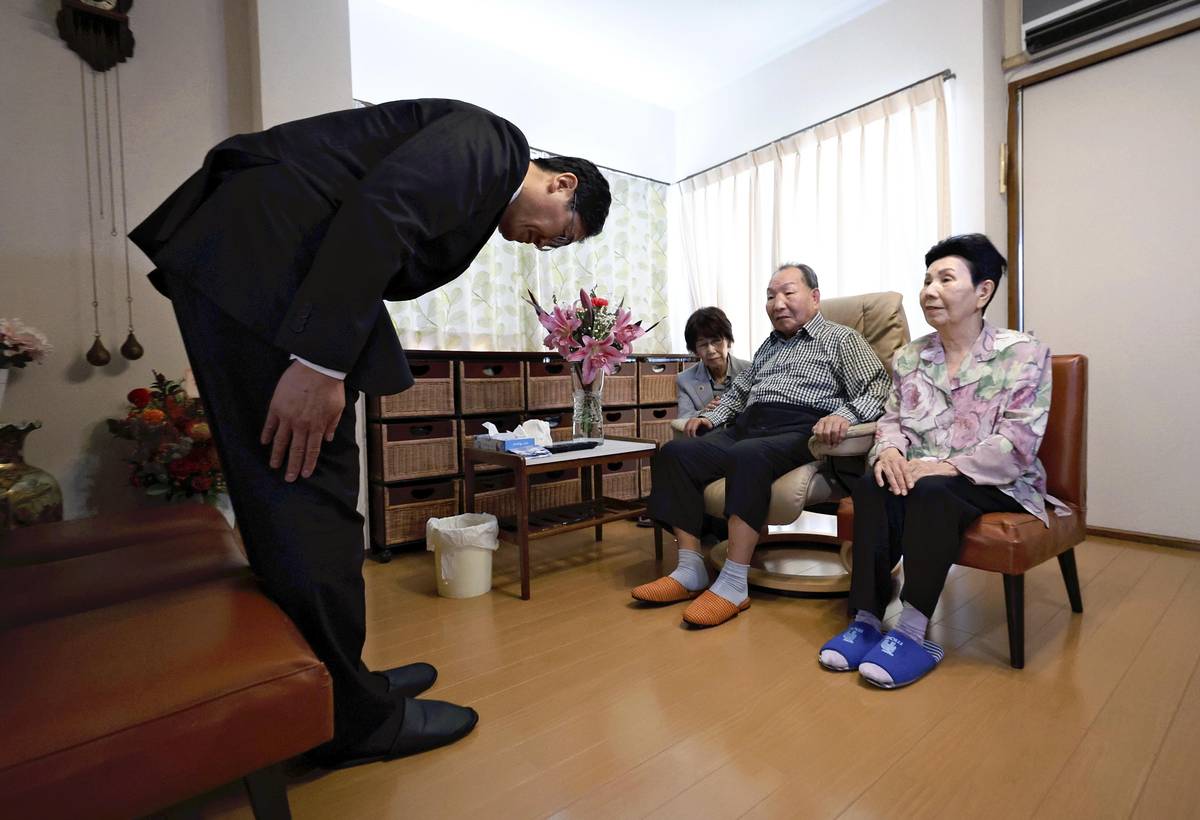
Takayoshi Tsuda, left, chief of the Shizuoka prefectural police, bows and apologizes to Iwao Hakamata, second from right, in Hamamatsu in October 2024.
17:59 JST, October 10, 2025
SHIZUOKA — Iwao Hakamata, a former death row inmate who was later acquitted in a retrial, filed a lawsuit on Thursday seeking damages from the central and prefectural governments.
Hakamata, 89, was sentenced to death for the 1966 murder of a family of four and was acquitted in a 2024 retrial. He is seeking ¥608 million in damages.
His defense team has said that they would pursue the illegality of the investigative authorities’ conduct. The behavior of the courts that issued the death sentence will also be pursued. Holding the judicially accountable is highly unusual.
According to the defense team, the claim is believed to be the largest ever filed in a state compensation lawsuit following a retrial that resulted in an acquittal.
Hakamata was arrested in 1966 by the Shizuoka prefectural police on suspicion of robbery and murder of four family members in the prefecture. His death sentence was finalized in 1980.
In retrial that took place in September 2024, the district court handed down a not guilty ruling, saying that three pieces of evidence, including five pieces of clothing that were said to have been worn at the time of the crime, “were fabricated by the investigative authorities.” The acquittal was finalized the month after on Oct. 9.
The complaint seeks to hold the police, prosecutors, and courts accountable for their illegal actions.
The defense team alleges that the police concealed facts linking the real culprit to the crime, deliberately neglected the investigation and fabricated evidence to frame Hakamata as the perpetrator. The police are also accused of attempting to coerce a confession by conducting daily interrogations lasting an average of 12 hours and by using intimidation through fear of continued detention if he denied the allegations.
Regarding the prosecutors, the complaint alleges collusion with the police to coerce Hakamata into making a false confession. Prosecutors are accused of indicting him despite recognizing, or being easily able to recognize the police’s fabrications.
The complaint also alleges that the Shizuoka District Court, which initially issued the death sentence, committed “gross negligence” by failing to thoroughly examine the pieces of clothing, despite the clear possibility they had been fabricated.
The complaint further concludes that both the Tokyo High Court and the Supreme Court also committed “gross negligence” by failing to correct the district court’s erroneous judgment.
“We will review the contents of the complaint and respond appropriately,” an official of the Shizuoka prefectural police said.
The Shizuoka District Public Prosecutors Office, the Shizuoka District Court, and the Supreme Court all said that they would refrain from comment.






Most Read
Popular articles in the past 24 hours
-

McDonald's Japan Raises Prices; Big Mac to Cost ¥500, Double Chee...
-

Nepal Bus Crash Kills 19 People, Injures 25 Including One Japanes...
-

Japan’s Nikkei Stock Average Rises as AI-Related Stocks Shine; Co...
-

Aggression against Ukraine: Malignant Precedent Must Not Be Set t...
-
Joruri Bunraku Narrative Performed in Honor of Donald Keene by La...
-

Early-Blooming Kawazu Cherry Blossoms Create Sea of Pink at Park ...
-

Astellas Collaborates with Vir to Develop Its Experimental Prosta...
-

Kanto's 1st Spring Wind Blows as Tokyo Sees Unseasonably High Tem...
Popular articles in the past week
-

Producer Behind Pop Group XG Arrested for Cocaine Possession
-

Japan PM Takaichi’s Cabinet Resigns en Masse
-

Sanae Takaichi Elected Prime Minister of Japan; Keeps All Cabinet...
-

Japan's Govt to Submit Road Map for Growth Strategy in March, PM ...
-

Bus Carrying 40 Passengers Catches Fire on Chuo Expressway; All E...
-

Japan, U.S. Name 3 Inaugural Investment Projects; Reached Agreeme...
-

Riku-Ryu Pair Wins Gold Medal: Their Strong Bond Leads to Major C...
-

iPS Treatments Pass Key Milestone, but Broader Applications Far f...
Popular articles in the past month
-
Producer Behind Pop Group XG Arrested for Cocaine Possession
-
Japan PM Takaichi’s Cabinet Resigns en Masse
-

Japan Institute to Use Domestic Commercial Optical Lattice Clock ...
-

Man Infected with Measles Reportedly Dined at Restaurant in Tokyo...
-

Israeli Ambassador to Japan Speaks about Japan’s Role in the Reco...
-

Videos Plagiarized, Reposted with False Subtitles Claiming ‘Ryuky...
-

Man Infected with Measles May Have Come in Contact with Many Peop...
-

Prudential Life Insurance Plans to Fully Compensate for Damages C...
Top Articles in Society
-
Producer Behind Pop Group XG Arrested for Cocaine Possession
-
Man Infected with Measles Reportedly Dined at Restaurant in Tokyo Station
-
Man Infected with Measles May Have Come in Contact with Many People in Tokyo, Went to Store, Restaurant Around When Symptoms Emerged
-

Woman with Measles Visited Hospital in Tokyo Multiple Times Before Being Diagnosed with Disease
-
Australian Woman Dies After Mishap on Ski Lift in Nagano Prefecture
JN ACCESS RANKING
-
Producer Behind Pop Group XG Arrested for Cocaine Possession
-
Japan PM Takaichi’s Cabinet Resigns en Masse
-
Man Infected with Measles Reportedly Dined at Restaurant in Tokyo Station
-
Israeli Ambassador to Japan Speaks about Japan’s Role in the Reconstruction of Gaza
-
Videos Plagiarized, Reposted with False Subtitles Claiming ‘Ryukyu Belongs to China’; Anti-China False Information Also Posted in Japan