
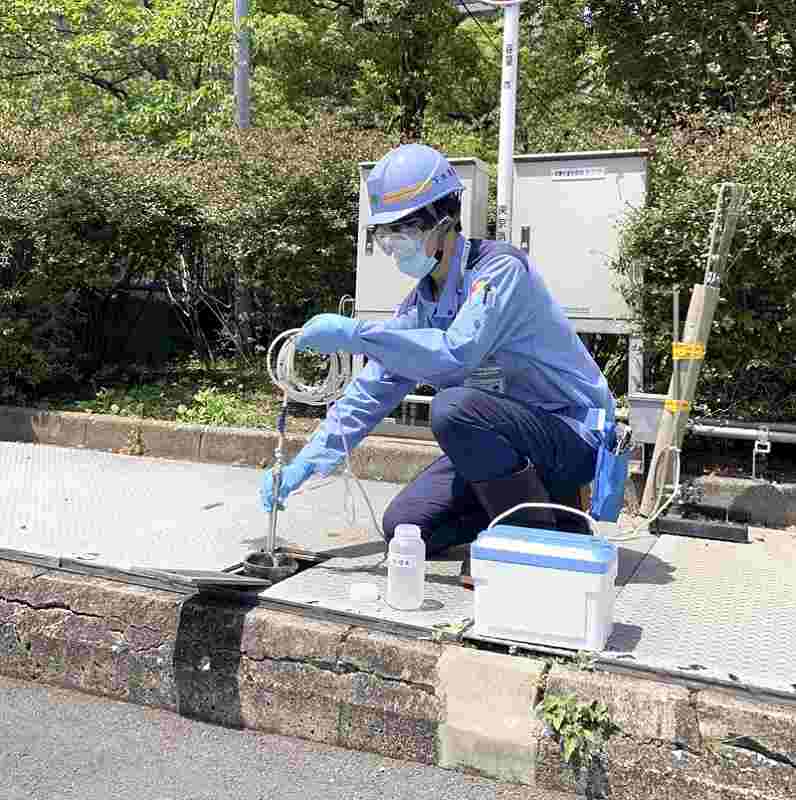
A Tokyo metropolitan government employee collects sewage water to check for the presence of the novel coronavirus in May 2020.
15:57 JST, June 3, 2022
The government will launch a major pilot project this summer to monitor the presence of the novel coronavirus in sewage, aiming to develop an early-warning system to detect the spread of the virus and implement effective pandemic measures.
Testing will be conducted at about 40 test sites at facilities nationwide, including wastewater treatment plants, schools and elderly care homes. As coronavirus can be detected in the feces of infected people, by checking virus levels in the sewage system, it is possible to determine the infection situation in a particular region or location.
Wastewater surveillance, which does not require testing people individually, can also be used to detect asymptomatic cases, making it possible to swiftly mitigate the spread of infections and the emergence of clusters.
However, such monitoring has yet to become fully established because the accuracy of results is dependent on various factors, including the volume of sewage and the sampling duration.
According to the Cabinet Secretariat, more applications than expected were received from entities that wished to participate. It plans to narrow down the candidates from the applications received so far.
In the pilot project, data will be collected at wastewater treatment plants to determine the number of infections per week and the infection trends in the respective areas. If the virus is detected in wastewater at facilities such as schools and care homes, follow-up PCR tests will be conducted to check the consistency of results from sewage surveillance.
Such methods have already been utilized to monitor COVID-19 cases in countries including the United States and the Netherlands.
In Japan, however, sewage surveillance is still in the testing phase, with projects being conducted by universities, local governments and companies. A research group comprising Tohoku University and other entities posts weekly estimates of infection cases in Sendai. The group tests sewage samples collected from a wastewater treatment plant in the city and uses a calculation method to predict the number of infection cases.
In the week ending May 29, 1,786 coronavirus cases were officially confirmed in Sendai. According to estimates released by the group, sewage surveillance indicated that there could have been as many as 2,172 cases in the city that week.







Most Read
Popular articles in the past 24 hours
-
Japan's Budget on Track for Quick Passage, but Ruling Parties to ...
-

Japan-Based USS Tripoli, Marine Unit to Be Sent to Middle East, U...
-
7 Men Arrested Over Robbery of ¥423 Mil. on Tokyo Street; Members...
-
Ransomware Attacks Hitting Japan's Small, Midsize Firms
-

National Intelligence Council: Proposed Body Must Be Utilized To ...
-

‘Kokuho’ Wins Record 10 Awards at Japan Academy Film Prize; Demon...
-

North Korea Fires about 10 Missiles toward Sea in Show of Force, ...
-

Milano Cortina 2026: Japan’s Daichi Oguri Wins Silver in Pa...
Popular articles in the past week
-

Japan Figure Skating Legend Yuzuru Hanyu Is Proud Disaster Surviv...
-
Govt to Utilize ODA for Ensuring Economic Security; Securing Ener...
-
15 Measles Patients Confirmed in Tokyo in Past 6 Days; 1 May Have...
-
Massive Sewer Pipe Found Jutting Out of Highway in Osaka
-
Japan Govt to Tighten Requirements to Receive Permanent Residency...
-
Power Outage Forces About 980 Passengers in Yokohama to Walk to T...
-
JR Tokai Breaks Ground on Yamanashi Maglev Station; Will Be Part ...
-

Beckoning Cats Get Makeover to Fit Modern Lifestyles with Sleek D...
Popular articles in the past month
-

Producer Behind Pop Group XG Arrested for Cocaine Possession
-

Japan PM Takaichi’s Cabinet Resigns en Masse
-

Man Infected with Measles Reportedly Dined at Restaurant in Tokyo...
-
Japan Figure Skating Legend Yuzuru Hanyu Is Proud Disaster Surviv...
-

iPS Treatments Pass Key Milestone, but Broader Applications Far f...
-

Sanae Takaichi Elected Prime Minister of Japan; Keeps All Cabinet...
-

South Korea Tightens Rules on Foreigners Buying Homes in Seoul Me...
-

Nepal Bus Crash Kills 19 People, Injures 25 Including One Japanes...
Top Articles in Society
-
Producer Behind Pop Group XG Arrested for Cocaine Possession
-
Man Infected with Measles Reportedly Dined at Restaurant in Tokyo Station
-
15 Measles Patients Confirmed in Tokyo in Past 6 Days; 1 May Have Come into Contact with Many in Shibuya
-

Bus Carrying 40 Passengers Catches Fire on Chuo Expressway; All Evacuate Safely
-

Ibaraki Pref.’s 1st Foreign Bus Driver Hired in Tsukuba
JN ACCESS RANKING
-
Producer Behind Pop Group XG Arrested for Cocaine Possession
-
Japan PM Takaichi’s Cabinet Resigns en Masse
-
Man Infected with Measles Reportedly Dined at Restaurant in Tokyo Station
-
Japan Figure Skating Legend Yuzuru Hanyu Is Proud Disaster Survivor and Gold Medalist, Vows to Continue Support Efforts
-
iPS Treatments Pass Key Milestone, but Broader Applications Far from Guaranteed