
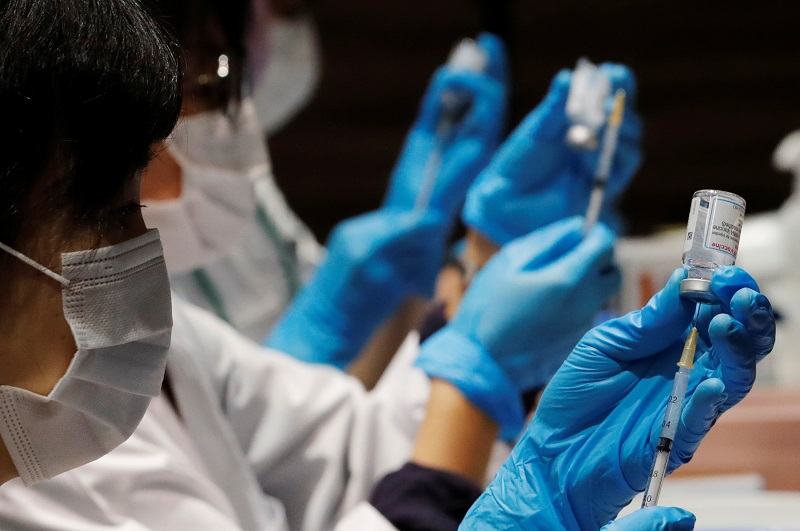
Healthcare workers prepare doses of the Moderna coronavirus disease (COVID-19) vaccine before administering them to staffers of Japan’s supermarket group Aeon at the company’s shopping mall in Chiba, Japan, on June 21, 2021.
11:50 JST, June 3, 2022
A study in Japan found that women were significantly more likely than men to develop rash-like side effects after a first dose of Moderna Inc’s COVID-19 vaccine.
The study of 5,893 participants between May and November last year showed that 22.4% of women developed delayed skin reactions after the first shot, compared to 5.1% of men.
The symptoms were mild and not considered a contraindication of the mRNA-based vaccine, according to the June 1 report in JAMA Dermatology.
Delayed skin reactions, happening on or after six days from the shot, have been also reported as a rare adverse event in the United States and Europe, according to the authors from Tokyo’s Self-Defense Forces Central Hospital.
But the incidences appear to be higher in Japan, they wrote, perhaps because of a higher awareness of such symptoms in the country. The greater likelihood among women may be due to differences in weight as well as hormonal and environmental factors, they said.
Moderna representatives in the United States and Japan did not immediately respond to a request for comment.








Most Read
Popular articles in the past 24 hours
-
Japan's Budget on Track for Quick Passage, but Ruling Parties to ...
-

Japan-Based USS Tripoli, Marine Unit to Be Sent to Middle East, U...
-

7 Men Arrested Over Robbery of ¥423 Mil. on Tokyo Street; Members...
-

Ransomware Attacks Hitting Japan's Small, Midsize Firms
-

National Intelligence Council: Proposed Body Must Be Utilized To ...
-

‘Kokuho’ Wins Record 10 Awards at Japan Academy Film Prize; Demon...
-

North Korea Fires about 10 Missiles toward Sea in Show of Force, ...
-

Milano Cortina 2026: Japan’s Daichi Oguri Wins Silver in Pa...
Popular articles in the past week
-

Japan Figure Skating Legend Yuzuru Hanyu Is Proud Disaster Surviv...
-
Govt to Utilize ODA for Ensuring Economic Security; Securing Ener...
-
15 Measles Patients Confirmed in Tokyo in Past 6 Days; 1 May Have...
-
Massive Sewer Pipe Found Jutting Out of Highway in Osaka
-

Japan Govt to Tighten Requirements to Receive Permanent Residency...
-
Power Outage Forces About 980 Passengers in Yokohama to Walk to T...
-
JR Tokai Breaks Ground on Yamanashi Maglev Station; Will Be Part ...
-

Beckoning Cats Get Makeover to Fit Modern Lifestyles with Sleek D...
Popular articles in the past month
-

Producer Behind Pop Group XG Arrested for Cocaine Possession
-

Japan PM Takaichi’s Cabinet Resigns en Masse
-

Man Infected with Measles Reportedly Dined at Restaurant in Tokyo...
-
Japan Figure Skating Legend Yuzuru Hanyu Is Proud Disaster Surviv...
-

iPS Treatments Pass Key Milestone, but Broader Applications Far f...
-

Sanae Takaichi Elected Prime Minister of Japan; Keeps All Cabinet...
-

South Korea Tightens Rules on Foreigners Buying Homes in Seoul Me...
-

Nepal Bus Crash Kills 19 People, Injures 25 Including One Japanes...
Top Articles in Society
-
Producer Behind Pop Group XG Arrested for Cocaine Possession
-
Man Infected with Measles Reportedly Dined at Restaurant in Tokyo Station
-
15 Measles Patients Confirmed in Tokyo in Past 6 Days; 1 May Have Come into Contact with Many in Shibuya
-

Bus Carrying 40 Passengers Catches Fire on Chuo Expressway; All Evacuate Safely
-

Ibaraki Pref.’s 1st Foreign Bus Driver Hired in Tsukuba
JN ACCESS RANKING
-
Producer Behind Pop Group XG Arrested for Cocaine Possession
-
Japan PM Takaichi’s Cabinet Resigns en Masse
-
Man Infected with Measles Reportedly Dined at Restaurant in Tokyo Station
-
Japan Figure Skating Legend Yuzuru Hanyu Is Proud Disaster Survivor and Gold Medalist, Vows to Continue Support Efforts
-
iPS Treatments Pass Key Milestone, but Broader Applications Far from Guaranteed