
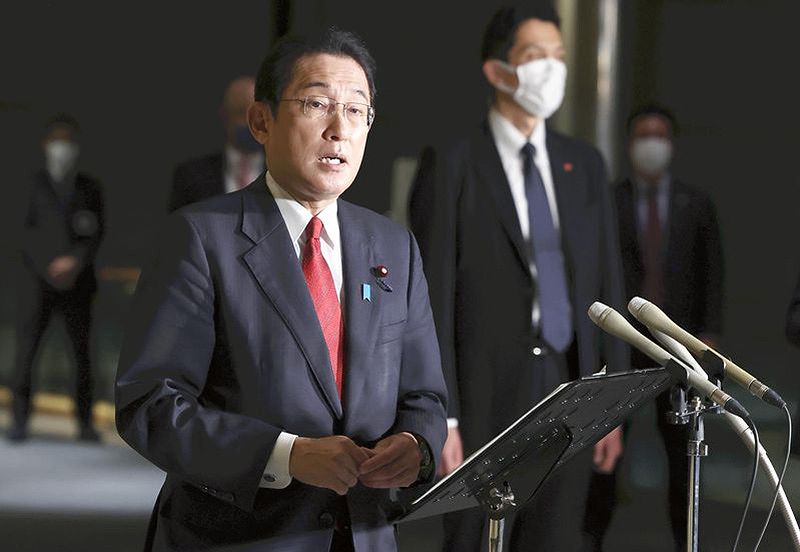
Prime Minister Fumio Kishida speaks at the Prime Minister’s Office in Tokyo on Friday.
14:50 JST, December 18, 2021
Medical workers and senior citizens will be offered COVID-19 booster shots six to seven months after their second shot as part of efforts to mitigate the spread of the omicron coronavirus variant.
Under current rules, boosters are being offered to certain groups eight months after the second dose. The policy, which Prime Minister Fumio Kishida announced on Friday, will shorten the interval for about 31 million people, including medical workers and senior citizens.
Booster shots will be offered after six months to medical workers, hospital inpatients, residents of elderly facilities, and daycare facility users and staff — comprising about 14.73 million people. All other senior citizens — comprising about 16.72 million — will be offered boosters after seven months from February.
Local governments were notified of the policy on Friday.
The government wants municipalities to make effective use of the about 8.9 million doses they have in stock. It will also deliver an additional 5 million doses of the Moderna vaccine to help expedite the booster campaign.
On Friday, Kishida indicated U.S. pharmaceutical company Merck & Co.’s molnupiravir oral coronavirus treatment will be made available to medical institutions by the end of this year if approved by the Health, Labor and Welfare Ministry’s expert panel, which is expected to make a decision on Dec. 24.
“We have already secured 1.6 million doses,” he said.
The prime minister also revealed that a basic agreement was reached on the supply of 2 million doses of a drug developed by Pfizer Inc. in a telephone conversation with the U.S. pharmaceutical giant’s Chief Executive Officer Albert Bourla on Friday.
Kishida said the government is preparing to implement free virus testing nationwide for people who cannot be vaccinated due to health factors or other reasons. The government is aiming for the service to be launched by the end of this year and the tests will not require reservations.
The prime minister said he would “do his utmost to ensure that the measures do not strain the medical system.”







Most Read
Popular articles in the past 24 hours
-
Japan's Budget on Track for Quick Passage, but Ruling Parties to ...
-

Japan-Based USS Tripoli, Marine Unit to Be Sent to Middle East, U...
-

Ransomware Attacks Hitting Japan's Small, Midsize Firms
-
7 Men Arrested Over Robbery of ¥423 Mil. on Tokyo Street; Members...
-

North Korea Fires about 10 Missiles toward Sea in Show of Force, ...
-

German Journalist Traces Footsteps of Great-Grandfather Who Was P...
-

Hiroshima: Yamato Museum to Reopen on April 23 after Major Renova...
-
CARTOON OF THE DAY (March 14)
Popular articles in the past week
-

Japan Figure Skating Legend Yuzuru Hanyu Is Proud Disaster Surviv...
-
Govt to Utilize ODA for Ensuring Economic Security; Securing Ener...
-
15 Measles Patients Confirmed in Tokyo in Past 6 Days; 1 May Have...
-
Massive Sewer Pipe Found Jutting Out of Highway in Osaka
-
Japan Govt to Tighten Requirements to Receive Permanent Residency...
-
Power Outage Forces About 980 Passengers in Yokohama to Walk to T...
-
JR Tokai Breaks Ground on Yamanashi Maglev Station; Will Be Part ...
-

Beckoning Cats Get Makeover to Fit Modern Lifestyles with Sleek D...
Popular articles in the past month
-

Producer Behind Pop Group XG Arrested for Cocaine Possession
-

Japan PM Takaichi’s Cabinet Resigns en Masse
-

Man Infected with Measles Reportedly Dined at Restaurant in Tokyo...
-
Japan Figure Skating Legend Yuzuru Hanyu Is Proud Disaster Surviv...
-

iPS Treatments Pass Key Milestone, but Broader Applications Far f...
-

Sanae Takaichi Elected Prime Minister of Japan; Keeps All Cabinet...
-

South Korea Tightens Rules on Foreigners Buying Homes in Seoul Me...
-

Nepal Bus Crash Kills 19 People, Injures 25 Including One Japanes...
Top Articles in Society
-
Producer Behind Pop Group XG Arrested for Cocaine Possession
-
Man Infected with Measles Reportedly Dined at Restaurant in Tokyo Station
-
15 Measles Patients Confirmed in Tokyo in Past 6 Days; 1 May Have Come into Contact with Many in Shibuya
-

Bus Carrying 40 Passengers Catches Fire on Chuo Expressway; All Evacuate Safely
-

Ibaraki Pref.’s 1st Foreign Bus Driver Hired in Tsukuba
JN ACCESS RANKING
-
Producer Behind Pop Group XG Arrested for Cocaine Possession
-
Japan PM Takaichi’s Cabinet Resigns en Masse
-
Man Infected with Measles Reportedly Dined at Restaurant in Tokyo Station
-
Japan Figure Skating Legend Yuzuru Hanyu Is Proud Disaster Survivor and Gold Medalist, Vows to Continue Support Efforts
-
iPS Treatments Pass Key Milestone, but Broader Applications Far from Guaranteed