
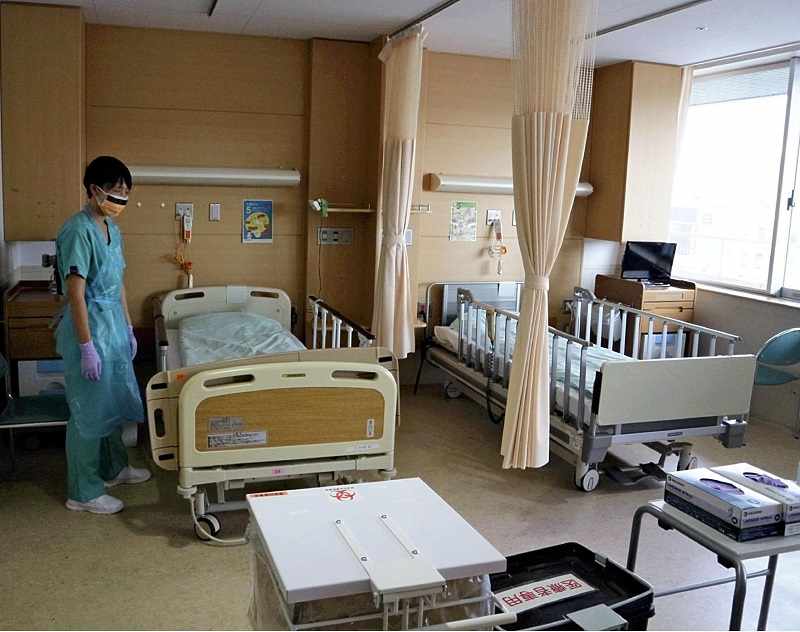
Beds for coronavirus patients are seen at a hospital in Shizuoka City.
16:57 JST, October 17, 2021
Over 34,000 people in Japan could require hospitalization in a “sixth” wave of novel coronavirus infections, according to estimates made by the Health, Labor and Welfare Ministry based on the virus countermeasures presented by the government on Friday.
The ministry estimates that accommodating these patients will require about 42,000 hospital beds — 5,000 more beds than were secured during the fifth wave of infections this summer in Tokyo and 16 other prefectures.
In light of this shortage, the ministry has asked each prefectural government to reassess within this month the number of hospital beds capacity for COVID patients and to set aside more beds as necessary.
To support the prefectures, the ministry will also for the first time request that the National Hospital Organization (140 hospitals) and the Japan Community Health Care Organization (57 hospitals) secure enough hospital beds under the National Hospital Organization Law and other laws.
As the fifth wave of infections surged over the summer, some communities were unable to secure enough beds in time, forcing many patients in need of hospitalization to recuperate at home.
To avoid such a situation and prepare for the next wave, the government has concluded that a capacity to accept admitted patients “1.2 times greater than during the fifth wave” will be needed.
The fifth wave peaked with 28,446 COVID patients either hospitalized or awaiting hospitalization. As such, the ministry projects that hospitals will need to be able to treat up to 34,135 admitted patients during a sixth wave.
But hospitals will require slightly more beds than the actual number of patients, in order to smoothly accommodate their intake.
In a scenario with 80% occupancy rates, the ministry projects that 42,669 beds should be secured nationwide for the sixth wave.
When compared with the fifth wave’s peak on Sept. 15, this means a combined total of 4,996 more beds will need to be secured in 17 prefectures, including Tokyo and Osaka.
But some hospitals have said it would be difficult for them to secure more beds in line with the ministry’s request.
The charters governing the National Hospital Organization and the Japan Community Health Care Organization allow the health minister to request the organizations to carry out tasks deemed necessary in the event of a serious public health crisis.
The ministry plans to request the organizations see to it that more beds are secured for COVID-19 patients at their affiliated hospitals.





Most Read
Popular articles in the past 24 hours
-

National Intelligence Council: Proposed Body Must Be Utilized To ...
-
Japan's Defense Ministry: North Korea Appears to Have Fired Balli...
-
North Korea Fires about 10 Missiles toward Sea in Show of Force, ...
-

Milano Cortina 2026: Japan’s Daichi Oguri Wins Silver in Pa...
-

‘Kokuho’ Wins Record 10 Awards at Japan Academy Film Prize; Demon...
-

Aichi Fisheries Cooperatives Use Smart Tech to Farm Triploid Oyst...
-

CARTOON OF THE DAY (March 14)
-
Japan's Lower House Passes Budget Proposal; Could Be Delayed in U...
Popular articles in the past week
-

Japan Figure Skating Legend Yuzuru Hanyu Is Proud Disaster Surviv...
-
Govt to Utilize ODA for Ensuring Economic Security; Securing Ener...
-
15 Measles Patients Confirmed in Tokyo in Past 6 Days; 1 May Have...
-
Massive Sewer Pipe Found Jutting Out of Highway in Osaka
-
Japan Govt to Tighten Requirements to Receive Permanent Residency...
-
JR Tokai Breaks Ground on Yamanashi Maglev Station; Will Be Part ...
-
Power Outage Forces About 980 Passengers in Yokohama to Walk to T...
-

Beckoning Cats Get Makeover to Fit Modern Lifestyles with Sleek D...
Popular articles in the past month
-

Producer Behind Pop Group XG Arrested for Cocaine Possession
-

Japan PM Takaichi’s Cabinet Resigns en Masse
-

Man Infected with Measles Reportedly Dined at Restaurant in Tokyo...
-
Japan Figure Skating Legend Yuzuru Hanyu Is Proud Disaster Surviv...
-

iPS Treatments Pass Key Milestone, but Broader Applications Far f...
-

Sanae Takaichi Elected Prime Minister of Japan; Keeps All Cabinet...
-
South Korea Tightens Rules on Foreigners Buying Homes in Seoul Me...
-

Nepal Bus Crash Kills 19 People, Injures 25 Including One Japanes...
Top Articles in Society
-
Producer Behind Pop Group XG Arrested for Cocaine Possession
-
Man Infected with Measles Reportedly Dined at Restaurant in Tokyo Station
-
15 Measles Patients Confirmed in Tokyo in Past 6 Days; 1 May Have Come into Contact with Many in Shibuya
-

Bus Carrying 40 Passengers Catches Fire on Chuo Expressway; All Evacuate Safely
-

Ibaraki Pref.’s 1st Foreign Bus Driver Hired in Tsukuba
JN ACCESS RANKING
-
Producer Behind Pop Group XG Arrested for Cocaine Possession
-
Japan PM Takaichi’s Cabinet Resigns en Masse
-
Man Infected with Measles Reportedly Dined at Restaurant in Tokyo Station
-
Japan Figure Skating Legend Yuzuru Hanyu Is Proud Disaster Survivor and Gold Medalist, Vows to Continue Support Efforts
-
iPS Treatments Pass Key Milestone, but Broader Applications Far from Guaranteed