
Japan Institute to Use Domestic Commercial Optical Lattice Clock to Set Japan Standard Time
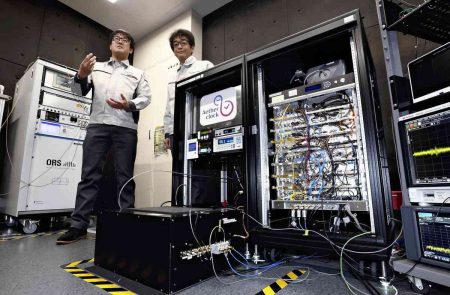
The Aetherclock, developed by Shimadzu Corp. as an optical lattice clock for commercial use
7:00 JST, January 28, 2026
An optical lattice clock, which is only off by one second every 10 billion years, will be used to decide Japan Standard Time, The Yomiuri Shimbun has learned.
The National Institute of Information and Communications Technology (NICT), a state-run research and development agency that decides Japan Standard Time, will introduce an optical lattice clock domestically produced for the commercial use by the end of this year at the earliest. The clock will be used to correct errors in the standard time.
Optical lattice clocks were originally invented in Japan. The clocks measure time by vibrating a large number of atoms trapped in laser lattices. They are regarded as the world’s most accurate, off by only one second every 10 billion years.
Prof. Hidetoshi Katori of the University of Tokyo, who devised the principle of the mechanism, is considered a candidate for a Nobel Prize.
The clock to be used by the institute was developed by Shimadzu Corp., based in Kyoto.
Maintaining accurate time measurement is essential for information communications and financial transactions that use the internet. Currently, Japan Standard Time is decided mainly by cesium atomic clocks, as international organizations use that kind of clock to define the length of one second.
However, cesium clocks experience lags of 20 nanoseconds about every month. One nanosecond is 1 billionth of a second.
Therefore, the NICT will correct the time lag with the optical lattice clock, which is more than 100 times more accurate than a cesium atomic clock. This will reduce the time lag to less than a quarter of its current state.
The NICT will use the world’s first commercial-purpose optical lattice clock — named Aetherclock, it was jointly developed by Katori, Shimadzu Corp. and other partners. The clock is about one meter high and about one meter wide, and weighs about 200 kilograms.
Since 2012, the institute has corrected Japan Standard Time with an optical lattice clock that it developed on its own. It will introduce the commercial-purpose clock developed by Shimadzu at a price of about ¥400 million.
The NICT will strengthen its backup system in case of mechanical trouble by utilizing both clocks, so it can always decide and provide Japan Standard Time with extreme accuracy.
Optical lattice clocks are expected to be used for a wide range of purposes.
According to Albert Einstein’s general theory of relativity, time passes more slowly in lower places that are more strongly affected by gravity than in high places. Optical lattice clocks can measure even very minimal time gaps that are caused by differences in altitudes. Research is actively conducted to apply the technology to observing crustal movements and land surveys.
“By correcting Japan Standard Time and other efforts, I want to show the world that this technology can have practical applications,” said Tetsuya Ido, director of the Space-Time Standards Laboratory of the NICT.
Japan Standard Time is nine hours earlier than the Coordinated Universal Time, which is decided by the International Bureau of Weights and Measures in France every month. Japan Standard Time is based on the time at 135 degrees east longitude, which passes through Akashi in Hyogo Prefecture.







Most Read
Popular articles in the past 24 hours
-

Ransomware Attacks Hitting Japan's Small, Midsize Firms
-

German Journalist Traces Footsteps of Great-Grandfather Who Was P...
-

10 Foreign Tourists Sustain Injuries After Fire at Capsule Hotel ...
-

World Baseball Classic: Venezuela Beats Japan in Nail-biting Back...
-

Rapid Services on JR Chuo Line Suspended; Accident at Kokubunji S...
-

Rapid Services Resume on JR Chuo Line; Suspension Caused by Accid...
-

World Baseball Classic: Red Sox’s Abreu Hits 3-run Homer, Giving ...
-

World Baseball Classic: Venezuela Beats Japan in Back-and-Forth Q...
Popular articles in the past week
-

Japan Figure Skating Legend Yuzuru Hanyu Is Proud Disaster Surviv...
-
15 Measles Patients Confirmed in Tokyo in Past 6 Days; 1 May Have...
-

Massive Sewer Pipe Found Jutting Out of Highway in Osaka
-

Japan Govt to Tighten Requirements to Receive Permanent Residency...
-
Power Outage Forces About 980 Passengers in Yokohama to Walk to T...
-
JR Tokai Breaks Ground on Yamanashi Maglev Station; Will Be Part ...
-

Parents in Japan to Get Instagram Notifications When Teens Repeat...
-

'World's Oldest Bio-Business' Is Japan's Seed Koji Retailing, Mol...
Popular articles in the past month
-

Producer Behind Pop Group XG Arrested for Cocaine Possession
-

Japan PM Takaichi’s Cabinet Resigns en Masse
-

Man Infected with Measles Reportedly Dined at Restaurant in Tokyo...
-
Japan Figure Skating Legend Yuzuru Hanyu Is Proud Disaster Surviv...
-

iPS Treatments Pass Key Milestone, but Broader Applications Far f...
-

Sanae Takaichi Elected Prime Minister of Japan; Keeps All Cabinet...
-

South Korea Tightens Rules on Foreigners Buying Homes in Seoul Me...
-

Nepal Bus Crash Kills 19 People, Injures 25 Including One Japanes...
Top Articles in Science & Nature
-
iPS Treatments Pass Key Milestone, but Broader Applications Far from Guaranteed
-

Record 700 Startups to Gather at SusHi Tech Tokyo in April; Event Will Center on Themes Like Artificial Intelligence and Robotics
-
Parents in Japan to Get Instagram Notifications When Teens Repeatedly Search for Suicide Content
-

iPS Cell Products for Parkinson’s, Heart Disease OK’d for Commercialization by Japan Health Ministry Panel
-

Japan to Ban Use of Power Banks on Airplanes
JN ACCESS RANKING
-
Producer Behind Pop Group XG Arrested for Cocaine Possession
-
Japan PM Takaichi’s Cabinet Resigns en Masse
-
Man Infected with Measles Reportedly Dined at Restaurant in Tokyo Station
-
Japan Figure Skating Legend Yuzuru Hanyu Is Proud Disaster Survivor and Gold Medalist, Vows to Continue Support Efforts
-
iPS Treatments Pass Key Milestone, but Broader Applications Far from Guaranteed