
Facial Recognition Gains Traction, Driven by Seamless Payments; Security Concerns Still Remain
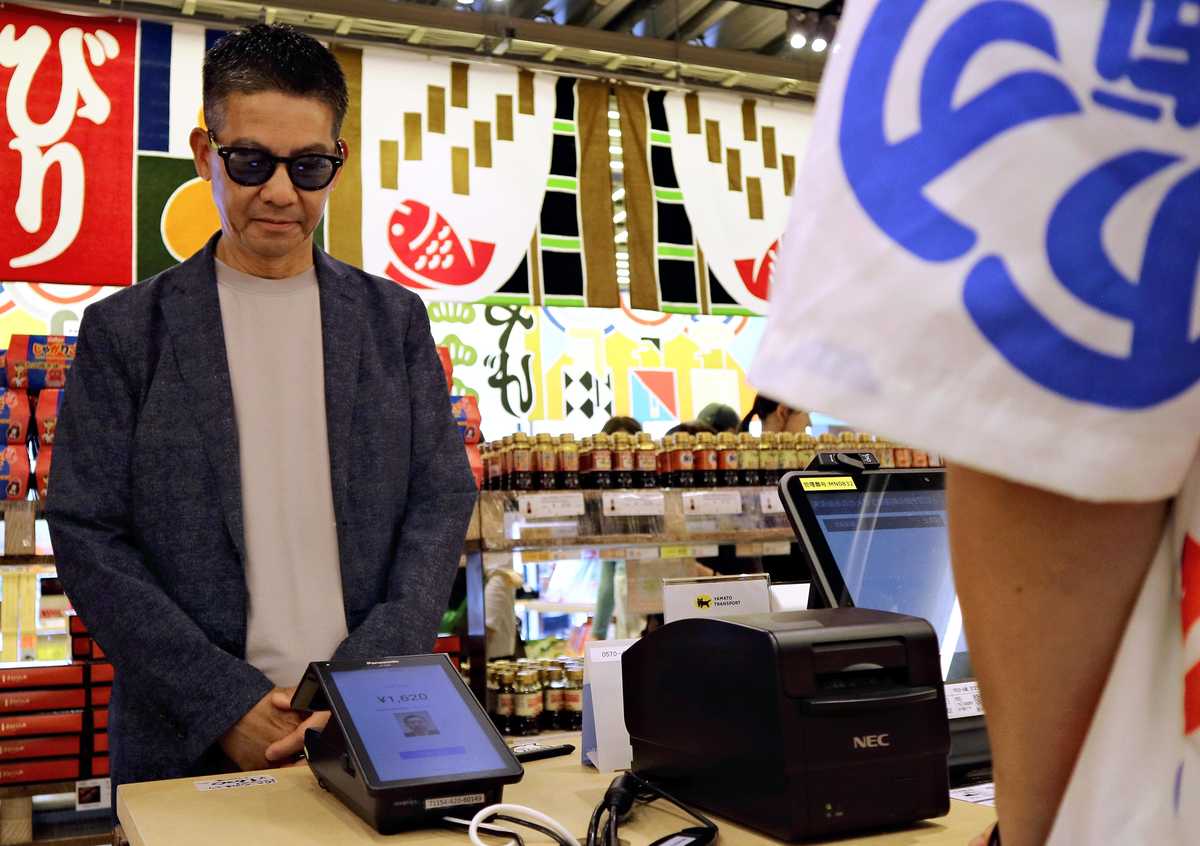
A customer pays using facial recognition, even while wearing sunglasses, at the Osaka-Kansai Expo in Osaka on June 9.
6:00 JST, July 12, 2025
Customers are increasingly able to conduct payment transactions simply by using their faces thanks to facial verification methods expanding into the financial sector.
Osaka-Kansai Expo is introducing a facial recognition authentication system at about 200 locations, including restaurants. Hundreds of thousands of people are expected to use the system by the time the Expo closes in October.
While facial recognition is now enabling deposits and withdrawals at certain bank ATMs, the broad adoption of this technology will likely hinge on the proliferation of security measures capable of detecting fraudulent transactions.
No need for wallet, smartphone
In early June, a man wearing sunglasses approached the cashier at the Ichibirian souvenir shop at the Expo venue and said, “I’ll pay using facial authentication.” After facing the camera attached to the payment terminal, the transaction was completed in about a second.
In order to make payments using facial authentication at the Expo venue, users are first required to register an image of their face and credit card information via the Expo’s smartphone app.
“I don’t need a wallet or smartphone. It’s revolutionary. We can make payments empty-handed,” said a man in his 20s from Osaka.
The president of the store’s operating company expressed his high hopes for the technology, saying: “This system cuts payment time to less than a quarter of what handling cash takes, significantly reducing the burden of cash management on stores. We hope more people will use this system.”
Since its introduction to the iPhone by Apple Inc. in 2017, facial authentication technology has become more commonplace. Since then, it has been used for immigration screening at airports and for staff access by major telecommunications companies such as SoftBank Corp. However, its use in payment transactions has largely been limited to small-scale pilot programs.
Tetsuya Yukutake, director at NEC Corp., which provides the facial authentication technology for the Expo venue, stated: “This is the first time the technology has been implemented in a place that sees a large amount of people.”
NEC aims to improve the service and encourage its adoption by collecting usage data from various stores with different environmental conditions, such as lighting intensity.
“With this system, we can create a world where both payments and earning points are handled seamlessly via facial recognition,” said Takeo Watanabe of Sumitomo Mitsui Card Co., which developed the payment terminal.
Security concerns
However, the adoption of this convenience comes with a significant psychological barrier to overcome — the worry that facial images captured during payment could be leaked, or that someone else could make payments without your knowledge.
According to NEC, the facial images captured during payment transactions are converted into numerical data, meaning that even if they were to be leaked, the individuals cannot be identified. However, there is a potential risk of impersonation by using deepfakes, which are sophisticated fake videos that are AI-generated.
To tackle the issue, a growing number of businesses are adopting multi-factor authentication, which uses multiple verification methods. For instance, even the highly accurate facial authentication payment system at the Expo requires a PIN entry if any doubt arises during verification.
Seven Bank Ltd. completed the introduction of a facial authentication system at ATMs nationwide in March. The system requires users to enter a pre-registered code or perform actions such as blinking.
“Given concerns about protecting personal information and the significant investment required for equipment, widespread adoption [of facial recognition payments] in general retail stores will likely face challenges,” said Prof. Kenya Fujiwara, an economics specialist at Kobe University. “However, its expansion is anticipated for identity verification at company cafeterias and events.”


Related Tags




Most Read
Popular articles in the past 24 hours
-

Ransomware Attacks Hitting Japan's Small, Midsize Firms
-

German Journalist Traces Footsteps of Great-Grandfather Who Was P...
-

10 Foreign Tourists Sustain Injuries After Fire at Capsule Hotel ...
-

World Baseball Classic: Venezuela Beats Japan in Nail-biting Back...
-

Rapid Services Resume on JR Chuo Line; Suspension Caused by Accid...
-

Rapid Services on JR Chuo Line Suspended; Accident at Kokubunji S...
-

World Baseball Classic: Venezuela Beats Japan in Back-and-Forth Q...
-

World Baseball Classic: Red Sox’s Abreu Hits 3-run Homer, Giving ...
Popular articles in the past week
-

Japan Figure Skating Legend Yuzuru Hanyu Is Proud Disaster Surviv...
-
15 Measles Patients Confirmed in Tokyo in Past 6 Days; 1 May Have...
-

Massive Sewer Pipe Found Jutting Out of Highway in Osaka
-
Japan Govt to Tighten Requirements to Receive Permanent Residency...
-

Power Outage Forces About 980 Passengers in Yokohama to Walk to T...
-

JR Tokai Breaks Ground on Yamanashi Maglev Station; Will Be Part ...
-
Parents in Japan to Get Instagram Notifications When Teens Repeat...
-
'World's Oldest Bio-Business' Is Japan's Seed Koji Retailing, Mol...
Popular articles in the past month
-

Producer Behind Pop Group XG Arrested for Cocaine Possession
-

Japan PM Takaichi’s Cabinet Resigns en Masse
-

Man Infected with Measles Reportedly Dined at Restaurant in Tokyo...
-
Japan Figure Skating Legend Yuzuru Hanyu Is Proud Disaster Surviv...
-

iPS Treatments Pass Key Milestone, but Broader Applications Far f...
-

Sanae Takaichi Elected Prime Minister of Japan; Keeps All Cabinet...
-

South Korea Tightens Rules on Foreigners Buying Homes in Seoul Me...
-

Nepal Bus Crash Kills 19 People, Injures 25 Including One Japanes...
Top Articles in Science & Nature
-
iPS Treatments Pass Key Milestone, but Broader Applications Far from Guaranteed
-
Record 700 Startups to Gather at SusHi Tech Tokyo in April; Event Will Center on Themes Like Artificial Intelligence and Robotics
-
Parents in Japan to Get Instagram Notifications When Teens Repeatedly Search for Suicide Content
-

iPS Cell Products for Parkinson’s, Heart Disease OK’d for Commercialization by Japan Health Ministry Panel
-

Japan to Ban Use of Power Banks on Airplanes
JN ACCESS RANKING
-
Producer Behind Pop Group XG Arrested for Cocaine Possession
-
Japan PM Takaichi’s Cabinet Resigns en Masse
-
Man Infected with Measles Reportedly Dined at Restaurant in Tokyo Station
-
Japan Figure Skating Legend Yuzuru Hanyu Is Proud Disaster Survivor and Gold Medalist, Vows to Continue Support Efforts
-
iPS Treatments Pass Key Milestone, but Broader Applications Far from Guaranteed