
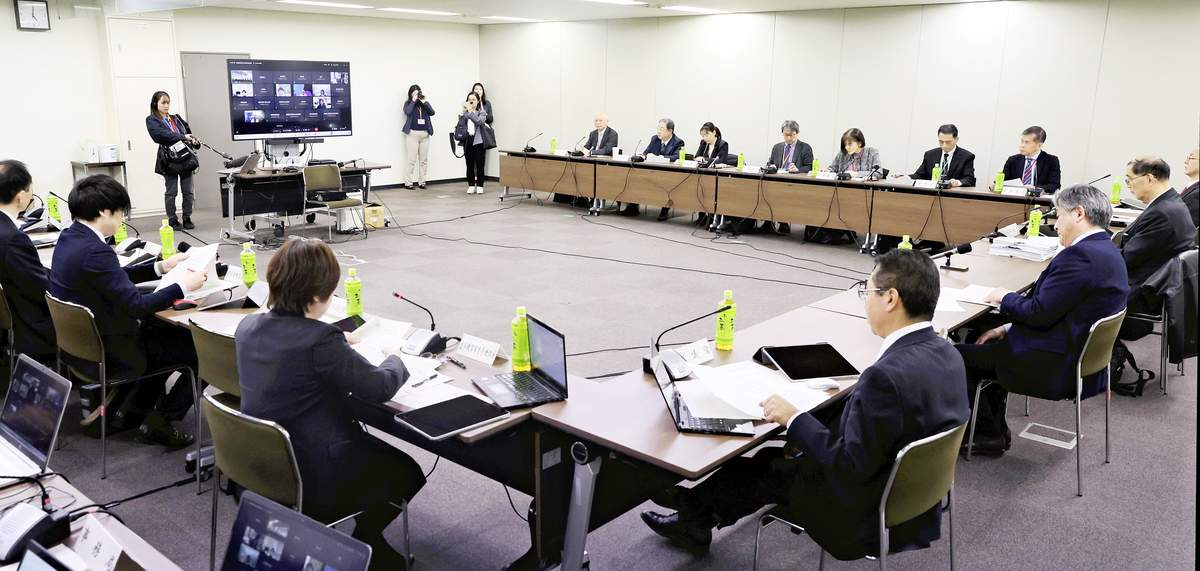
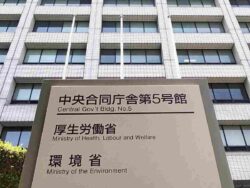
A government panel discusses the production and sale of medical products derived from stem cells in Chiyoda Ward, Tokyo, on Thursday.
7:00 JST, February 21, 2026
A health ministry panel has conditionally approved, for a limited time, two regenerative medical products derived from induced pluripotent stem (iPS) cells, a key milestone in the possible wider use and commercialization of iPS cell treatments.
Verification of the products’ efficacy is required before formal government approval can be given, and the cost of these products, likely to be exorbitant, is one issue that will need addressing.
The panel announced its decision Thursday. “The result of our deliberations is a major step forward,” said Kyoto University Prof. Atsushi Takahashi, director of the university’s Center for iPS Cell Research and Application. “We will make every effort to ensure these treatment methods become common options that are fully trusted as soon as possible.”
In April 2025, the university announced the results of a clinical trial in which nerve cells made from iPS cells had been transplanted into the brains of Parkinson’s disease patients. The transplants reportedly delivered results that conventional methods had never achieved, such as providing a patient, who had needed assistance to walk, with the ability to live on their own.
In August, major drugmaker Sumitomo Pharma Co. applied to the Health, Labor and Welfare Ministry for approval to produce and sell a product containing these nerve cells. Given that Sumitomo Pharma’s medical product was covered by the government’s screening system for innovative pharmaceutical products, the medicine cleared the screening in six months, rather than the usual one year. The product is called Amchepry.
Cuorips Inc., a startup originating from the University of Osaka, developed iPS cell-derived patches for treating serious heart disease. In April 2025, Cuorips applied for approval to manufacture and market this product, based on the findings of trials conducted by the university. Cuorips exhibited an iPS “heart,” which pulsed like a real heart, in a red liquid culture at the 2025 Osaka-Kansai Expo. The heart became one of the expo’s biggest attractions and suggested the practical application of such innovations was getting closer.
Obstacles to progress
Kyoto University Prof. Shinya Yamanaka developed iPS cells and was awarded the Nobel Prize in Physiology or Medicine in 2012 for this feat. Consequently, the government poured ¥110 billion into regenerative medicine research over 10 years from fiscal 2013. Some observers raised concerns that the transplanted cells could become cancerous, but advances have been made in this area. The world’s first iPS cell transplant for an eye disease patient was conducted in 2014, and 10 years later, it was confirmed that those cells had not turned cancerous. During this period, clinical research and trials were continuing on several diseases, and these treatments are increasingly ready for practical application.
Fujita Health University Prof. Yoshimi Yashiro, an expert on regenerative medicine and stem cell biology, said, “The fact that iPS cells, which didn’t exist on earth, have been commercialized in about 20 years is certainly a rapid development. Now that these first approvals have been issued, I think it’ll become easier for various companies to enter the sector and to attract more investment.”
Will iPS treatments take off?
The answer to that question could hinge on whether the makers of the two products given conditional and time-limited approval will reapply within seven years and gain formal approval.
The government can grant early approval, as conditional and time-limited approval is also known, for the manufacture and sale of products provided they are expected to be effective and are confirmed safe during clinical trials on a small number of patients — an exception for regenerative medicine products that would not apply to screenings for conventional products. This system aims to accelerate the practical use of treatments for diseases that only affect a few people. The manufacturer must verify the medicine’s effectiveness within seven years and reapply for government approval. Drugs that fail to gain formal approval can no longer be produced or sold.
To get formal approval, the sample size must be expanded from the several cases in early-stage approval up to dozens of cases. The treatment’s efficacy also must be demonstrated. However, the effects of regenerative medical products that use cells vary widely compared with regular drugs.
Fuzzy outlook for profits
The Kobe City Eye Hospital applied to have a treatment in which retinal cells made from iPS cells are transplanted into an eye designated as “advanced medical care,” which is partly covered by public medical insurance. However, this application was turned down last year, due in part to a lack of clear results indicating patients’ eyesight had recovered. The screening process for this treatment now has to restart from square one.
Some earlier cases, which did not involve iPS cells, offer hard lessons. In 2015, a regenerative medicail product, in which thigh muscle cells are cultivated and transplanted into a heart to treat serious heart disease, became the first to receive conditional and time-limited approval. This was based on results from seven clinical cases. However, the manufacturer was unable to gather enough cases to gain formal approval even though the deadline was extended by three years. In 2024, approval was suspended and sales of the product were halted.
Since fiscal 2016, Takeda Pharmaceutical Co. has injected ¥20 billion into joint research with Kyoto University’s iPS cell research center. However, Takeda has announced that it will terminate this funding at the end of this fiscal year. Businesses seem to be growing more reluctant to involve themselves with iPS cell treatments.
Regenerative medical products, which require cultivating cells and strict quality management, are typically expensive. One of the medicinal patches derived from thigh muscle cells cost ¥14.76 million, which was partially covered by public insurance.
Ryo Hanamura, a partner at the Tokyo office of major consultancy Arthur D. Little, is worried that costs will be a decisive factor in whether regenerative treatments using iPS cells can survive as an industry.
“Prices will be the biggest focus of attention,” said Hanamura, an expert on the pharmaceutical industry. “If the price is too low from a business’ perspective, subsequent companies won’t enter the market.”







Most Read
Popular articles in the past 24 hours
-

Milano Cortina 2026: Kaori Sakamoto Wins Silver, Ami Nakai Takes ...
-

Anonymous Individual Donates Gold Bars Worth ¥566 Mil. to Osaka M...
-
Approval of Takaichi Cabinet Stands at 73%; Yomiuri Survey Finds ...
-

New Japanese Animated Film ‘A New Dawn’ Applauded at Berlin Inter...
-

Ex-ROK President Yoon Gets Life Sentence: Declaration of Martial ...
-

Early-Blooming Cherry Blossoms Adorn Former Samurai Residences in...
-

CARTOON OF THE DAY (February 20)
-

Milano Cortina 2026: Sakamoto’s Final Olympic Skate Ends in...
Popular articles in the past week
-

Japan PM Takaichi’s Cabinet Resigns en Masse
-

Man Infected with Measles Reportedly Dined at Restaurant in Tokyo...
-

Videos Plagiarized, Reposted with False Subtitles Claiming ‘Ryuky...
-

Sanae Takaichi Elected 105th Prime Minister of Japan; Keeps All C...
-

Japan's Govt to Submit Road Map for Growth Strategy in March, PM ...
-

Milano Cortina 2026: Figure Skaters Riku Miura, Ryuichi Kihara Pa...
-

Bus Carrying 40 Passengers Catches Fire on Chuo Expressway; All E...
-

Tokyo’s New Record-Breaking Fountain Named ‘Tokyo Aqua Symphony’
Popular articles in the past month
-
Japan PM Takaichi’s Cabinet Resigns en Masse
-

Japan Institute to Use Domestic Commercial Optical Lattice Clock ...
-

Israeli Ambassador to Japan Speaks about Japan’s Role in the Reco...
-
Man Infected with Measles Reportedly Dined at Restaurant in Tokyo...
-

Man Infected with Measles May Have Come in Contact with Many Peop...
-
Videos Plagiarized, Reposted with False Subtitles Claiming ‘Ryuky...
-

Prudential Life Insurance Plans to Fully Compensate for Damages C...
-

Woman with Measles Visited Hospital in Tokyo Multiple Times Befor...
Top Articles in Science & Nature
-
Japan Institute to Use Domestic Commercial Optical Lattice Clock to Set Japan Standard Time
-
Japan to Face Shortfall of 3.39 Million Workers in AI, Robotics in 2040; Clerical Workers Seen to Be in Surplus
-
Record 700 Startups to Gather at SusHi Tech Tokyo in April; Event Will Center on Themes Like Artificial Intelligence and Robotics
-
iPS Cell Products for Parkinson’s, Heart Disease OK’d for Commercialization by Japan Health Ministry Panel
-

Japan to Ban Use of Power Banks on Airplanes
JN ACCESS RANKING
-
Japan PM Takaichi’s Cabinet Resigns en Masse
-
Japan Institute to Use Domestic Commercial Optical Lattice Clock to Set Japan Standard Time
-
Israeli Ambassador to Japan Speaks about Japan’s Role in the Reconstruction of Gaza
-
Man Infected with Measles Reportedly Dined at Restaurant in Tokyo Station
-
Man Infected with Measles May Have Come in Contact with Many People in Tokyo, Went to Store, Restaurant Around When Symptoms Emerged