

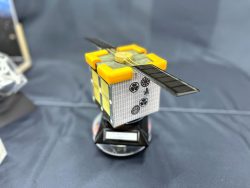
The Michibiki No. 6 satellite is unveiled to the media in November 2024.
21:00 JST, December 23, 2025
The failed launch on Monday of an H3 rocket, which was carrying the Michibiki No. 5 satellite, is a setback for Japan’s attempt to establish its own high-precision satellite positioning network.
The Michibiki satellite system, whose development has been led by the Cabinet Office, serves as Japan’s version of GPS, which is run by the United States.
The last satellite for the seven-unit array was set to be launched in February, with the government seeking full autonomy for positioning data. However, the launch failure means that timeline has been pushed back.
The Michibiki system consists of satellites that operate in two types of orbits: “quasi-zenith” orbits, which keep the satellites nearly directly above Japan for extended periods, and geostationary orbits over the equator, which make the satellites appear fixed in the sky to an observer on the ground.
With Michibiki, high-precision positioning data can be obtained with minimal errors, as signals are not obstructed by buildings and other ground-level structures.
Five Michibiki satellites are currently in service, including the No. 6 unit, which launched before the No. 5 unit. However, Japan needs seven satellites to achieve a fully independent, high-precision positioning system.
At present, the system must be supplemented with data from foreign satellites, including those used for GPS.
According to the Cabinet Office, Michibiki units 5, 6 and 7 can measure distances between satellites, allowing for even greater positioning accuracy.
These three satellites cost about ¥100 billion to develop in total. The seventh unit was scheduled to launch in February, with full operations set to begin in the next fiscal year.
The Self-Defense Forces also use these satellites for positioning data, which is vital to national security. The Cabinet Office is swiftly reviewing the cause of the launch failure and may revise the project’s master plan.






Most Read
Popular articles in the past 24 hours
-

Director Naomi Kawase's New Film Explores Heart Transplants in Ja...
-

Milano Cortina 2026: Japan’s Mari Fukada Wins Gold in Women’s Sno...
-

Japan’s Nikkei Stock Average Rises on Tech Rally and Takaichi's S...
-
Japanese Man Living in Iraq Suspected of Illegally Entering U.S. ...
-

Takaichi Expected to Express Desire for Constitutional Revision P...
-

Milano Cortina 2026: Snowboarding Star Fukada Wins Gold in Hard-F...
-

Mark Zuckerberg Quizzed on Kids' Instagram Use in Social Media Tr...
-

Security Services Law Unconstitutional: Do Not Restrict Career Ch...
Popular articles in the past week
-

Japan PM Takaichi’s Cabinet Resigns en Masse
-

Man Infected with Measles Reportedly Dined at Restaurant in Tokyo...
-

Videos Plagiarized, Reposted with False Subtitles Claiming ‘Ryuky...
-

Sanae Takaichi Elected 105th Prime Minister of Japan; Keeps All C...
-

Japan's Govt to Submit Road Map for Growth Strategy in March, PM ...
-

Milano Cortina 2026: Figure Skaters Riku Miura, Ryuichi Kihara Pa...
-
Tokyo’s New Record-Breaking Fountain Named ‘Tokyo Aqua Symphony’
-

Bus Carrying 40 Passengers Catches Fire on Chuo Expressway; All E...
Popular articles in the past month
-
Japan PM Takaichi’s Cabinet Resigns en Masse
-

Japan Institute to Use Domestic Commercial Optical Lattice Clock ...
-

Israeli Ambassador to Japan Speaks about Japan’s Role in the Reco...
-
Man Infected with Measles Reportedly Dined at Restaurant in Tokyo...
-

Man Infected with Measles May Have Come in Contact with Many Peop...
-

Prudential Life Insurance Plans to Fully Compensate for Damages C...
-
Videos Plagiarized, Reposted with False Subtitles Claiming ‘Ryuky...
-

Woman with Measles Visited Hospital in Tokyo Multiple Times Befor...
Top Articles in Science & Nature
-
Japan Institute to Use Domestic Commercial Optical Lattice Clock to Set Japan Standard Time
-
Japan to Face Shortfall of 3.39 Million Workers in AI, Robotics in 2040; Clerical Workers Seen to Be in Surplus
-
Record 700 Startups to Gather at SusHi Tech Tokyo in April; Event Will Center on Themes Like Artificial Intelligence and Robotics
-

Japan to Ban Use of Power Banks on Airplanes
JN ACCESS RANKING
-
Japan PM Takaichi’s Cabinet Resigns en Masse
-
Japan Institute to Use Domestic Commercial Optical Lattice Clock to Set Japan Standard Time
-
Israeli Ambassador to Japan Speaks about Japan’s Role in the Reconstruction of Gaza
-
Man Infected with Measles Reportedly Dined at Restaurant in Tokyo Station
-
Man Infected with Measles May Have Come in Contact with Many People in Tokyo, Went to Store, Restaurant Around When Symptoms Emerged