
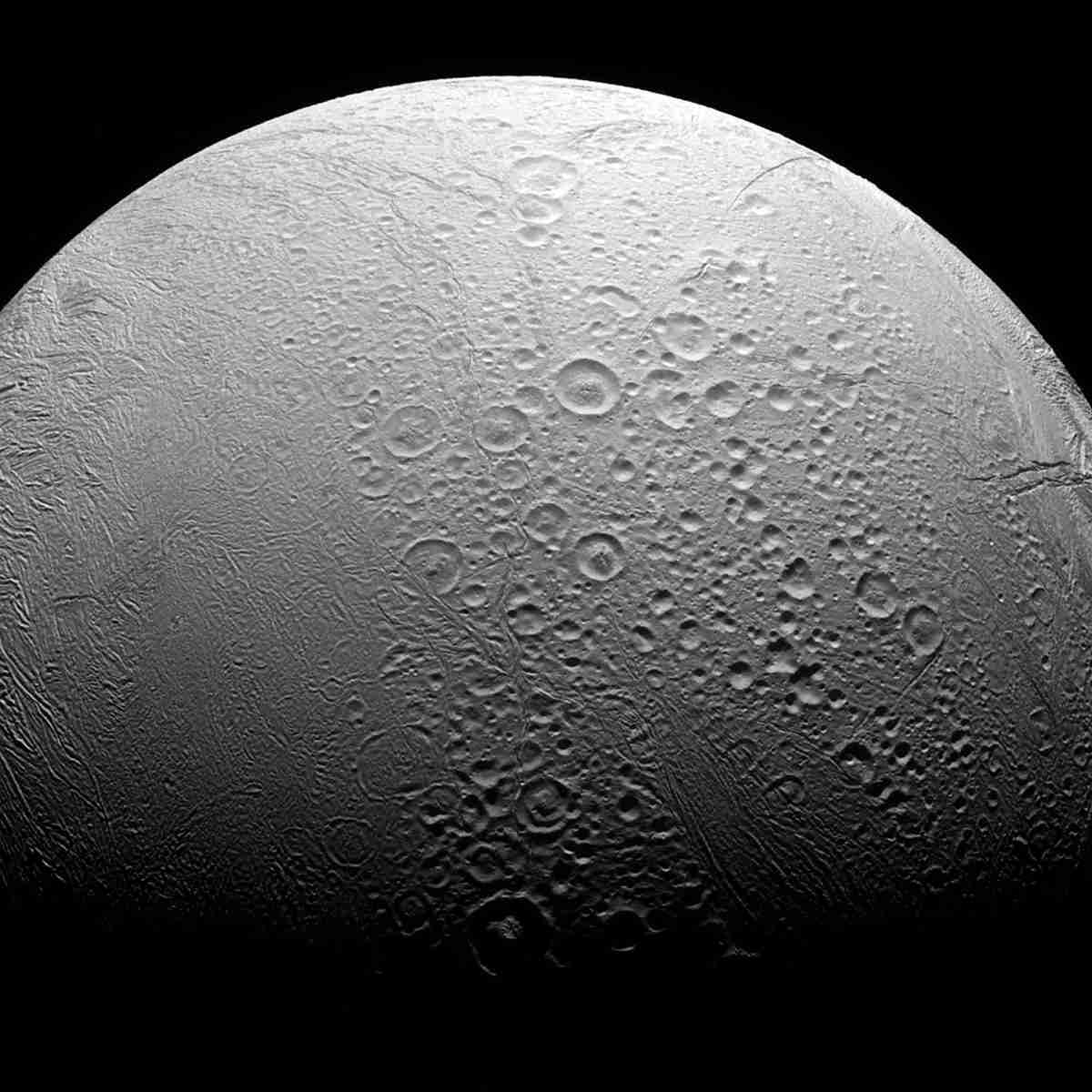
Saturn’s ocean-bearing moon Enceladus is seen in visible light with the Cassini spacecraft narrow-angle camera in November 2016.
16:28 JST, October 17, 2025
WASHINGTON (Reuters) — A fresh look at data collected by NASA’s Cassini spacecraft has uncovered more evidence that Saturn’s moon Enceladus may be able to support life, with additional complex organic molecules identified from the geyser-like jets of ice grains that spew into space from this small icy world’s subsurface ocean.
Researchers reexamined in great detail data obtained when Cassini conducted its closest flyby of Enceladus in 2008, including when it flew directly through plumes of ice grains and gases erupting from the ice-encrusted moon’s surface through fractures near its south pole. In doing so, they were able to gain a clearer picture of the moon’s subsurface chemistry.
In addition to confirming the presence of certain organic molecules, including precursors for amino acids — the building blocks of proteins, the large and complex molecules essential for life — previously detected in the plumes, they found new classes of organic molecules not spotted before.
“We have found several categories of organic — meaning primarily carbon-containing — molecules that span a range of structures and chemical properties,” said Nozair Khawaja, a planetary scientist at Freie Universitat Berlin and lead author of the study published recently in the journal Nature Astronomy.
These are the type of molecules that could be involved under the right circumstances in the processes leading to the formation of more complex organic compounds that are essential components for life.
“Such compounds are believed to be intermediates in the synthesis of more complex molecules, which could be potentially biologically relevant. It is important to note, however, that these molecules can be formed abiotically as well without any interaction with life on Earth,” Khawaja said.
Enceladus is considered one of the most intriguing places in our solar system to look for possible life beyond Earth. Named after a giant in ancient Greek mythology, it is one of the innermost moons of the ringed gas giant Saturn, our solar system’s second-largest planet. It has a diameter of 504 kilometers and orbits Saturn at a distance of roughly 238,000 kilometers.
Scientists believe Enceladus possesses the chemical ingredients needed for life and has hydrothermal vents releasing hot, mineral-rich water into its ocean, the same type of environment that may have spawned Earth’s first living organisms. Its ocean resides under a crust of ice about 20-30 kilometers thick.
“First of all, we did not find life on Enceladus and we did not find any biosignatures,” Khawaja said, referring to anything indicative of life, past or present.
“Even if such things exist there, I doubt that we would find it in the data of Cassini’s instruments, which were decades-old technology. However, we have compelling evidence that all three keystones of habitability — liquid water, an energy source and essential elements and organics — exist on Enceladus,” Khawaja said.
The researchers conducted a comprehensive chemical analysis of the ice grains sampled directly from the plume during Cassini’s flyby at a speed of about 64,800 kph. These grains are tiny bits of frozen water from the subsurface ocean that had been ejected only minutes earlier, so they were not altered over time by intense space radiation like the ice grains from Enceladus that form a ring around Saturn that traces the moon’s orbital path.
The chemical properties of the plume grains thus reflected complex chemical reactions occurring in the ocean.
The European Space Agency is planning a future mission to return to Enceladus.
“Enceladus is, and should be ranked, as the prime target to explore habitability and search whether there is life or not,” Khawaja said.




Most Read
Popular articles in the past 24 hours
-

Ransomware Attacks Hitting Japan's Small, Midsize Firms
-

German Journalist Traces Footsteps of Great-Grandfather Who Was P...
-

10 Foreign Tourists Sustain Injuries After Fire at Capsule Hotel ...
-

World Baseball Classic: Venezuela Beats Japan in Nail-biting Back...
-
Rapid Services Resume on JR Chuo Line; Suspension Caused by Accid...
-
Rapid Services on JR Chuo Line Suspended; Accident at Kokubunji S...
-

World Baseball Classic: Venezuela Beats Japan in Back-and-Forth Q...
-

World Baseball Classic: Red Sox’s Abreu Hits 3-run Homer, Giving ...
Popular articles in the past week
-

Japan Figure Skating Legend Yuzuru Hanyu Is Proud Disaster Surviv...
-
15 Measles Patients Confirmed in Tokyo in Past 6 Days; 1 May Have...
-

Massive Sewer Pipe Found Jutting Out of Highway in Osaka
-

Japan Govt to Tighten Requirements to Receive Permanent Residency...
-

Power Outage Forces About 980 Passengers in Yokohama to Walk to T...
-

JR Tokai Breaks Ground on Yamanashi Maglev Station; Will Be Part ...
-

Parents in Japan to Get Instagram Notifications When Teens Repeat...
-
'World's Oldest Bio-Business' Is Japan's Seed Koji Retailing, Mol...
Popular articles in the past month
-

Producer Behind Pop Group XG Arrested for Cocaine Possession
-

Japan PM Takaichi’s Cabinet Resigns en Masse
-

Man Infected with Measles Reportedly Dined at Restaurant in Tokyo...
-
Japan Figure Skating Legend Yuzuru Hanyu Is Proud Disaster Surviv...
-

iPS Treatments Pass Key Milestone, but Broader Applications Far f...
-

Sanae Takaichi Elected Prime Minister of Japan; Keeps All Cabinet...
-

South Korea Tightens Rules on Foreigners Buying Homes in Seoul Me...
-

Nepal Bus Crash Kills 19 People, Injures 25 Including One Japanes...
Top Articles in Science & Nature
-
iPS Treatments Pass Key Milestone, but Broader Applications Far from Guaranteed
-

Record 700 Startups to Gather at SusHi Tech Tokyo in April; Event Will Center on Themes Like Artificial Intelligence and Robotics
-
Parents in Japan to Get Instagram Notifications When Teens Repeatedly Search for Suicide Content
-
iPS Cell Products for Parkinson’s, Heart Disease OK’d for Commercialization by Japan Health Ministry Panel
-

Japan to Ban Use of Power Banks on Airplanes
JN ACCESS RANKING
-
Producer Behind Pop Group XG Arrested for Cocaine Possession
-
Japan PM Takaichi’s Cabinet Resigns en Masse
-
Man Infected with Measles Reportedly Dined at Restaurant in Tokyo Station
-
Japan Figure Skating Legend Yuzuru Hanyu Is Proud Disaster Survivor and Gold Medalist, Vows to Continue Support Efforts
-
iPS Treatments Pass Key Milestone, but Broader Applications Far from Guaranteed