
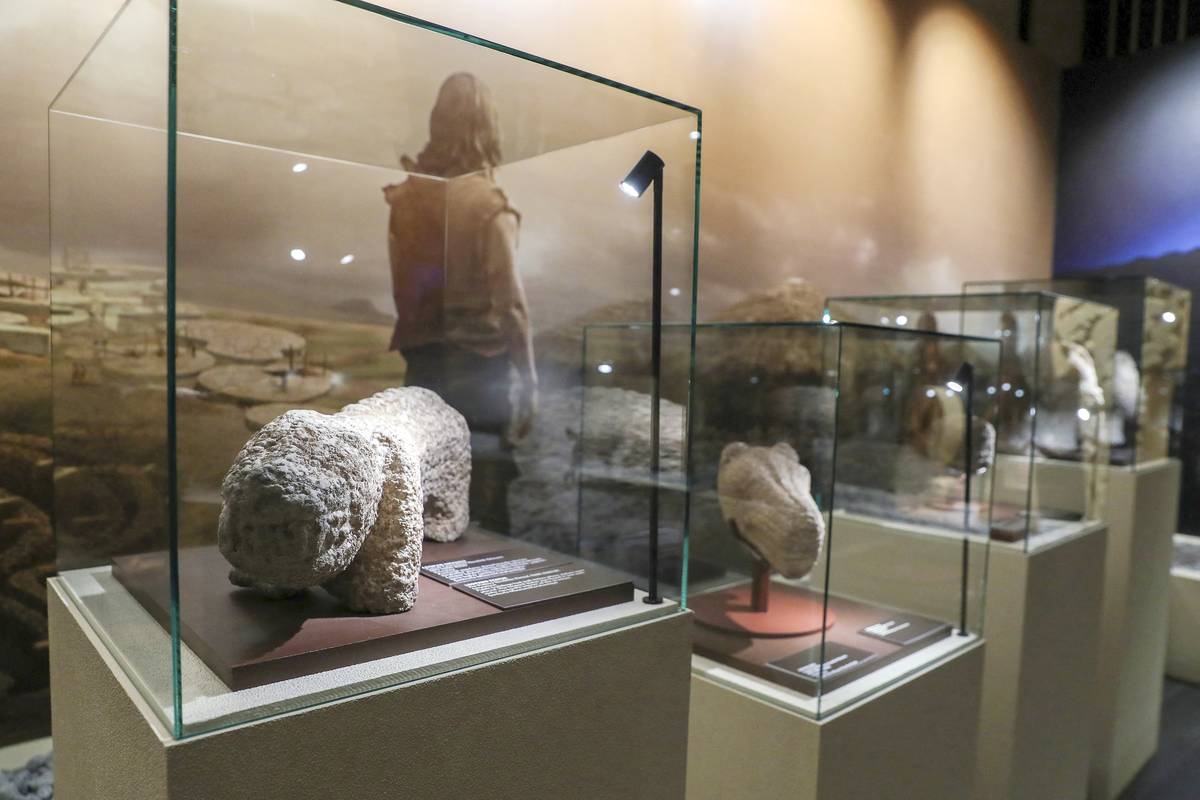
Animal sculptures, discovered at the Karahan Tepe archaeological site, are seen at the “Golden Age of Archaeology” exhibition at the Presidential Complex Exhibition Hall in Ankara on Aug. 21.
11:27 JST, September 18, 2025
ISTANBUL (Reuters) — A set of carved stone animals — a fox, a vulture and a wild boar — is shedding light on the way prehistoric people told stories after being unearthed by archaeologists in southeastern Turkey.
Dating back some 11,500 years, the trio of figurines found at the Karahantepe archaeological site is the first known example of objects being arranged in a specific way to convey a narrative, archaeologists say.
“Telling a story undoubtedly brings storytellers to mind, and carving them into stone reveals the existence of artists. But it also proves that communities who know those stories share a common memory,” Necmi Karul, head of the excavations at Karahantepe, one of the world’s oldest Neolithic settlements, said.
Unearthed late last year, the artifacts are now on display for the first time at the Presidential Complex in Turkey’s capital, Ankara, along with other items unearthed at Karahantepe, which dates back to 9,500 B.C.

Figurines forming a three-dimensional narrative, discovered at the Karahantepe archaeological site
The set of animal figures — each one about 3.5 centimeters tall — was found in a small container, covered with a stone lid, and placed inside another, larger vessel. Each of the three figurines had its head placed into a limestone ring.
The intricacies of the arrangement reflect the figurines’ use as part of a carefully prepared composition, Karul said, adding that previously only two-dimensional and often independent depictions had been found on immovable artifacts.
“With the Neolithic period and sedentism, we see a fundamental shift in narrative language,” he said.
Sedentism, or living in one place for long periods, replaced millions of years of hunter-gatherer culture and gave rise to a new social order.
“These narratives must have been the social bonds that held this new order together,” Karul said, describing the figurines as “one of the most important discoveries from a prehistoric perspective.”
Prehistoric success story
Karahantepe is one of the earliest settlements of the Neolithic period. Nearby Gobeklitepe, a UNESCO World Heritage Site, is believed to be the world’s oldest.
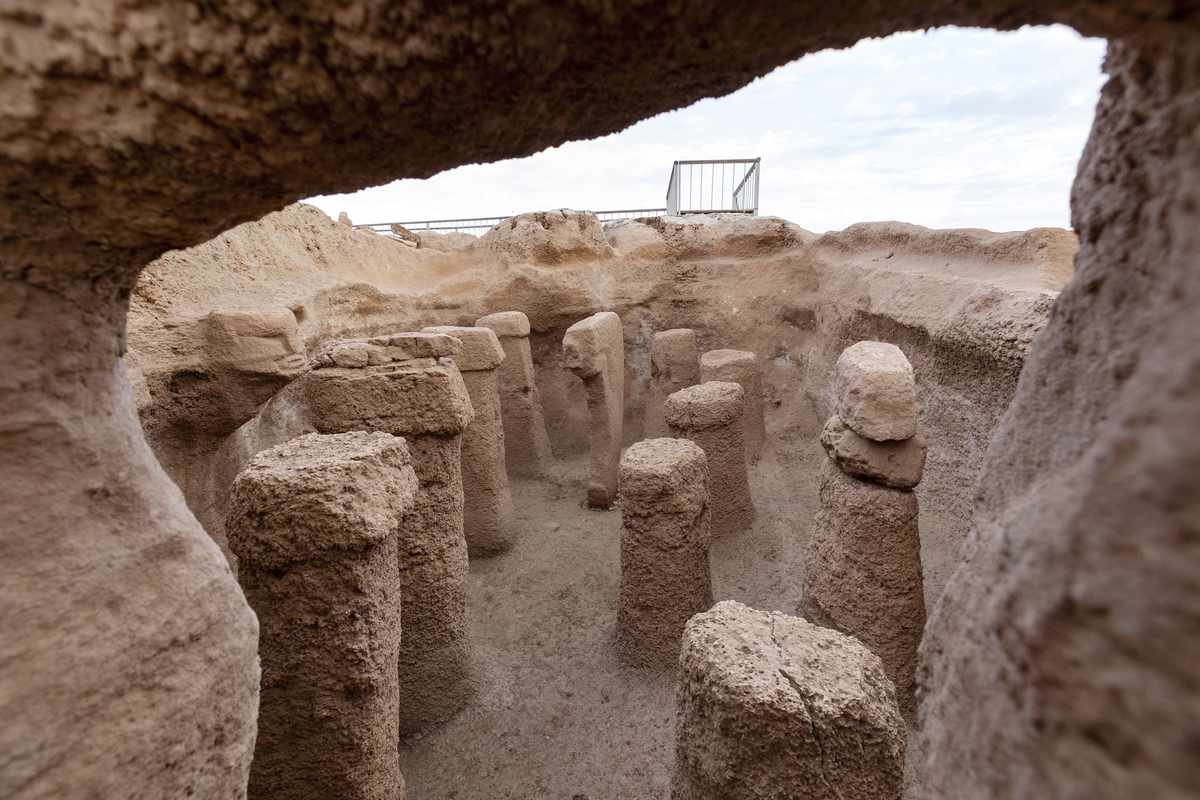
The archaeological site of Karahantepe in Sanliurfa, Turkey, in September 2023
Both sites are a part of a wider Neolithic research project called Tas Tepeler, or “Stone Hills,” that includes various settlements dotted across the Turkish province of Sanliurfa and where excavations are ongoing.
Karahantepe covers 14 hectares, but excavation work carried out there since 2019 has covered only a tiny fraction of the site, Karul said.
Pillars decorated with reliefs and a complex of circular communal buildings were also found there, with a human head carved into the bedrock on one of the walls.
“Modern people always place themselves at the pinnacle when compared to the past,” he said. “Karahantepe shows us how successful people were in art and storytelling 11,000-12,000 years ago.”








Most Read
Popular articles in the past 24 hours
-

Ransomware Attacks Hitting Japan's Small, Midsize Firms
-

German Journalist Traces Footsteps of Great-Grandfather Who Was P...
-

10 Foreign Tourists Sustain Injuries After Fire at Capsule Hotel ...
-

World Baseball Classic: Venezuela Beats Japan in Nail-biting Back...
-

Rapid Services Resume on JR Chuo Line; Suspension Caused by Accid...
-

Rapid Services on JR Chuo Line Suspended; Accident at Kokubunji S...
-

World Baseball Classic: Venezuela Beats Japan in Back-and-Forth Q...
-

World Baseball Classic: Red Sox’s Abreu Hits 3-run Homer, Giving ...
Popular articles in the past week
-

Japan Figure Skating Legend Yuzuru Hanyu Is Proud Disaster Surviv...
-
15 Measles Patients Confirmed in Tokyo in Past 6 Days; 1 May Have...
-

Massive Sewer Pipe Found Jutting Out of Highway in Osaka
-

Japan Govt to Tighten Requirements to Receive Permanent Residency...
-

Power Outage Forces About 980 Passengers in Yokohama to Walk to T...
-

JR Tokai Breaks Ground on Yamanashi Maglev Station; Will Be Part ...
-

Parents in Japan to Get Instagram Notifications When Teens Repeat...
-

'World's Oldest Bio-Business' Is Japan's Seed Koji Retailing, Mol...
Popular articles in the past month
-

Producer Behind Pop Group XG Arrested for Cocaine Possession
-

Japan PM Takaichi’s Cabinet Resigns en Masse
-

Man Infected with Measles Reportedly Dined at Restaurant in Tokyo...
-
Japan Figure Skating Legend Yuzuru Hanyu Is Proud Disaster Surviv...
-

iPS Treatments Pass Key Milestone, but Broader Applications Far f...
-

Sanae Takaichi Elected Prime Minister of Japan; Keeps All Cabinet...
-

South Korea Tightens Rules on Foreigners Buying Homes in Seoul Me...
-
Nepal Bus Crash Kills 19 People, Injures 25 Including One Japanes...
Top Articles in Science & Nature
-
iPS Treatments Pass Key Milestone, but Broader Applications Far from Guaranteed
-

Record 700 Startups to Gather at SusHi Tech Tokyo in April; Event Will Center on Themes Like Artificial Intelligence and Robotics
-
Parents in Japan to Get Instagram Notifications When Teens Repeatedly Search for Suicide Content
-

iPS Cell Products for Parkinson’s, Heart Disease OK’d for Commercialization by Japan Health Ministry Panel
-

Japan to Ban Use of Power Banks on Airplanes
JN ACCESS RANKING
-
Producer Behind Pop Group XG Arrested for Cocaine Possession
-
Japan PM Takaichi’s Cabinet Resigns en Masse
-
Man Infected with Measles Reportedly Dined at Restaurant in Tokyo Station
-
Japan Figure Skating Legend Yuzuru Hanyu Is Proud Disaster Survivor and Gold Medalist, Vows to Continue Support Efforts
-
iPS Treatments Pass Key Milestone, but Broader Applications Far from Guaranteed