
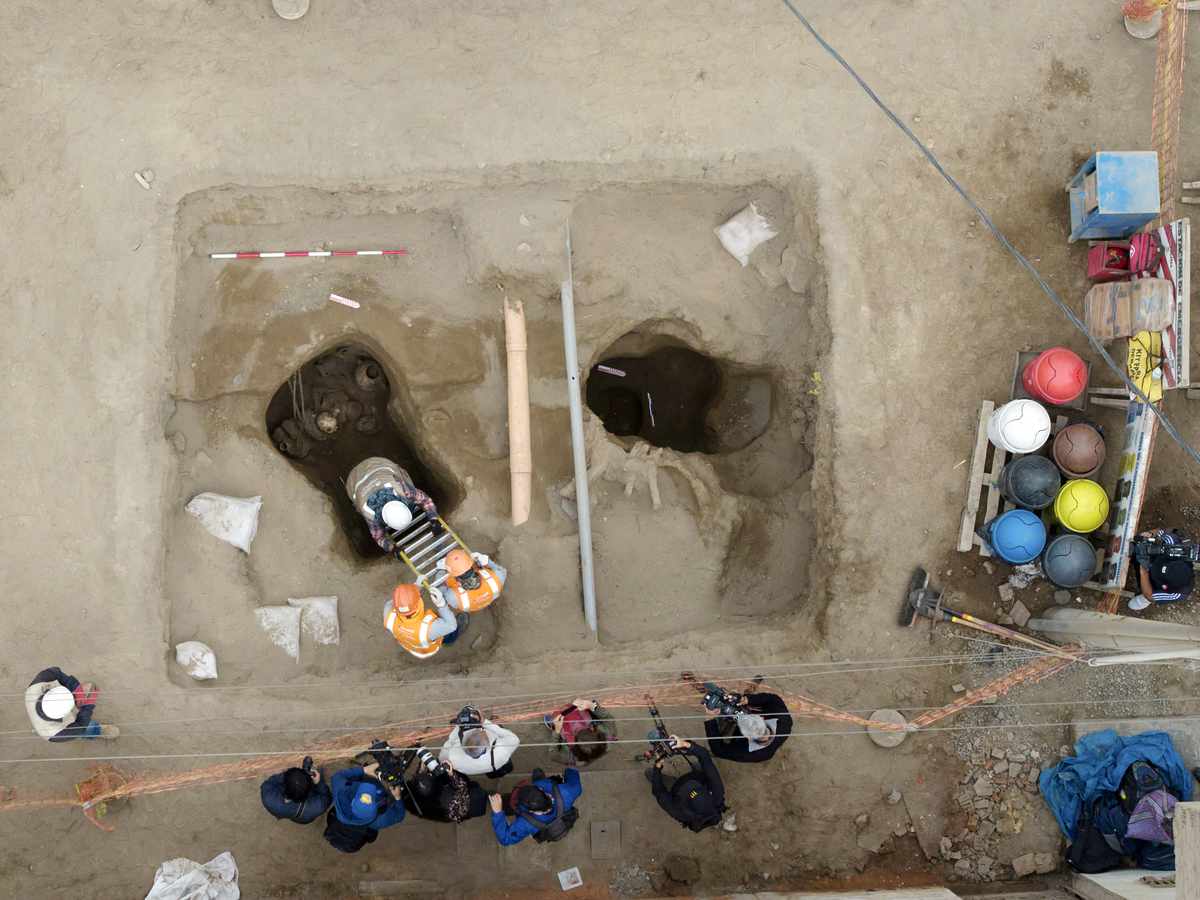
Archaeologists work at the site where city workers discovered ancient remains from the pre-Incan Chancay culture and artifacts on the outskirts of Lima on July 31.
10:36 JST, August 6, 2025
LIMA (AP) — Utility workers excavating trenches to expand underground gas networks in Peru’s capital unearthed two pre-Incan tombs on July 31. One was empty, but the other held the 1,000-year-old remains of an individual, alongside four clay vessels and three pumpkin shell artifacts.
This isn’t the first time Calidda, the company that distributes natural gas in Lima, has found archaeological remains. Over more than two decades of excavation work to expand the underground network, the company says it has made more than 2,200 discoveries.
According to archaeologist Jose Aliaga, the vessels’ iconography and their black, white and red colors “allow us to establish a connection with the pre-Incan Chancay culture, which is approximately 1,000 to 1,470 years old.” Aliaga told The Associated Press that the individual was found wrapped in a torn bundle, in a sitting position with his legs against his chest, and his team will continue cleaning the remains.
“Lima is unique among Latin American capitals,” Aliaga said, “in that various archaeological finds are unearthed during nearly every civil project.”
The Peruvian capital, a city of 10 million people, has more than 400 archaeological sites from the Inca era, the 15th century, or earlier, from the pre-Inca period, according to the Ministry of Culture.
On the same day, passersby stopped in their tracks to observe the burial site, even taking out their cellphones to take a picture.
“I always thought they were paths where no one had lived,” said Flor Prieto, who was walking with her 7-year-old daughter. “But now I know that people older than the Incas have lived there … it feels so exciting.”
“It is very common to find archaeological remains on the Peruvian coast, including Lima, mainly funerary elements: tombs, burials and, among these, mummified individuals,” said Pieter Van Dalen, dean of the College of Archaeologists of Peru. Van Dalen was not involved in the July 31 discovery.






Most Read
Popular articles in the past 24 hours
-

German Journalist Traces Footsteps of Great-Grandfather Who Was P...
-

10 Foreign Tourists Sustain Injuries After Fire at Capsule Hotel ...
-

World Baseball Classic: Venezuela Beats Japan in Nail-biting Back...
-
Rapid Services Resume on JR Chuo Line; Suspension Caused by Accid...
-
Rapid Services on JR Chuo Line Suspended; Accident at Kokubunji S...
-

World Baseball Classic: Venezuela Beats Japan in Back-and-Forth Q...
-

World Baseball Classic: Red Sox’s Abreu Hits 3-run Homer, Giving ...
-

Zelenskiy Says Ukraine Wants Money, Technology in Return for Midd...
Popular articles in the past week
-

Japan Figure Skating Legend Yuzuru Hanyu Is Proud Disaster Surviv...
-
15 Measles Patients Confirmed in Tokyo in Past 6 Days; 1 May Have...
-
Massive Sewer Pipe Found Jutting Out of Highway in Osaka
-
Japan Govt to Tighten Requirements to Receive Permanent Residency...
-
Power Outage Forces About 980 Passengers in Yokohama to Walk to T...
-
JR Tokai Breaks Ground on Yamanashi Maglev Station; Will Be Part ...
-

Parents in Japan to Get Instagram Notifications When Teens Repeat...
-
'World's Oldest Bio-Business' Is Japan's Seed Koji Retailing, Mol...
Popular articles in the past month
-

Producer Behind Pop Group XG Arrested for Cocaine Possession
-

Japan PM Takaichi’s Cabinet Resigns en Masse
-

Man Infected with Measles Reportedly Dined at Restaurant in Tokyo...
-
Japan Figure Skating Legend Yuzuru Hanyu Is Proud Disaster Surviv...
-

iPS Treatments Pass Key Milestone, but Broader Applications Far f...
-

Sanae Takaichi Elected Prime Minister of Japan; Keeps All Cabinet...
-

South Korea Tightens Rules on Foreigners Buying Homes in Seoul Me...
-

Nepal Bus Crash Kills 19 People, Injures 25 Including One Japanes...
Top Articles in Science & Nature
-
iPS Treatments Pass Key Milestone, but Broader Applications Far from Guaranteed
-
Record 700 Startups to Gather at SusHi Tech Tokyo in April; Event Will Center on Themes Like Artificial Intelligence and Robotics
-
Parents in Japan to Get Instagram Notifications When Teens Repeatedly Search for Suicide Content
-
iPS Cell Products for Parkinson’s, Heart Disease OK’d for Commercialization by Japan Health Ministry Panel
-
Japan to Ban Use of Power Banks on Airplanes
JN ACCESS RANKING
-
Producer Behind Pop Group XG Arrested for Cocaine Possession
-
Japan PM Takaichi’s Cabinet Resigns en Masse
-
Man Infected with Measles Reportedly Dined at Restaurant in Tokyo Station
-
Japan Figure Skating Legend Yuzuru Hanyu Is Proud Disaster Survivor and Gold Medalist, Vows to Continue Support Efforts
-
iPS Treatments Pass Key Milestone, but Broader Applications Far from Guaranteed