
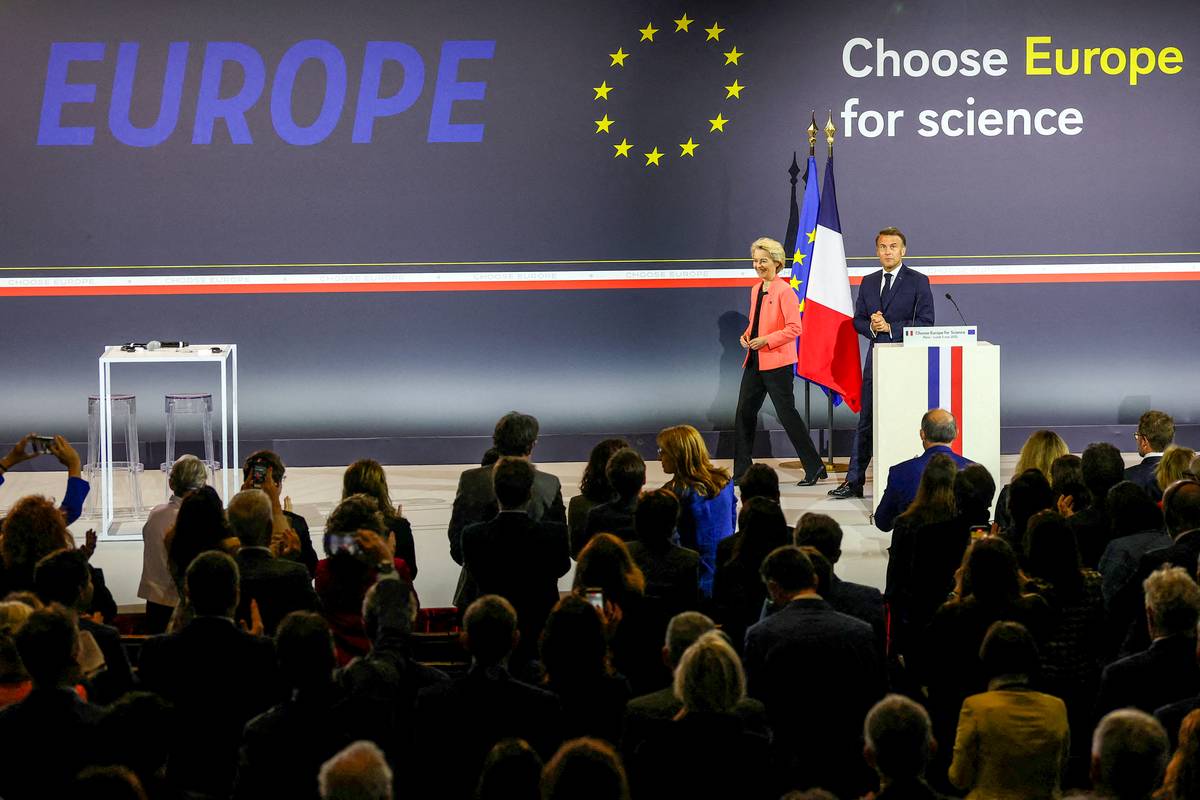
French President Emmanuel Macron, right, and European Commission President Ursula Von der Leyen arrive to attend the “Choose Europe for Science” event in the amphitheatre of the Sorbonne University in Paris on May 5.
16:44 JST, May 14, 2025
PARIS (Reuters) — The European Union and France on May 5 announced half a billion euros worth of incentives to lure scientists to the continent, seeking to profit from U.S. President Donald Trump’s federal funding cuts and clashes with top U.S. universities.
“We call on researchers worldwide to unite and join us … If you love freedom, come and help us stay free,” French President Emmanuel Macron said at Paris’ Sorbonne University alongside European Commission President Ursula von der Leyen.
The money would fund research projects and help universities cover the cost of bringing foreign scientists over to help run them, officials said.
Von der Leyen announced the €500 million ($566.6 million) incentive package and said she also wanted EU member states to invest 3% of gross domestic product in research and development by 2030.
Macron pledged €100 million from France, though it was not immediately clear if this came on top of the EU pledge.
‘Reverse brain drain’
Robert N. Proctor, a historian at Stanford University, told Reuters that Trump was leading “a libertarian right-wing assault on the scientific enterprise” that had been years in the making.
“We could well see a reverse brain drain,” he said. “It’s not just to Europe, but scholars are moving to Canada and Asia as well.”
Meredith Whittaker, the president of encrypted messaging app Signal, declined to comment on geopolitical disputes. But she told Reuters it was inevitable top talent would gravitate to welcoming jurisdictions.
“I think researchers, people whose lives, whose inquiry, whose obsessions are motivated by particular questions, particular fields, who exist in a community of intellectual practice, will always be attracted to places where the ground is fertile for that work, where they’re not threatened, and where their research isn’t hampered or perverted,” she said.
The threat to academics’ livelihoods at U.S. universities including Yale, Columbia and Johns Hopkins has given Europe’s political leaders hope they could reap an intellectual windfall.
But with European universities far less wealthy than their U.S. peers, it remains to be seen if they can bridge the funding gap that is needed to attract top U.S. researchers.
Last month, Macron and Von der Leyen said they would be looking to invite scientists and researchers from the world to Europe.
In April, France also launched the “Choose France for Science” platform, operated by the French National Research Agency, which enables universities, schools and research organizations to apply for cofunding from the government to host researchers.







Most Read
Popular articles in the past 24 hours
-

German Journalist Traces Footsteps of Great-Grandfather Who Was P...
-
10 Foreign Tourists Sustain Injuries After Fire at Capsule Hotel ...
-

World Baseball Classic: Venezuela Beats Japan in Nail-biting Back...
-
Rapid Services Resume on JR Chuo Line; Suspension Caused by Accid...
-
Rapid Services on JR Chuo Line Suspended; Accident at Kokubunji S...
-

Zelenskiy Says Ukraine Wants Money, Technology in Return for Midd...
-

World Baseball Classic: Venezuela Beats Japan in Back-and-Forth Q...
-

World Baseball Classic: Red Sox’s Abreu Hits 3-run Homer, Giving ...
Popular articles in the past week
-

Japan Figure Skating Legend Yuzuru Hanyu Is Proud Disaster Surviv...
-
15 Measles Patients Confirmed in Tokyo in Past 6 Days; 1 May Have...
-

Massive Sewer Pipe Found Jutting Out of Highway in Osaka
-
Japan Govt to Tighten Requirements to Receive Permanent Residency...
-

Power Outage Forces About 980 Passengers in Yokohama to Walk to T...
-
JR Tokai Breaks Ground on Yamanashi Maglev Station; Will Be Part ...
-
Parents in Japan to Get Instagram Notifications When Teens Repeat...
-

'World's Oldest Bio-Business' Is Japan's Seed Koji Retailing, Mol...
Popular articles in the past month
-

Producer Behind Pop Group XG Arrested for Cocaine Possession
-

Japan PM Takaichi’s Cabinet Resigns en Masse
-

Man Infected with Measles Reportedly Dined at Restaurant in Tokyo...
-
Japan Figure Skating Legend Yuzuru Hanyu Is Proud Disaster Surviv...
-

iPS Treatments Pass Key Milestone, but Broader Applications Far f...
-

Sanae Takaichi Elected Prime Minister of Japan; Keeps All Cabinet...
-

South Korea Tightens Rules on Foreigners Buying Homes in Seoul Me...
-

Nepal Bus Crash Kills 19 People, Injures 25 Including One Japanes...
Top Articles in Science & Nature
-
iPS Treatments Pass Key Milestone, but Broader Applications Far from Guaranteed
-
Record 700 Startups to Gather at SusHi Tech Tokyo in April; Event Will Center on Themes Like Artificial Intelligence and Robotics
-
Parents in Japan to Get Instagram Notifications When Teens Repeatedly Search for Suicide Content
-
iPS Cell Products for Parkinson’s, Heart Disease OK’d for Commercialization by Japan Health Ministry Panel
-

Japan to Ban Use of Power Banks on Airplanes
JN ACCESS RANKING
-
Producer Behind Pop Group XG Arrested for Cocaine Possession
-
Japan PM Takaichi’s Cabinet Resigns en Masse
-
Man Infected with Measles Reportedly Dined at Restaurant in Tokyo Station
-
Japan Figure Skating Legend Yuzuru Hanyu Is Proud Disaster Survivor and Gold Medalist, Vows to Continue Support Efforts
-
iPS Treatments Pass Key Milestone, but Broader Applications Far from Guaranteed