
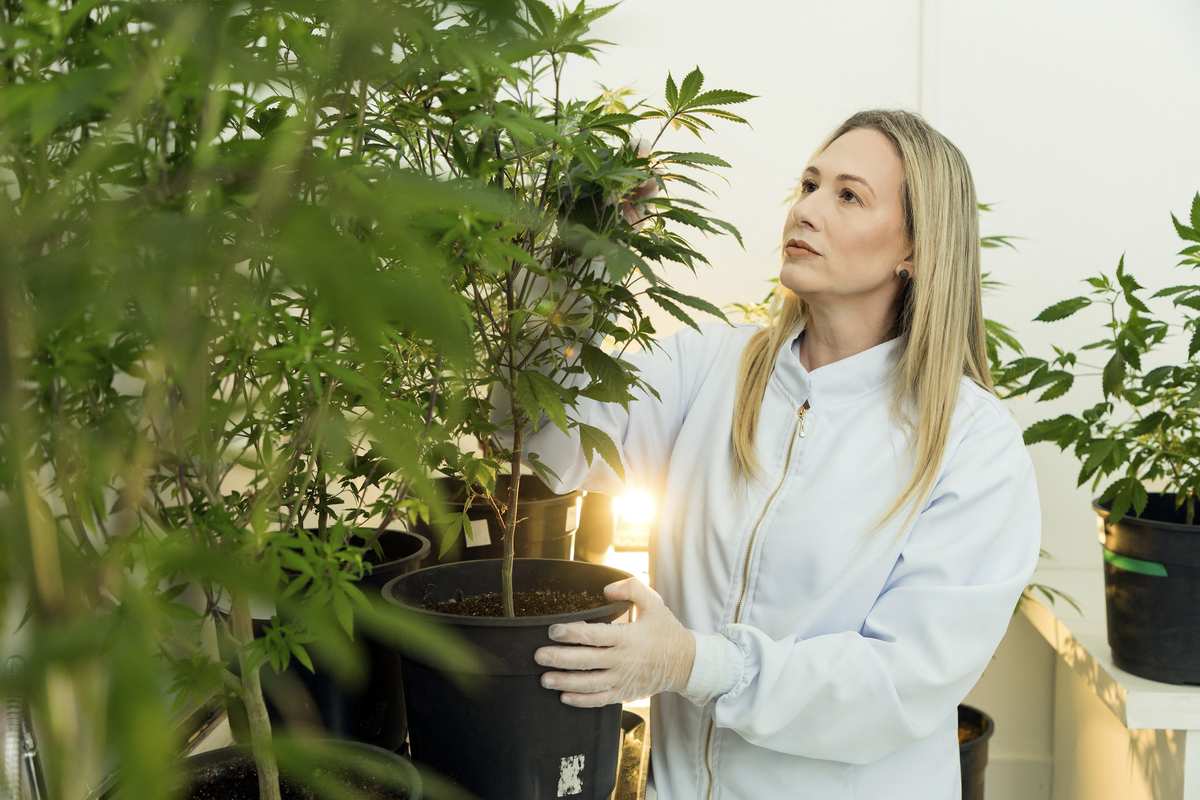
Kiara Cardoso inspects cannabis plants used to extract medicinal CBD oil in Petrolina, Pernambuco, Brazil, on Feb. 7.
12:59 JST, February 28, 2025
SAO PAULO (Reuters) — Brazil’s agricultural research agency Embrapa, which helped turn the country into a leading grains exporter, is preparing a 12-year research program that could do the same for cannabis cultivation in the farming powerhouse.
Embrapa scientists, who bred genetic varieties of grains, cotton and vegetables best suited for Brazil’s tropical climate, expect health agency Anvisa to give a green light this year for the cannabis research program.
“Can you imagine if we had already carried out the genetic improvement of this plant like we’ve done with cotton in the last 50 years?” said Daniela Bittencourt, a researcher with the cannabis work group at Embrapa.
Embrapa’s plans include creating a cannabis seed bank and adapting varieties to the Brazilian soil and climate, while helping to identify and develop regional cannabis production hubs around the country, she said.
Bittencourt said about ten domestic and international companies have already contacted Embrapa about cannabis research partnerships. The firms are interested in applications ranging from medicine to food products, as well as exploring traits to facilitate crop rotation or fix carbon in soil.
Similar efforts by Embrapa since the 1970s opened up vast regions of Brazil for productive soybean farming, for example, kicking off a tenfold increase in Brazil’s soy output to make it the world’s largest producer.
A Brazilian higher court ruling in November legalized planting of a type of cannabis known as hemp for medicinal purposes, giving Anvisa until May to establish regulations.
Another court hearing on Feb. 12 denied Anvisa’s request to extend that deadline by six months. The health agency did not comment immediately on the decision.
Recreational marijuana sale remains illegal in Brazil, unlike trailblazers such as Uruguay and Canada in the Western Hemisphere, which have encouraged domestic cannabis industries.
For now, November’s court ruling opened the door in Brazil to planting hemp, a version of cannabis with less than 0.3% of the psychoactive compound THC. The variety is often cultivated for cannabidiol, used for medical purposes, and its fibers, which have various industrial applications.
Kiara Cardoso, founder of DNA Solucoes em Biotecnologia, which won the court case allowing it and other interested firms to apply for a planting permit, said she eventually expects large-scale hemp production in Brazil to supply the paper, textile and food industries.
For the moment, she said, planting rules may restrict cultivation to small, indoor spaces that meet rigorous protocols for pharmaceutical supply chains.
China, Brazil’s biggest trading partner, is the world’s largest producer and exporter of hemp, according to academic research. Countries such as France and Paraguay have also authorized cultivation for industrial and medicinal purposes.






Most Read
Popular articles in the past 24 hours
-

10 Foreign Tourists Sustain Injuries After Fire at Capsule Hotel ...
-

World Baseball Classic: Venezuela Beats Japan in Nail-biting Back...
-

Zelenskiy Says Ukraine Wants Money, Technology in Return for Midd...
-
Rapid Services Resume on JR Chuo Line; Suspension Caused by Accid...
-
Rapid Services on JR Chuo Line Suspended; Accident at Kokubunji S...
-

World Baseball Classic: Venezuela Beats Japan in Back-and-Forth Q...
-

World Baseball Classic: Red Sox’s Abreu Hits 3-run Homer, Giving ...
-
Rich Local Ingredients Make Nagato Oden Popular Dish
Popular articles in the past week
-

Japan Figure Skating Legend Yuzuru Hanyu Is Proud Disaster Surviv...
-
15 Measles Patients Confirmed in Tokyo in Past 6 Days; 1 May Have...
-

Massive Sewer Pipe Found Jutting Out of Highway in Osaka
-
Japan Govt to Tighten Requirements to Receive Permanent Residency...
-

Power Outage Forces About 980 Passengers in Yokohama to Walk to T...
-
JR Tokai Breaks Ground on Yamanashi Maglev Station; Will Be Part ...
-

Parents in Japan to Get Instagram Notifications When Teens Repeat...
-
'World's Oldest Bio-Business' Is Japan's Seed Koji Retailing, Mol...
Popular articles in the past month
-

Producer Behind Pop Group XG Arrested for Cocaine Possession
-

Japan PM Takaichi’s Cabinet Resigns en Masse
-

Man Infected with Measles Reportedly Dined at Restaurant in Tokyo...
-
Japan Figure Skating Legend Yuzuru Hanyu Is Proud Disaster Surviv...
-

iPS Treatments Pass Key Milestone, but Broader Applications Far f...
-

Sanae Takaichi Elected Prime Minister of Japan; Keeps All Cabinet...
-

South Korea Tightens Rules on Foreigners Buying Homes in Seoul Me...
-

Nepal Bus Crash Kills 19 People, Injures 25 Including One Japanes...
Top Articles in Science & Nature
-
iPS Treatments Pass Key Milestone, but Broader Applications Far from Guaranteed
-

Record 700 Startups to Gather at SusHi Tech Tokyo in April; Event Will Center on Themes Like Artificial Intelligence and Robotics
-
Parents in Japan to Get Instagram Notifications When Teens Repeatedly Search for Suicide Content
-
iPS Cell Products for Parkinson’s, Heart Disease OK’d for Commercialization by Japan Health Ministry Panel
-

Japan to Ban Use of Power Banks on Airplanes
JN ACCESS RANKING
-
Producer Behind Pop Group XG Arrested for Cocaine Possession
-
Japan PM Takaichi’s Cabinet Resigns en Masse
-
Man Infected with Measles Reportedly Dined at Restaurant in Tokyo Station
-
Japan Figure Skating Legend Yuzuru Hanyu Is Proud Disaster Survivor and Gold Medalist, Vows to Continue Support Efforts
-
iPS Treatments Pass Key Milestone, but Broader Applications Far from Guaranteed