
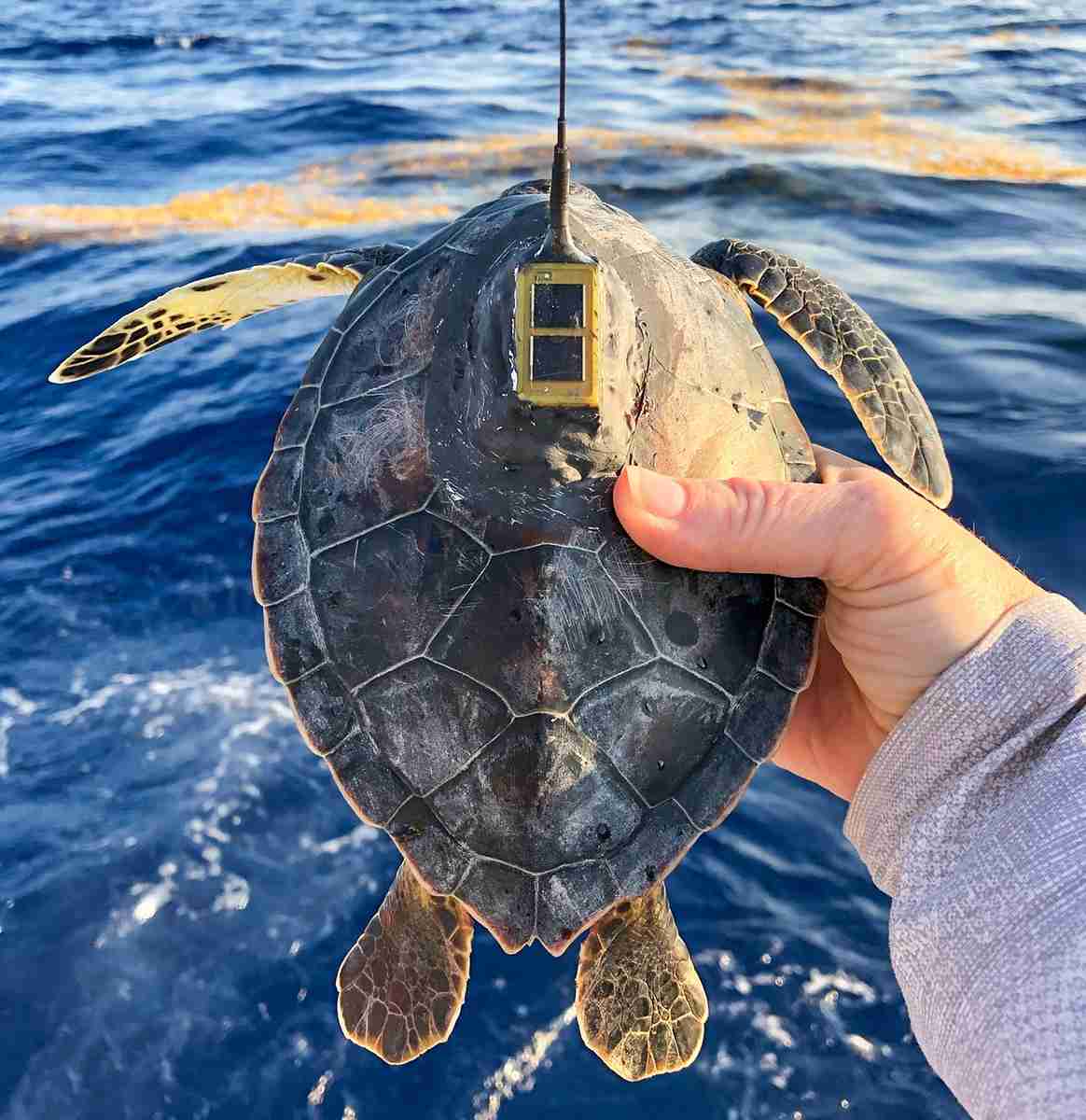
A young green sea turtle with a satellite tag is seen before release offshore of Destin, Fla., in May 2022
14:00 JST, February 12, 2025
WASHINGTON (AP) — Using satellite trackers, scientists have discovered the whereabouts of young sea turtles during a key part of their lives.
“We’ve had massive data gaps about the early baby to toddler life stages of sea turtles,” said Kate Mansfield, a marine scientist at the University of Central Florida. “This part of their long lives has been largely a mystery.”
For decades, scientists have wondered about what happens during the so-called lost years between when tiny hatchlings leave the beach and when they return to coastlines nearly grown — a span of about one to 10 years.
New research published on Feb. 4 begins to fill in that gap.
For over a decade, Mansfield and colleagues attached GPS tags to the fast-growing shells of young wild turtles. Steering small boats, they looked for young turtles drifting among algae in the Gulf of Mexico, eventually tagging 114 animals — including endangered green turtles, loggerheads, hawksbills and Kemp’s ridleys.
Eventually the GPS tags slough off because “the outside of a young turtle’s shell sheds as they grow very quickly,” said Katrina Phillips, a marine ecologist at the University of Central Florida and coauthor of the new study published in Proceedings of the Royal Society B.
But each tag stayed on long enough to transmit a few weeks to a few months of location data. What the researchers found challenged many old ideas.
Scientists long thought that tiny turtles drifted passively with ocean currents, literally going with the flow.
“What we’ve uncovered is that the turtles are actually swimming,” said coauthor Nathan Putman, an ecologist at LGL Ecological Research Associates in Texas.
The scientists confirmed this by comparing location data of young turtles with the routes of drifting buoys set in the water at the same time. More than half of the buoys washed ashore while the turtles did not.
“This tiny little hatchling is actually making its own decisions about where it wants to go in the ocean and what it wants to avoid,” said Bryan Wallace, a wildlife ecologist at Ecolibrium in Colorado.
The tracking data also showed more variability in locations than scientists expected, as the little turtles moved between continental shelf waters and open ocean.
Besides the painstaking work of finding turtles, the trick was developing flexible solar-powered tags that could hang onto shells long enough to send back data.
“For years, the technology couldn’t match the dream,” said Jeffrey Seminoff, a marine biologist at NOAA who was not involved in the study.
The findings give biologists a better idea of how young turtles use the Gulf of Mexico, a critical region for four species of endangered sea turtles.
“It’s not that the sea turtles were ever lost, but that we had lost track of them,” said Jeanette Wyneken at Florida Atlantic University, who had no role in the research.







Most Read
Popular articles in the past 24 hours
-

10 Foreign Tourists Sustain Injuries After Fire at Capsule Hotel ...
-

World Baseball Classic: Venezuela Beats Japan in Nail-biting Back...
-

Zelenskiy Says Ukraine Wants Money, Technology in Return for Midd...
-

Rapid Services Resume on JR Chuo Line; Suspension Caused by Accid...
-

Rapid Services on JR Chuo Line Suspended; Accident at Kokubunji S...
-

World Baseball Classic: Venezuela Beats Japan in Back-and-Forth Q...
-

World Baseball Classic: Red Sox’s Abreu Hits 3-run Homer, Giving ...
-

Rich Local Ingredients Make Nagato Oden Popular Dish
Popular articles in the past week
-

Japan Figure Skating Legend Yuzuru Hanyu Is Proud Disaster Surviv...
-
15 Measles Patients Confirmed in Tokyo in Past 6 Days; 1 May Have...
-

Massive Sewer Pipe Found Jutting Out of Highway in Osaka
-

Japan Govt to Tighten Requirements to Receive Permanent Residency...
-

Power Outage Forces About 980 Passengers in Yokohama to Walk to T...
-

JR Tokai Breaks Ground on Yamanashi Maglev Station; Will Be Part ...
-

Parents in Japan to Get Instagram Notifications When Teens Repeat...
-
'World's Oldest Bio-Business' Is Japan's Seed Koji Retailing, Mol...
Popular articles in the past month
-

Producer Behind Pop Group XG Arrested for Cocaine Possession
-

Japan PM Takaichi’s Cabinet Resigns en Masse
-

Man Infected with Measles Reportedly Dined at Restaurant in Tokyo...
-
Japan Figure Skating Legend Yuzuru Hanyu Is Proud Disaster Surviv...
-

iPS Treatments Pass Key Milestone, but Broader Applications Far f...
-

Sanae Takaichi Elected Prime Minister of Japan; Keeps All Cabinet...
-

South Korea Tightens Rules on Foreigners Buying Homes in Seoul Me...
-

Nepal Bus Crash Kills 19 People, Injures 25 Including One Japanes...
Top Articles in Science & Nature
-
iPS Treatments Pass Key Milestone, but Broader Applications Far from Guaranteed
-

Record 700 Startups to Gather at SusHi Tech Tokyo in April; Event Will Center on Themes Like Artificial Intelligence and Robotics
-
Parents in Japan to Get Instagram Notifications When Teens Repeatedly Search for Suicide Content
-

iPS Cell Products for Parkinson’s, Heart Disease OK’d for Commercialization by Japan Health Ministry Panel
-

Japan to Ban Use of Power Banks on Airplanes
JN ACCESS RANKING
-
Producer Behind Pop Group XG Arrested for Cocaine Possession
-
Japan PM Takaichi’s Cabinet Resigns en Masse
-
Man Infected with Measles Reportedly Dined at Restaurant in Tokyo Station
-
Japan Figure Skating Legend Yuzuru Hanyu Is Proud Disaster Survivor and Gold Medalist, Vows to Continue Support Efforts
-
iPS Treatments Pass Key Milestone, but Broader Applications Far from Guaranteed