
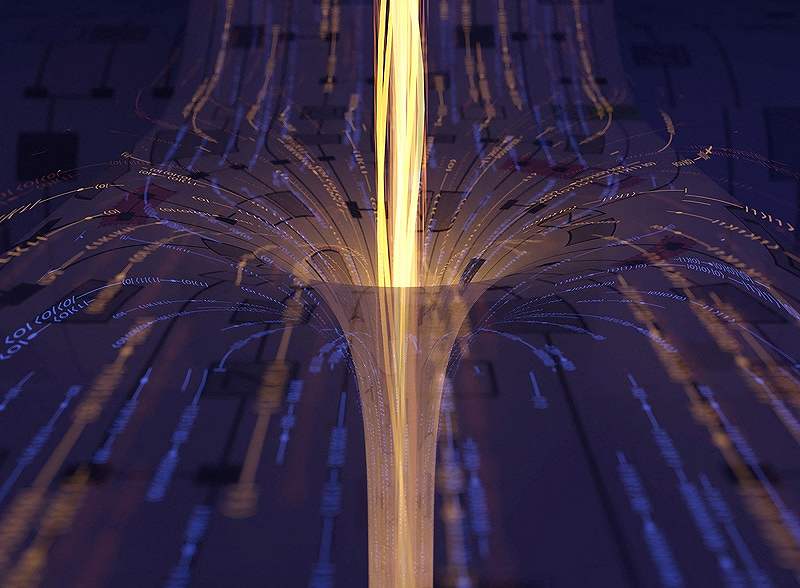
A quantum experiment that observes traversable wormhole behavior is depicted in this undated illustration.
11:58 JST, December 9, 2022
WASHINGTON (Reuters) — In science fiction — think films and TV like “Interstellar” and “Star Trek” — wormholes in the cosmos serve as portals through space and time for spacecraft to traverse unimaginable distances with ease. If only it were that simple.
Scientists have long pursued a deeper understanding of wormholes and now appear to be making progress. Researchers announced on Nov. 30 that they forged two miniscule simulated black holes — those extraordinarily dense celestial objects with gravity so powerful that not even light can escape — in a quantum computer and transmitted a message between them through what amounted to a tunnel in space-time.
It was a “baby wormhole,” according to Caltech physicist Maria Spiropulu, a coauthor of the research published in the journal Nature. But scientists are a long way from being able to send people or other living beings through such a portal, she said.
“Experimentally, for me, I will tell you that it’s very, very far away. People come to me and they ask me, ‘Can you put your dog in the wormhole?’ So, no,” Spiropulu told reporters during a video briefing. “… That’s a huge leap.”
“There’s a difference between something being possible in principle and possible in reality,” added physicist and study coauthor Joseph Lykken of Fermilab, America’s particle physics and accelerator laboratory. “So don’t hold your breath about sending your dog through the wormhole. But you have to start somewhere. And I think to me it’s just exciting that we’re able to get our hands on this at all.”
The researchers observed the wormhole dynamics on a quantum device at Alphabet’s Google called the Sycamore quantum processor.
A wormhole — a rupture in space and time — is considered a bridge between two remote regions in the universe. Scientists refer to them as Einstein-Rosen bridges after the two physicists who described them — Albert Einstein and Nathan Rosen.
Such wormholes are consistent with Einstein’s theory of general relativity, which focuses on gravity, one of the fundamental forces in the universe. The term “wormhole” was coined by physicist John Wheeler in the 1950s.
Spiropulu said the researchers found a quantum system that exhibits key properties of a gravitational wormhole but was small enough to implement on existing quantum hardware.
“It looks like a duck, it walks like a duck, it quacks like a duck. So that’s what we can say at this point — that we have something that in terms of the properties we look at, it looks like a wormhole,” Lykken said.
The researchers said no rupture of space and time was created in physical space in the experiment, though a traversable wormhole appeared to have emerged based on quantum information teleported using quantum codes on the quantum processor.
“These ideas have been around for a long time and they’re very powerful ideas,” Lykken said.
“But in the end, we’re in experimental science, and we’ve been struggling now for a very long time to find a way to explore these ideas in the laboratory. And that’s what’s really exciting about this. It’s not just, ‘Well, wormholes are cool.’ This is a way to actually look at these very fundamental problems of our universe in a laboratory setting.”





Most Read
Popular articles in the past 24 hours
-

10 Foreign Tourists Sustain Injuries After Fire at Capsule Hotel ...
-

World Baseball Classic: Venezuela Beats Japan in Nail-biting Back...
-

Zelenskiy Says Ukraine Wants Money, Technology in Return for Midd...
-

Rapid Services Resume on JR Chuo Line; Suspension Caused by Accid...
-

Rapid Services on JR Chuo Line Suspended; Accident at Kokubunji S...
-

World Baseball Classic: Venezuela Beats Japan in Back-and-Forth Q...
-

World Baseball Classic: Red Sox’s Abreu Hits 3-run Homer, Giving ...
-

Rich Local Ingredients Make Nagato Oden Popular Dish
Popular articles in the past week
-

Japan Figure Skating Legend Yuzuru Hanyu Is Proud Disaster Surviv...
-
15 Measles Patients Confirmed in Tokyo in Past 6 Days; 1 May Have...
-

Massive Sewer Pipe Found Jutting Out of Highway in Osaka
-

Japan Govt to Tighten Requirements to Receive Permanent Residency...
-

Power Outage Forces About 980 Passengers in Yokohama to Walk to T...
-

JR Tokai Breaks Ground on Yamanashi Maglev Station; Will Be Part ...
-

Parents in Japan to Get Instagram Notifications When Teens Repeat...
-

'World's Oldest Bio-Business' Is Japan's Seed Koji Retailing, Mol...
Popular articles in the past month
-

Producer Behind Pop Group XG Arrested for Cocaine Possession
-

Japan PM Takaichi’s Cabinet Resigns en Masse
-

Man Infected with Measles Reportedly Dined at Restaurant in Tokyo...
-
Japan Figure Skating Legend Yuzuru Hanyu Is Proud Disaster Surviv...
-

iPS Treatments Pass Key Milestone, but Broader Applications Far f...
-

Sanae Takaichi Elected Prime Minister of Japan; Keeps All Cabinet...
-

South Korea Tightens Rules on Foreigners Buying Homes in Seoul Me...
-

Nepal Bus Crash Kills 19 People, Injures 25 Including One Japanes...
Top Articles in Science & Nature
-
iPS Treatments Pass Key Milestone, but Broader Applications Far from Guaranteed
-

Record 700 Startups to Gather at SusHi Tech Tokyo in April; Event Will Center on Themes Like Artificial Intelligence and Robotics
-
Parents in Japan to Get Instagram Notifications When Teens Repeatedly Search for Suicide Content
-
iPS Cell Products for Parkinson’s, Heart Disease OK’d for Commercialization by Japan Health Ministry Panel
-

Japan to Ban Use of Power Banks on Airplanes
JN ACCESS RANKING
-
Producer Behind Pop Group XG Arrested for Cocaine Possession
-
Japan PM Takaichi’s Cabinet Resigns en Masse
-
Man Infected with Measles Reportedly Dined at Restaurant in Tokyo Station
-
Japan Figure Skating Legend Yuzuru Hanyu Is Proud Disaster Survivor and Gold Medalist, Vows to Continue Support Efforts
-
iPS Treatments Pass Key Milestone, but Broader Applications Far from Guaranteed