
Scientists confirm fossils discovered 17 years ago in Japan belong to hitherto unknown dinosaur
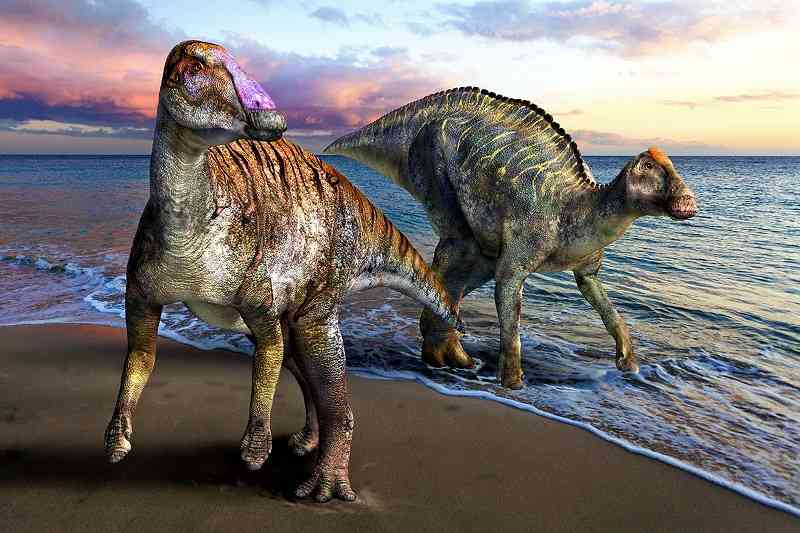
An artist’s rendering of Yamatosaurus, left, and Kamuysaurus, which is believed to have lived in Hokkaido.
17:41 JST, April 28, 2021
Dinosaur fossils discovered on Awaji Island in Hyogo Prefecture 17 years ago have been confirmed as belonging to a new species of herbivorous dinosaurs, according to a group of scientists from Hokkaido University; the Museum of Nature and Human Activities, Hyogo; and other academic organizations.
The group decided the scientific name of the dinosaur would be “Yamatosaurus izanagii,” a reference to a Japanese creation myth in which the island was the first Japanese terrain created.
This is the ninth time a new dinosaur species discovered in the country has been given a scientific name. A paper about the dinosaur was published in a British science journal on Wednesday.
The fossils were discovered in 2004 by amateur fossil enthusiast Shingo Kishimoto, 72, from Himeji in the prefecture, among others. In the city of Sumoto on the island, they excavated 23 pieces of fossils, including part of the dinosaur’s lower jaw measuring about 50 centimeters long and about 20 centimeters tall, from a late Cretaceous stratum formed about 72 million years ago.
The fossils were analyzed in detail by Prof. Yoshitsugu Kobayashi of Hokkaido University and other researchers. They were convinced that the tooth alignment and dentary bones of the fossils showed unique characteristics not found in the fossils of other herbivorous dinosaurs from the same period. The scientists came to the conclusion that the dinosaur was a new species belonging to the Hadrosauridae family.
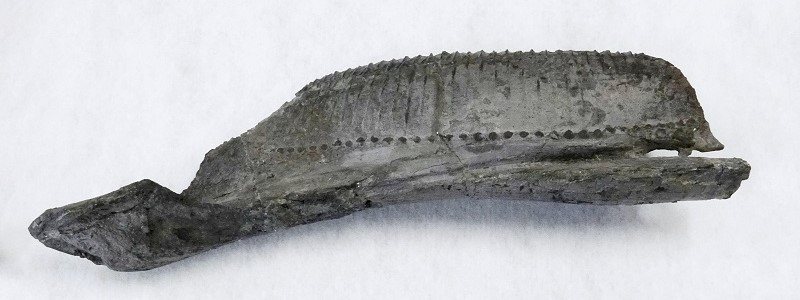
A fossil of the lower jaw of Yamatosaurus, which was discovered on Awaji Island in Hyogo Prefecture in 2004
The dinosaur is believed to have been bipedal with a body length of about 7 to 8 meters, weighing about 4 to 5 tons.
“This is an important specimen to shed light on the evolution of herbivorous dinosaurs in East Asia,” said Yoichi Azuma, an honorary professor of Fukui Prefectural University.
Fossils of Kamuysaurus, which also belongs to the hadrosaurids, were also excavated from a stratum of the same period in Hokkaido.







Most Read
Popular articles in the past 24 hours
-

Ransomware Attacks Hitting Japan's Small, Midsize Firms
-

German Journalist Traces Footsteps of Great-Grandfather Who Was P...
-

10 Foreign Tourists Sustain Injuries After Fire at Capsule Hotel ...
-

World Baseball Classic: Venezuela Beats Japan in Nail-biting Back...
-

Rapid Services Resume on JR Chuo Line; Suspension Caused by Accid...
-

Rapid Services on JR Chuo Line Suspended; Accident at Kokubunji S...
-

World Baseball Classic: Venezuela Beats Japan in Back-and-Forth Q...
-

World Baseball Classic: Red Sox’s Abreu Hits 3-run Homer, Giving ...
Popular articles in the past week
-

Japan Figure Skating Legend Yuzuru Hanyu Is Proud Disaster Surviv...
-
15 Measles Patients Confirmed in Tokyo in Past 6 Days; 1 May Have...
-

Massive Sewer Pipe Found Jutting Out of Highway in Osaka
-

Japan Govt to Tighten Requirements to Receive Permanent Residency...
-

Power Outage Forces About 980 Passengers in Yokohama to Walk to T...
-
JR Tokai Breaks Ground on Yamanashi Maglev Station; Will Be Part ...
-

Parents in Japan to Get Instagram Notifications When Teens Repeat...
-
'World's Oldest Bio-Business' Is Japan's Seed Koji Retailing, Mol...
Popular articles in the past month
-

Producer Behind Pop Group XG Arrested for Cocaine Possession
-

Japan PM Takaichi’s Cabinet Resigns en Masse
-

Man Infected with Measles Reportedly Dined at Restaurant in Tokyo...
-
Japan Figure Skating Legend Yuzuru Hanyu Is Proud Disaster Surviv...
-

iPS Treatments Pass Key Milestone, but Broader Applications Far f...
-

Sanae Takaichi Elected Prime Minister of Japan; Keeps All Cabinet...
-

South Korea Tightens Rules on Foreigners Buying Homes in Seoul Me...
-

Nepal Bus Crash Kills 19 People, Injures 25 Including One Japanes...
Top Articles in Science & Nature
-
iPS Treatments Pass Key Milestone, but Broader Applications Far from Guaranteed
-

Record 700 Startups to Gather at SusHi Tech Tokyo in April; Event Will Center on Themes Like Artificial Intelligence and Robotics
-
Parents in Japan to Get Instagram Notifications When Teens Repeatedly Search for Suicide Content
-
iPS Cell Products for Parkinson’s, Heart Disease OK’d for Commercialization by Japan Health Ministry Panel
-

Japan to Ban Use of Power Banks on Airplanes
JN ACCESS RANKING
-
Producer Behind Pop Group XG Arrested for Cocaine Possession
-
Japan PM Takaichi’s Cabinet Resigns en Masse
-
Man Infected with Measles Reportedly Dined at Restaurant in Tokyo Station
-
Japan Figure Skating Legend Yuzuru Hanyu Is Proud Disaster Survivor and Gold Medalist, Vows to Continue Support Efforts
-
iPS Treatments Pass Key Milestone, but Broader Applications Far from Guaranteed