
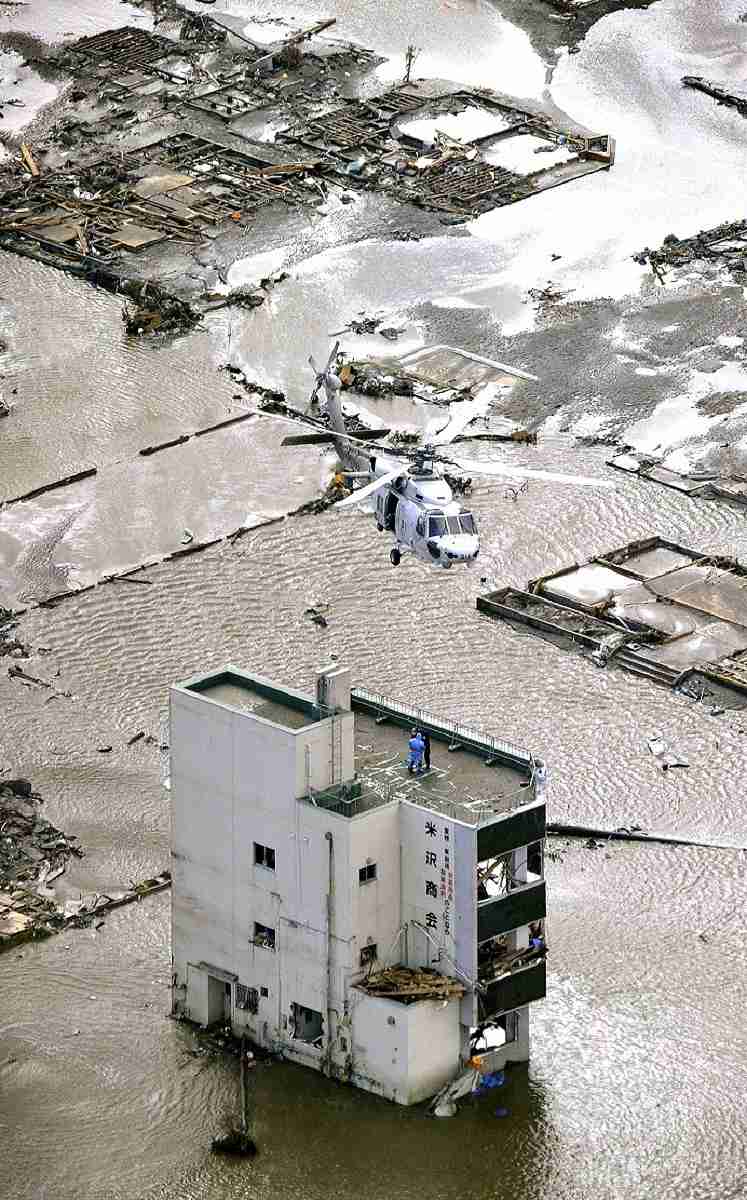
A survivor of the Great East Japan Earthquake and subsequent tsunami is rescued by a Maritime Self-Defense Forces helicopter in Rikuzen-Takata, Iwate Prefecture, on March 12, 2011.
16:41 JST, February 9, 2021
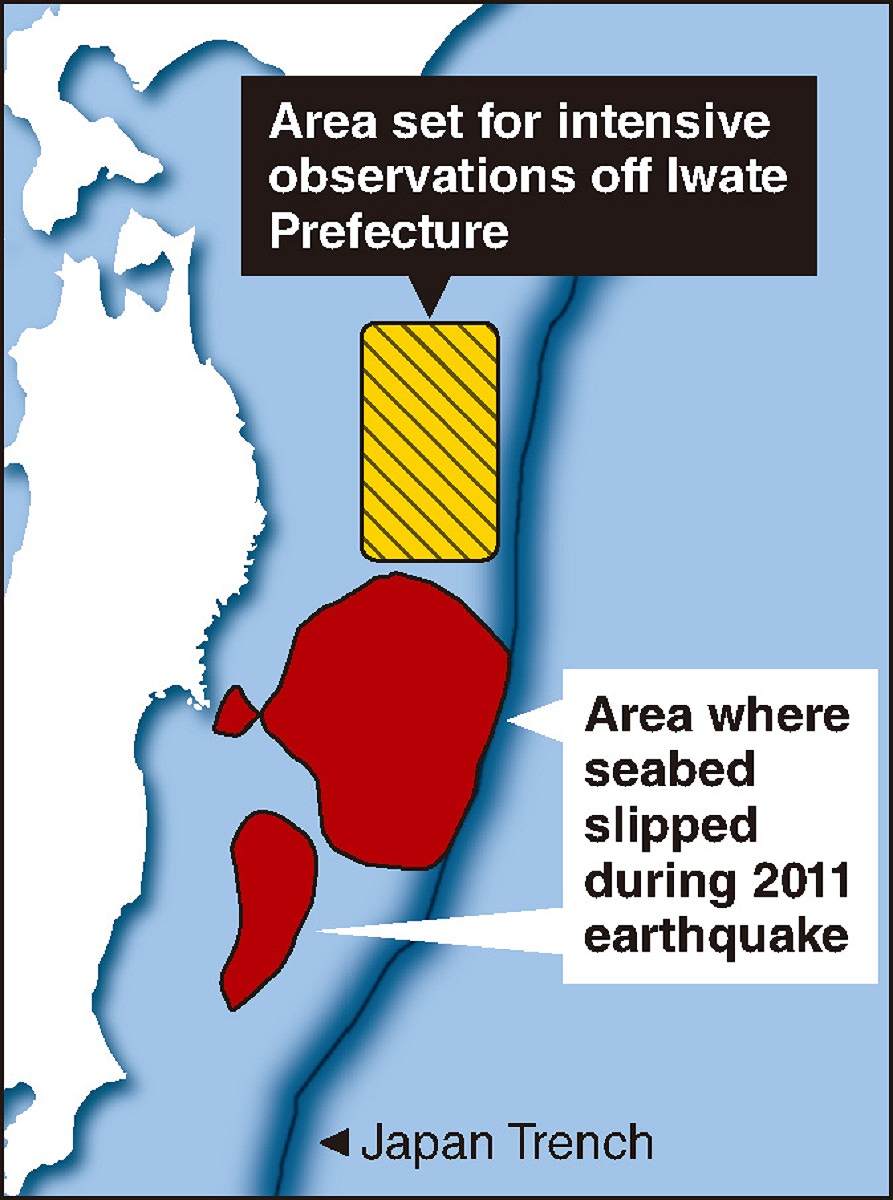
To help predict the risk of powerful earthquakes more accurately, a team of researchers from Tohoku University and the Japan Agency for Marine-Earth Science and Technology will soon begin intensive observations of crustal movements.
Their work will be based on the assumption that strain, which can generate energy for a massive earthquake, may have accumulated in the seabed north of the epicenter of the Great East Japan Earthquake that occurred in 2011. There is precedent for a huge earthquake being followed by another after a certain period of time in an adjacent marine area, and the team will examine the movement of the seabed to assess the risk.
According to the team, the observations are to be conducted along the Japan Trench off the coast of Iwate Prefecture. A fault in the seabed is said not to have slipped during the 2011 earthquake.
The team will use the Wave Glider, an autonomous unmanned surface vehicle powered by wave and solar energy. The vehicle will obtain information from six observation points on the seabed and deliver it to land via satellite.
The team will begin operating this new system in April and conduct intensive observations two or three times annually for several years. This will allow the movement of the seabed to be ascertained in detail, in a bid to detect unusual phenomena that could be a precursor to a huge earthquake.
This method would cost less than one-tenth of conventional means. In the past, researchers had to go offshore by ship, costing several tens of millions of yen each time. Observations were limited to about once a year.
Tohoku University Prof. Ryota Hino said, “I want to collect basic data for areas that we have not observed at all, and make this the first step in predicting the next great earthquake that will cause a huge tsunami.”
It is understood that major earthquakes tend to occur in neighboring areas. For example, two powerful earthquakes occurred within several tens of hours to several years later in areas along the Nankai Trough off the Pacific coast of central to southwestern Japan, where massive earthquakes are said to occur repeatedly.
About three months after the magnitude-9.1 earthquake off Sumatra, Indonesia, in 2004, which killed and left many people missing, another earthquake measuring 8.6 on the Richter scale struck waters to the south.






Most Read
Popular articles in the past 24 hours
-

Ransomware Attacks Hitting Japan's Small, Midsize Firms
-

German Journalist Traces Footsteps of Great-Grandfather Who Was P...
-

10 Foreign Tourists Sustain Injuries After Fire at Capsule Hotel ...
-

World Baseball Classic: Venezuela Beats Japan in Nail-biting Back...
-

Rapid Services Resume on JR Chuo Line; Suspension Caused by Accid...
-

Rapid Services on JR Chuo Line Suspended; Accident at Kokubunji S...
-

World Baseball Classic: Venezuela Beats Japan in Back-and-Forth Q...
-

World Baseball Classic: Red Sox’s Abreu Hits 3-run Homer, Giving ...
Popular articles in the past week
-

Japan Figure Skating Legend Yuzuru Hanyu Is Proud Disaster Surviv...
-
15 Measles Patients Confirmed in Tokyo in Past 6 Days; 1 May Have...
-
Massive Sewer Pipe Found Jutting Out of Highway in Osaka
-
Japan Govt to Tighten Requirements to Receive Permanent Residency...
-
Power Outage Forces About 980 Passengers in Yokohama to Walk to T...
-
JR Tokai Breaks Ground on Yamanashi Maglev Station; Will Be Part ...
-

Parents in Japan to Get Instagram Notifications When Teens Repeat...
-
'World's Oldest Bio-Business' Is Japan's Seed Koji Retailing, Mol...
Popular articles in the past month
-

Producer Behind Pop Group XG Arrested for Cocaine Possession
-

Japan PM Takaichi’s Cabinet Resigns en Masse
-

Man Infected with Measles Reportedly Dined at Restaurant in Tokyo...
-
Japan Figure Skating Legend Yuzuru Hanyu Is Proud Disaster Surviv...
-

iPS Treatments Pass Key Milestone, but Broader Applications Far f...
-

Sanae Takaichi Elected Prime Minister of Japan; Keeps All Cabinet...
-

South Korea Tightens Rules on Foreigners Buying Homes in Seoul Me...
-

Nepal Bus Crash Kills 19 People, Injures 25 Including One Japanes...
Top Articles in Science & Nature
-
iPS Treatments Pass Key Milestone, but Broader Applications Far from Guaranteed
-

Record 700 Startups to Gather at SusHi Tech Tokyo in April; Event Will Center on Themes Like Artificial Intelligence and Robotics
-
Parents in Japan to Get Instagram Notifications When Teens Repeatedly Search for Suicide Content
-
iPS Cell Products for Parkinson’s, Heart Disease OK’d for Commercialization by Japan Health Ministry Panel
-

Japan to Ban Use of Power Banks on Airplanes
JN ACCESS RANKING
-
Producer Behind Pop Group XG Arrested for Cocaine Possession
-
Japan PM Takaichi’s Cabinet Resigns en Masse
-
Man Infected with Measles Reportedly Dined at Restaurant in Tokyo Station
-
Japan Figure Skating Legend Yuzuru Hanyu Is Proud Disaster Survivor and Gold Medalist, Vows to Continue Support Efforts
-
iPS Treatments Pass Key Milestone, but Broader Applications Far from Guaranteed