
LDP, DPFP Reach Deal to Hike Taxable Income Threshold to ¥1.78 Mil.; Income Cap for Full Basic Deduction Will Also Rise to ¥6.65 Mil.
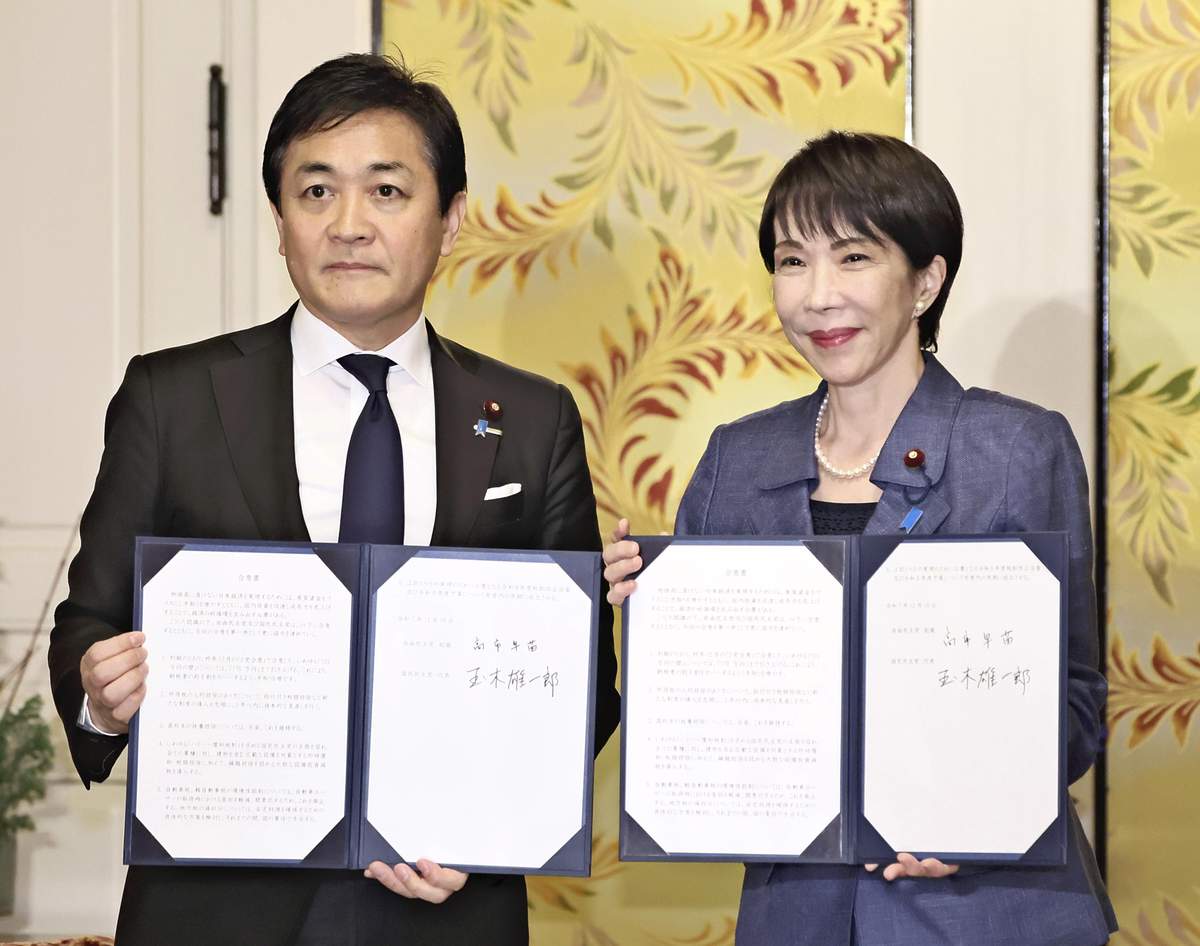
Prime Minister Sanae Takaichi, right, and Democratic Party for the People leader Yuichiro Tamaki show off their signed agreement on raising “annual income barrier” at the Diet on Thursday.
17:53 JST, December 19, 2025
The Liberal Democratic Party and the Democratic Party for the People have agreed on a deal to raise the taxable income threshold from ¥1.6 million to ¥1.78 million.
During a meeting at the Diet on Thursday, Prime Minister Sanae Takaichi, who also serves as the LDP president, and DPFP Leader Yuichiro Tamaki signed an agreement addressing the so-called “annual income barrier,” which is the income threshold at which income tax is first imposed.
In response to demands from the DPFP, the government will implement a substantial increase in deductions for middle-income earners for two years to boost their after-tax income.
These changes were added into the fiscal 2026 tax reform plan, which the ruling coalition finalized on Friday.
Takaichi spoke to reporters after the meeting, emphasizing, “I made my final decision in hopes of creating a virtuous cycle — rising incomes will bolster consumer sentiment, which will drive up business profits.”
In addition to raising the income barrier to ¥1.78 million, the government will expand the income bracket for those eligible for the full basic deduction, widening it from the current ¥2 million or less to up to ¥6.65 million.
About 80% of all taxpayers are set to benefit from this change. The application of the ¥6.65 million limit will be restricted to a two-year period, spanning 2026 and 2027.
The LDP made these concessions to the DPFP to address their demands for increasing after-tax income for middle-income earners, though the changes are expected to reduce tax revenue by an amount estimated at around ¥650 billion.
The government also plans to review the structure of income tax deductions within three years, with an eye toward the introduction of a “ tax credit and benefit system,” which would combine benefits and tax cuts.
In December last year, the LDP, Komeito and the DPFP agreed to work toward raising the annual income barrier to ¥1.78 million.
However, during the discussions on the fiscal 2025 tax reform, the parties could not reach an agreement on funding and other issues.
They settled for a smaller increase, setting the target at ¥1.6 million. However, the DPFP continued pushing for the original target.
An agreement was reached to eliminate the environmental performance tax, which was a levy of up to 3% on car purchases based on fuel economy.
Although the government and the ruling coalition initially considered suspending the tax for two years, they ultimately agreed to the DPFP’s demand to eliminate it completely.
They plan for the time being to maintain the dependent deduction that reduces the income tax burden for parents with high school-aged children between 16 and 18 years old.
The agreement also includes a commitment to ensure the early passage of the fiscal 2026 tax reform and budget proposals within the current fiscal year.
This marks a significant shift from the previous fiscal year, when the DPFP opposed both measures.
“We were able to overcome this challenge together, and our mutual trust has grown stronger. I believe we are now positioned to cooperate toward the passage of the budget,” Tamaki said at a press conference.



Most Read
Popular articles in the past 24 hours
-

Director Naomi Kawase's New Film Explores Heart Transplants in Ja...
-

Japan’s Nikkei Stock Average Rises on Tech Rally and Takaichi's S...
-
Takaichi Expected to Express Desire for Constitutional Revision P...
-

Security Services Law Unconstitutional: Do Not Restrict Career Ch...
-
Japanese Man Living in Iraq Suspected of Illegally Entering U.S. ...
-
New Leader of Japan's CRA Opposition Party Faces Challenge of For...
-

Tokyo Exhibition Featuring VR Walk Through 2025 Osaka-Kansai Expo...
-

Milano Cortina 2026: Snowboarding Star Fukada Wins Gold in Hard-F...
Popular articles in the past week
-

Japan PM Takaichi’s Cabinet Resigns en Masse
-

Man Infected with Measles Reportedly Dined at Restaurant in Tokyo...
-

Videos Plagiarized, Reposted with False Subtitles Claiming ‘Ryuky...
-

Sanae Takaichi Elected 105th Prime Minister of Japan; Keeps All C...
-

Japan's Govt to Submit Road Map for Growth Strategy in March, PM ...
-

Milano Cortina 2026: Figure Skaters Riku Miura, Ryuichi Kihara Pa...
-

Tokyo’s New Record-Breaking Fountain Named ‘Tokyo Aqua Symphony’
-

Bus Carrying 40 Passengers Catches Fire on Chuo Expressway; All E...
Popular articles in the past month
-
Japan PM Takaichi’s Cabinet Resigns en Masse
-

Japan Institute to Use Domestic Commercial Optical Lattice Clock ...
-

Israeli Ambassador to Japan Speaks about Japan’s Role in the Reco...
-
Man Infected with Measles Reportedly Dined at Restaurant in Tokyo...
-

Man Infected with Measles May Have Come in Contact with Many Peop...
-

Prudential Life Insurance Plans to Fully Compensate for Damages C...
-
Videos Plagiarized, Reposted with False Subtitles Claiming ‘Ryuky...
-

Woman with Measles Visited Hospital in Tokyo Multiple Times Befor...
Top Articles in Politics
-
Japan PM Takaichi’s Cabinet Resigns en Masse
-
Sanae Takaichi Elected 105th Prime Minister of Japan; Keeps All Cabinet Appointees from Previous Term
-
Japan’s Govt to Submit Road Map for Growth Strategy in March, PM Takaichi to Announce in Upcoming Policy Speech
-

LDP Wins Historic Landslide Victory
-

LDP Wins Landslide Victory, Secures Single-party Majority; Ruling Coalition with JIP Poised to Secure Over 300 seats (UPDATE 1)
JN ACCESS RANKING
-
Japan PM Takaichi’s Cabinet Resigns en Masse
-
Japan Institute to Use Domestic Commercial Optical Lattice Clock to Set Japan Standard Time
-
Israeli Ambassador to Japan Speaks about Japan’s Role in the Reconstruction of Gaza
-
Man Infected with Measles Reportedly Dined at Restaurant in Tokyo Station
-
Man Infected with Measles May Have Come in Contact with Many People in Tokyo, Went to Store, Restaurant Around When Symptoms Emerged