
Japan’s Dispute with China Set to Simmer On After Meeting at G20 Falls Through
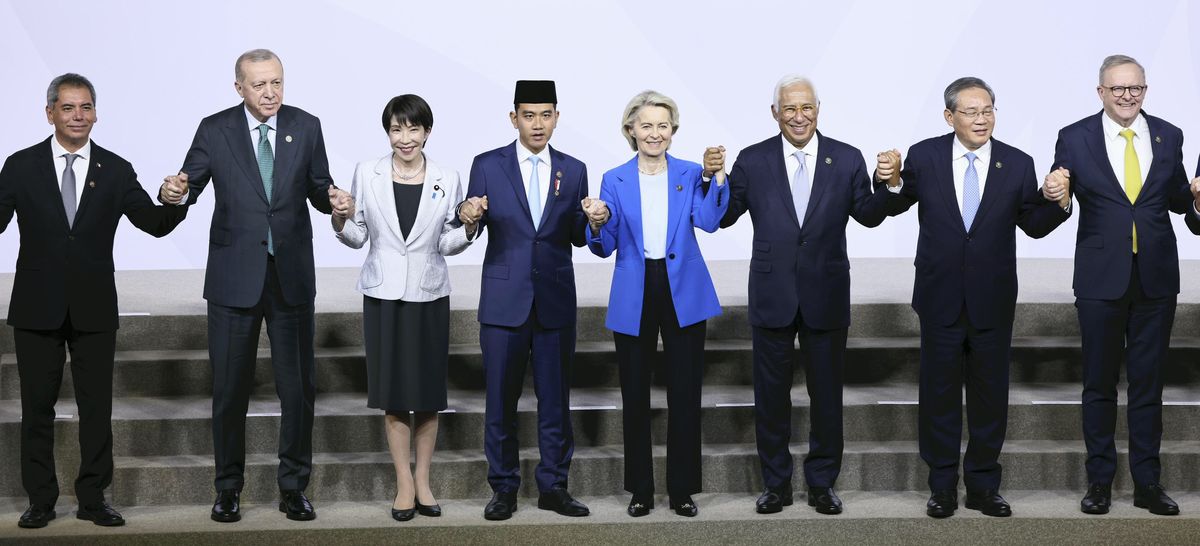
Prime Minister Sanae Takaichi, third from left, poses for a photo at the Group of 20 summit meeting in Johannesburg on Saturday. Chinese Premier Li Qiang is seen second from right.
17:05 JST, November 24, 2025
JOHANNESBURG/BEIJING — Japan and China failed to arrange a meeting together at the Group of 20 summit in South Africa last weekend.
Japan had hoped that direct communication between the countries’ prime ministers would offer a breakthrough, allowing dialogue to continue and preventing the situation from worsening. However, China stuck to its hardline stance, suggesting that the confrontation will likely drag on.
“We must say what we need to say,” Prime Minister Sanae Takaichi told reporters after a series of G20 events when asked how she was handling China. “We will keep responding appropriately.”
During the photo session on Saturday, the first day of the summit, Takaichi and Chinese Premier Li Qiang stood just a few meters apart for the picture. However, they left the venue without exchanging greetings.
Japan had initially planned to have a director from the Foreign Ministry’s China and Mongolia Division accompany Takaichi. Li is second in command in the Chinese Communist Party hierarchy and a close aide to President Xi Jinping. There was hope that direct communication would get the message of Takaichi’s true position to the top ranks of the Xi administration.
However, China remained intransigent and repeatedly said “there are no plans for a meeting,” which made Japan reluctant to reach out and decide to not send the director. The Japanese government was also concerned that if it appeared desperate for a meeting, that could be exploited by China in its propaganda.
Curbing dependence
With the meeting having failed to materialize, efforts to resolve the dispute seem to have stalled. Takaichi refuses to retract her remark in the Diet about a Taiwan contingency and a “survival-threatening situation,” which enraged China, and this has left little room for compromise with Beijing, which views the remark as encroaching on its sovereignty.
China has played its cards cautiously, such as by urging its citizens to refrain from non-essential travel to Japan, but has not resorted to more muscular economic measures, such as restricting rare earth exports to Japan, a tactic it has used in the past.
“China is carefully avoiding steps that would disrupt international supply chains,” a Japanese government official said.
If China imposed export restrictions, countries importing Japanese products made with Chinese rare earths would also suffer, meaning China would be the one to expand the conflict to the international community.
The Japanese government is also pivoting back toward caution when it comes to economic dependence on China, with economic security minister Kimi Onoda calling such dependence a “risk.” Expecting a long standoff, the Japanese government plans to lessen its economic dependence on China, such as by restructuring the supply chain.
A dilemma
On the other hand, a prolonged Japan-China conflict will inevitably impact such sectors as tourism, which could reflect negatively on the Takaichi administration.
While the Cabinet’s approval rating remains at a high 70%, the ruling coalition holds a minority in both houses of the Diet, leaving the government unstable. A drop in approval ratings would “put the brakes on the administration,” a former cabinet minister said.
Takaichi’s conservative supporters are demanding a tougher approach to China, but her stance seems to have created a dilemma in dealing with China.
“Overly conscious of her conservative stance, the prime minister has been unable to make political judgments flexibly,” a senior ruling party official said.
There is also concern about the lack of a liaison who can convey Takaichi’s position to China. Moreover, parliamentary diplomacy appears to be fading following the retirement of former Liberal Democratic Party Secretary General Toshihiro Nikai, who had built relations with China, and the secession from the ruling bloc of Komeito — traditionally close to China.
Japan has prepared for a long battle, with a foreign ministry official saying, “In the worst case, the confrontation could last for years.”


Related Tags




Most Read
Popular articles in the past 24 hours
-
78% Interested in Reconstruction from 2011 Disaster; Concern High...
-

Japan’s Nikkei Stock Average Rise Lifted by AI Stocks, Easing Con...
-

15 Years since Great East Japan Earthquake: How Can Affected Area...
-
2 Mt. Fuji Hikers Identified as Police Warn People Not to Climb i...
-

Parents in Japan to Get Instagram Notifications When Teens Repeat...
-

CARTOON OF THE DAY (March 11)
-

Japan’s Mitsui O.S.K. Lines Container Ship Anchored in Persian Gu...
-
Tokyo Conference 2026 Opens, Discusses Rebuilding Multilateralism...
Popular articles in the past week
-

Ibaraki Pref.'s 1st Foreign Bus Driver Hired in Tsukuba
-

Nippon Life Insurance's U.S. Arm Sues OpenAI Over Legal Assistanc...
-
Govt to Utilize ODA for Ensuring Economic Security; Securing Ener...
-

Amid Strait of Hormuz Blockade, Shipping Companies Scramble to Ge...
-
Japan Govt Survey Finds Just 10% of Workers Want Working Hours to...
-
Japan's 2nd Round of U.S. Investments May Be Worth Over $100 Bill...
-

Beckoning Cats Get Makeover to Fit Modern Lifestyles with Sleek D...
-

Imperial Family Watches World Baseball Classic Game Against Austr...
Popular articles in the past month
-

Producer Behind Pop Group XG Arrested for Cocaine Possession
-

Japan PM Takaichi’s Cabinet Resigns en Masse
-

Man Infected with Measles Reportedly Dined at Restaurant in Tokyo...
-

Videos Plagiarized, Reposted with False Subtitles Claiming ‘Ryuky...
-

iPS Treatments Pass Key Milestone, but Broader Applications Far f...
-

Sanae Takaichi Elected Prime Minister of Japan; Keeps All Cabinet...
-

Nepal Bus Crash Kills 19 People, Injures 25 Including One Japanes...
-
South Korea Tightens Rules on Foreigners Buying Homes in Seoul Me...
Top Articles in Politics
-
Japan PM Takaichi’s Cabinet Resigns en Masse
-
Sanae Takaichi Elected Prime Minister of Japan; Keeps All Cabinet Appointees from Previous Term
-

Japan’s Govt to Submit Road Map for Growth Strategy in March, PM Takaichi to Announce in Upcoming Policy Speech
-
CRA Leadership Election Will Center on Party Rebuilding; Lower House Defeat Leaves Divisions among Former CDPJ, Komeito Members
-
LDP Begins Training New Lawmakers to Avoid Scandal, Gaffes; Historic Victory in Latest Election Heightens Focus on Party
JN ACCESS RANKING
-
Producer Behind Pop Group XG Arrested for Cocaine Possession
-
Japan PM Takaichi’s Cabinet Resigns en Masse
-
Man Infected with Measles Reportedly Dined at Restaurant in Tokyo Station
-
Videos Plagiarized, Reposted with False Subtitles Claiming ‘Ryukyu Belongs to China’; Anti-China False Information Also Posted in Japan
-
iPS Treatments Pass Key Milestone, but Broader Applications Far from Guaranteed