
Japan’s Government Monitors China’s Propaganda Battle Over Takaichi’s Taiwan Contingency Remark
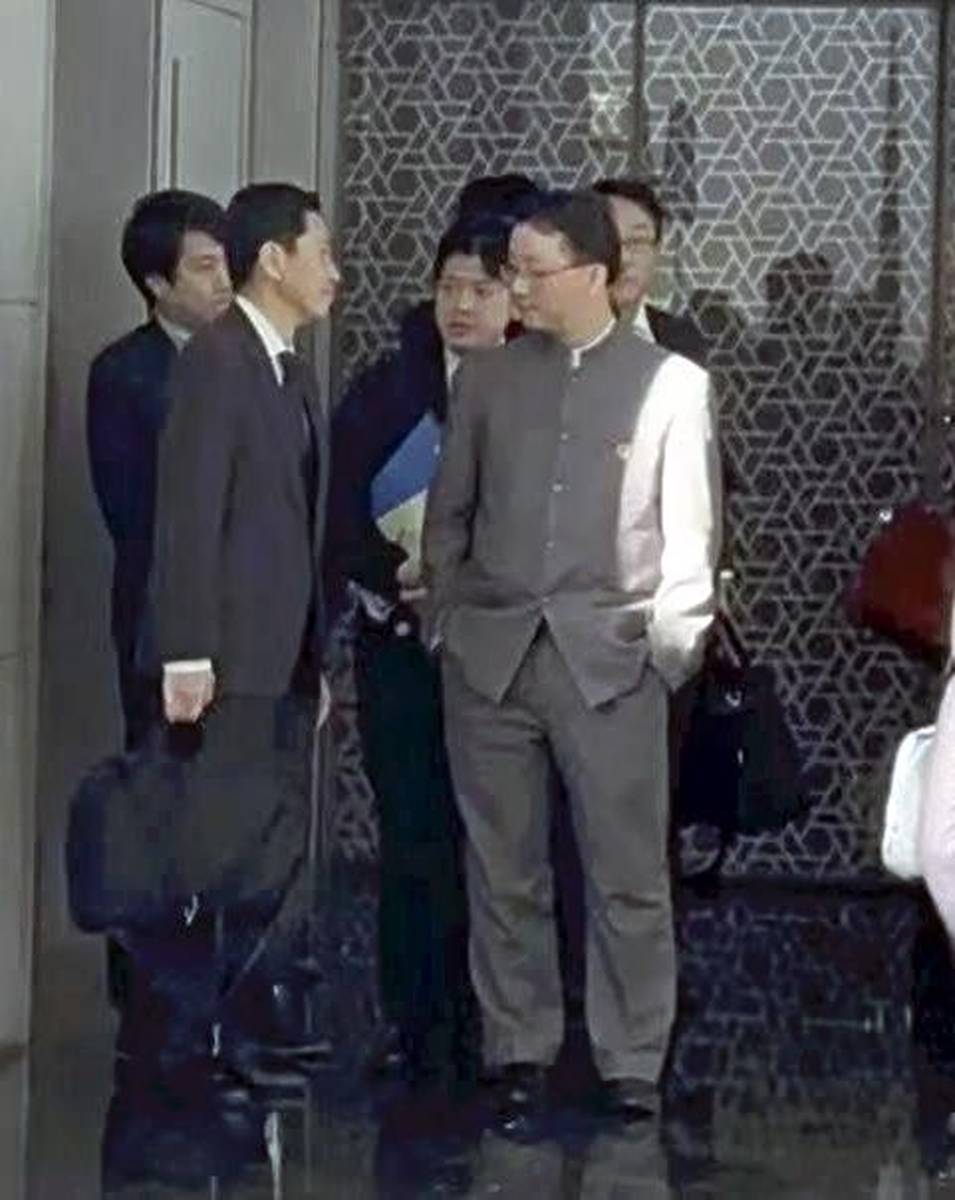
Masaaki Kanai, front left, director general of the Foreign Ministry’s Asian and Oceanian Affairs Bureau, talks with his Chinese counterpart Liu Jinsong, right, after their meeting in Beijing on Tuesday.
21:00 JST, November 19, 2025
The Japanese government sees China waging a propaganda battle as the Chinese side reiterated its strong condemnation of a remark by Prime Minister Sanae Takaichi over Taiwan. The latest condemnation came at a meeting of foreign ministry bureau chiefs of the two countries in Beijing on Tuesday.
The Japanese government assumes the Chinese side aims to get the upper hand concerning the Taiwan issue through propaganda.
Determined to face what may be a prolonged confrontational situation, the government is ready to respond in a cool-headed manner.
On Tuesday evening, China Central Television aired a video clip in which Liu Jinsong, director general of the Chinese Foreign Ministry’s Department of Asian Affairs, and Masaaki Kanai, director general of the Japanese Foreign Ministry’s Asian and Oceanian Affairs Bureau, appeared at the entrance of the Chinese Foreign Ministry building after their meeting.
In the video image, Liu spoke to Kanai with his hands in his pockets and a grim expression on his face.
Airing the scene seemed to aim to give the impression that the Chinese side had summoned the Japanese official and lodged a protest.
The remarks at issue were made by the prime minister on Nov. 7 during a Diet session, in response to a question by an opposition lawmaker. Takaichi said that a sea blockade around Taiwan by China “would constitute a survival-threatening situation” for Japan.
Subsequently, Takaichi said she would not retract her remark. But she also tried to calm the controversy by saying she would “reflect” on her remarks having gone too deeply into a specific assumption.
Chief Cabinet Secretary Minoru Kihara, with a 1972 Japan-China joint statement in mind, also said at a press conference that Japan’s stance on Taiwan “has not changed.” He has reiterated that Japan aims to support a peaceful solution between Beijing and Taipei.
Despite such follow-up remarks from Tokyo, Beijing has not laid down its rhetorical arms and appears to regard Takaichi’s remark in the Diet as a suggestion of Japan’s intervention into the Taiwan issue with military force.
If Takaichi does not retract the remark, Chinese Vice Foreign Minster Sun Weidong warned, “The Japanese side should take all the responsibility.”
The Chinese side is waging its campaign as if Japan had unilaterally raised the tension about the Taiwan issue.
A senior official of the Japanese Foreign Ministry said China’s attitude is the fiercest it has been since 2012, when Japan nationalized the Senkaku Islands in Okinawa Prefecture. The official added, “It seems they have decided to thoroughly condemn Japan.”
In 2012, as China made it routine for its ships to intrude into Japanese territorial waters around the Senkaku Islands, China said that Japan solely bore responsibility for the situation.
Also this time, it is possible that China aims to lower trust in Japan and strengthen pressure on Taiwan.
About the two officials’ meeting in Beijing, some lawmakers including Liberal Democratic Party members criticized the government, asking whether Kanai was going to attend the meeting to apologize to the Chinese government. The Japanese government emphasized that the meeting was merely a regularly scheduled one.
As conservative Japanese people who support Takaichi demand that the government should take a resolute diplomatic attitude toward China, a government source said, “Time is needed to change China’s attitude while carefully responding, so that we do not give a pretext for escalation.”




Most Read
Popular articles in the past 24 hours
-
BOJ Keeping Eye on Economy and Takaichi's ‘Proactive Fiscal Polic...
-
Tokyo Measles Patient Traveled to Fukuoka Aboard JAL Planes; Susp...
-

Party Representatives’ Questions in Diet: Takaichi Says Consumpti...
-

Govt to Set Working-Level Meeting Group for Refundable Tax Credit...
-

University of Tsukuba Hospital to Introduce Working Dog Next Year...
-

Milano Cortina 2026: News in Pictures / Feats of Japanese Athlete...
-

Pokémon Celebrates 30 Years with Japanese Pro Baseball Collab
-

Nikkei Crosses 59,000 for First Time on Software Rally; Gains Shr...
Popular articles in the past week
-

Producer Behind Pop Group XG Arrested for Cocaine Possession
-

iPS Treatments Pass Key Milestone, but Broader Applications Far f...
-

Tokyo Skytree's Elevator Stops, Trapping 20 People; All Rescued (...
-
Milano Cortina 2026: Japanese Gold Medalist Figure Skater Miura S...
-

Nepal Bus Crash Kills 19 People, Injures 25 Including One Japanes...
-

Japan’s Major Real Estate Firms Expanding Overseas Businesses to ...
-

Baby Monkey Punch Captures Hearts at Chiba Pref. Zoo, on Social M...
-

Milano Cortina 2026: Japanese Figure Skater Kaori Sakamoto’...
Popular articles in the past month
-
Producer Behind Pop Group XG Arrested for Cocaine Possession
-

Japan PM Takaichi’s Cabinet Resigns en Masse
-

Japan Institute to Use Domestic Commercial Optical Lattice Clock ...
-

Man Infected with Measles Reportedly Dined at Restaurant in Tokyo...
-

Israeli Ambassador to Japan Speaks about Japan’s Role in the Reco...
-

Videos Plagiarized, Reposted with False Subtitles Claiming ‘Ryuky...
-

Man Infected with Measles May Have Come in Contact with Many Peop...
-

Prudential Life Insurance Plans to Fully Compensate for Damages C...
Top Articles in Politics
-
Japan PM Takaichi’s Cabinet Resigns en Masse
-

Sanae Takaichi Elected Prime Minister of Japan; Keeps All Cabinet Appointees from Previous Term
-

Japan’s Govt to Submit Road Map for Growth Strategy in March, PM Takaichi to Announce in Upcoming Policy Speech
-

LDP Wins Historic Landslide Victory
-

LDP Wins Landslide Victory, Secures Single-party Majority; Ruling Coalition with JIP Poised to Secure Over 300 seats (UPDATE 1)
JN ACCESS RANKING
-
Producer Behind Pop Group XG Arrested for Cocaine Possession
-
Japan PM Takaichi’s Cabinet Resigns en Masse
-
Man Infected with Measles Reportedly Dined at Restaurant in Tokyo Station
-
Israeli Ambassador to Japan Speaks about Japan’s Role in the Reconstruction of Gaza
-
Videos Plagiarized, Reposted with False Subtitles Claiming ‘Ryukyu Belongs to China’; Anti-China False Information Also Posted in Japan