
Japan’s Rice Prices Remain High, but Agriculture Minister Intends to Change Policy on Increasing Production
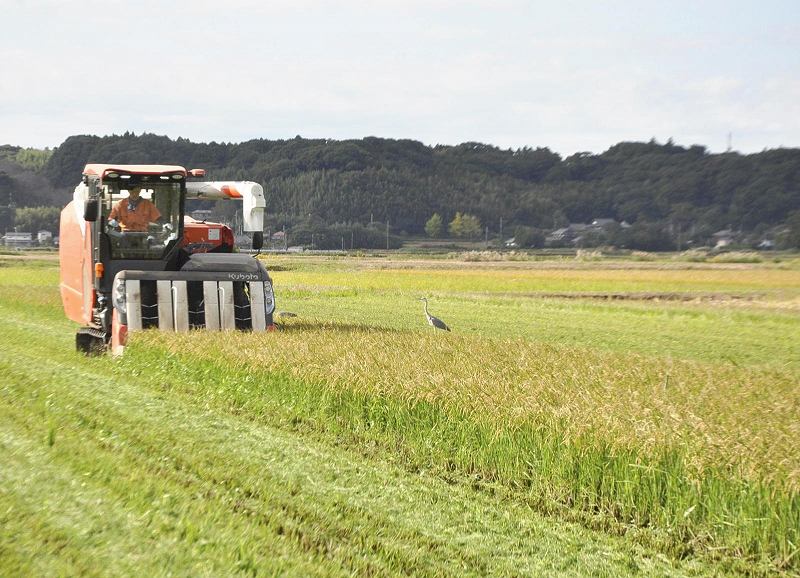
Rice fields are seen in Tonosho, Chiba Prefecture, on Oct. 28.
8:03 JST, November 9, 2025
Newly appointed Agriculture, Forestry and Fisheries Minister Norikazu Suzuki expressed his intention to revise rice production policy to one “based on demand.” Just three months ago, former Prime Minister Shigeru Ishiba implemented a policy on increasing rice production.
The move is believed to have been made out of consideration for farmers, who are worried about a potential collapse in rice prices. Yet, if prices remain elevated, the burden placed on consumers will remain.
“It is an important and fundamental rule to produce rice based on demand. We will administrate reassuring and far-sighted agricultural policies,” Suzuki stressed at his inaugural press conference in October, which showed his intention to alter the Ishiba administration’s decision made at a Cabinet meeting in August.
Production increases appear to have been a factor behind the latest move. Soaring rice prices have motivated farmers to grow more rice, and about 7.48 million tons of rice are expected to be produced for consumption as a staple food in 2025, up 10% from the previous year. The crop in 2026 is forecast to drop 5% year-on-year to 7.11 million tons.
Projecting rice demand for fiscal 2026 at 6.94 million to 7.11 million tons, the ministry said the latest change in rice policy is “in line with projected maximum rice demand.”
The government outlined a policy to increase rice production in the Basic Plan for Food, Agriculture and Rural Areas — formulated in March — which will serve as a guideline for agricultural policy over the next five years.
With an eye toward the development of rice export markets and for processed rice products, Suzuki said he does aim for medium-to-long-term production increases. “The rice production policy based on demand remains unchanged under the Basic Plan,” Suzuki said.
However, there is uncertainty about the future.
Private-sector imports surge
The average price of rice sold at supermarkets nationwide fell to the ¥3,500 range per 5 kilograms for the first time in six months in July, following the large-scale release of rice stockpiles into the market based on the government’s discretionary contracts with various retailers.
However, the average price rebounded and has now been in the ¥4,000 range for nine consecutive weeks and threatened the record high of ¥4,285 set in mid-May.
Ishiba had expressed his strong determination to suppress rice prices, saying, “The prices must be in the ¥3,000 range.” Former agriculture minister Shinjiro Koizumi sought to lower the prices through the government-stockpiled rice releases.
Suzuki said on a TV program on Oct. 27 that a prime minister should not comment on desirable rice price levels.
“Rice prices should be determined by the market. I will not commit to a specific rice price,” he said, indicating that rice prices should be stabilized by realizing stability in supply and demand.
Against the backdrop of soaring rice prices, however, private-sector imports of overseas rice have surged.
According to the Finance Ministry’s trade statistics, 86,523 tons of rice was privately imported in the first half of fiscal 2025, more than 200 times the volume over the same period last year.
When private parties import rice, a tariff of ¥341 per kilogram is imposed. Despite this, Japanese companies have increased their rice imports because the prices are lower than domestically produced rice, even with the tariff.
Aeon Co. began selling Calrose medium grain rice produced in California at its stores nationwide in June. The price of the rice fell to ¥2,138 per 4 kilograms in August from the initial ¥2,894.
Calrose is said to have been well-received thanks to its lighter texture compared to domestic Japanese rice. About 14,000 tons of the rice was imported by Aeon and is expected to sell out soon.
There are voices among rice farmers supporting rice production being tied to demand. “Bringing water to unmanaged farmland is not an easy task. We just cannot increase production as instructed,” said a 60-year-old farmer who produces Tsuyahime and other brand rice in Nanyo, Yamagata Prefecture.
“Koizumi took measures against rapidly soaring rice prices in a swift manner, demonstrating that agricultural policies are meant for consumers, too,” said Kazunuki Oizumi, professor emeritus of Miyagi University.
“A return to traditional agricultural policies is seen in Suzuki, who comes from the agriculture ministry. He prioritizes the perspective of rice producers,” Oizumi added.


Related Tags





Most Read
Popular articles in the past 24 hours
-
78% Interested in Reconstruction from 2011 Disaster; Concern High...
-
Japan’s Nikkei Stock Average Rise Lifted by AI Stocks, Easing Con...
-

15 Years since Great East Japan Earthquake: How Can Affected Area...
-
2 Mt. Fuji Hikers Identified as Police Warn People Not to Climb i...
-

Parents in Japan to Get Instagram Notifications When Teens Repeat...
-

Japan’s Mitsui O.S.K. Lines Container Ship Anchored in Persian Gu...
-

CARTOON OF THE DAY (March 11)
-
Tokyo Conference 2026 Opens, Discusses Rebuilding Multilateralism...
Popular articles in the past week
-

Ibaraki Pref.'s 1st Foreign Bus Driver Hired in Tsukuba
-

Nippon Life Insurance's U.S. Arm Sues OpenAI Over Legal Assistanc...
-
Govt to Utilize ODA for Ensuring Economic Security; Securing Ener...
-

Amid Strait of Hormuz Blockade, Shipping Companies Scramble to Ge...
-
Japan Govt Survey Finds Just 10% of Workers Want Working Hours to...
-

Beckoning Cats Get Makeover to Fit Modern Lifestyles with Sleek D...
-
Japan's 2nd Round of U.S. Investments May Be Worth Over $100 Bill...
-

Imperial Family Watches World Baseball Classic Game Against Austr...
Popular articles in the past month
-

Producer Behind Pop Group XG Arrested for Cocaine Possession
-

Japan PM Takaichi’s Cabinet Resigns en Masse
-

Man Infected with Measles Reportedly Dined at Restaurant in Tokyo...
-

Videos Plagiarized, Reposted with False Subtitles Claiming ‘Ryuky...
-

iPS Treatments Pass Key Milestone, but Broader Applications Far f...
-

Sanae Takaichi Elected Prime Minister of Japan; Keeps All Cabinet...
-

Nepal Bus Crash Kills 19 People, Injures 25 Including One Japanes...
-
South Korea Tightens Rules on Foreigners Buying Homes in Seoul Me...
Top Articles in Politics
-
Japan PM Takaichi’s Cabinet Resigns en Masse
-
Sanae Takaichi Elected Prime Minister of Japan; Keeps All Cabinet Appointees from Previous Term
-

Japan’s Govt to Submit Road Map for Growth Strategy in March, PM Takaichi to Announce in Upcoming Policy Speech
-
CRA Leadership Election Will Center on Party Rebuilding; Lower House Defeat Leaves Divisions among Former CDPJ, Komeito Members
-
LDP Begins Training New Lawmakers to Avoid Scandal, Gaffes; Historic Victory in Latest Election Heightens Focus on Party
JN ACCESS RANKING
-
Producer Behind Pop Group XG Arrested for Cocaine Possession
-
Japan PM Takaichi’s Cabinet Resigns en Masse
-
Man Infected with Measles Reportedly Dined at Restaurant in Tokyo Station
-
Videos Plagiarized, Reposted with False Subtitles Claiming ‘Ryukyu Belongs to China’; Anti-China False Information Also Posted in Japan
-
iPS Treatments Pass Key Milestone, but Broader Applications Far from Guaranteed