
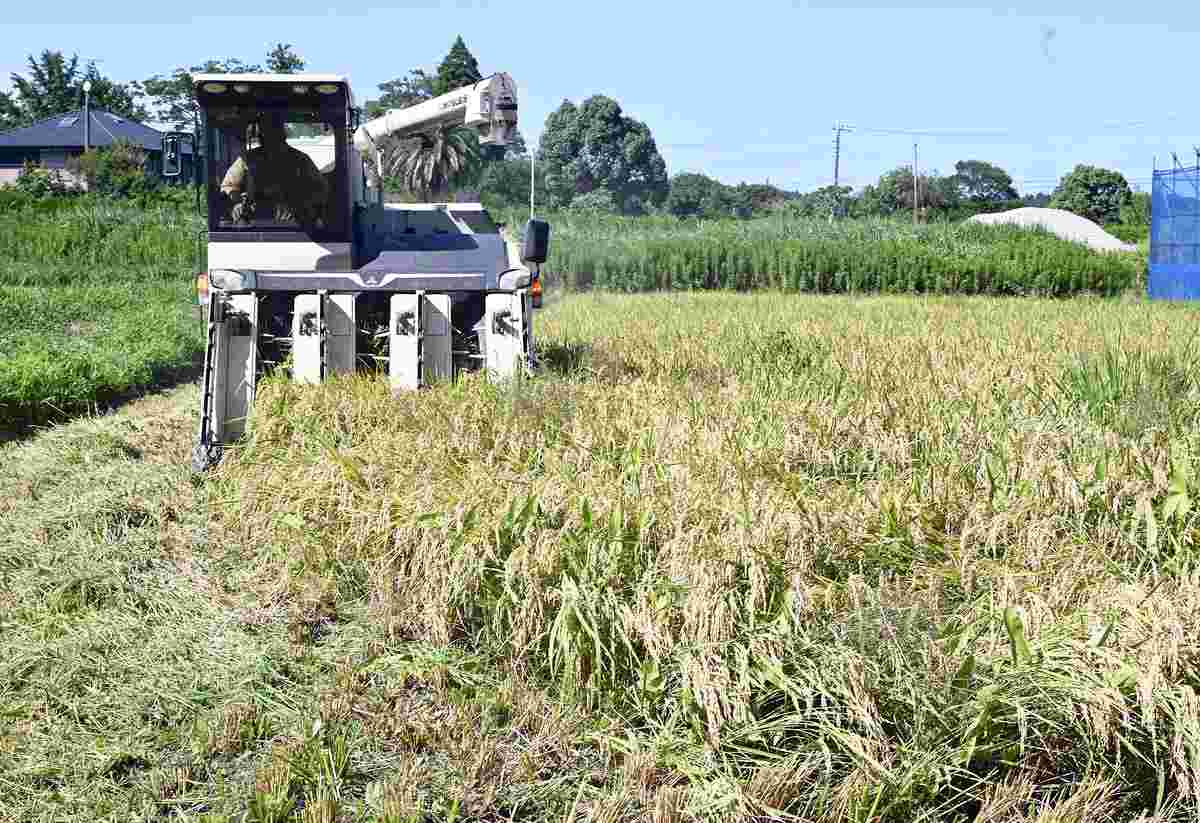
A farmer harvests in Isumi, Chiba Prefecture, on July 22.
1:00 JST, August 7, 2025
The government has revised its agricultural policy, shifting to a new strategy aimed at boosting rice production.
Although the policy of capping rice production ended with the rice harvested in 2018, the government has continued to make unofficial attempts to control production volumes.
Since the 2022 harvest, demand has largely exceeded production.
The government concluded that the recent rice price hikes were caused by low production volumes. Therefore, it plans to help rice farmers increase their crop yields through measures to raise productivity and by other means to stabilize prices.
Rice prices remain high
The average retail price of rice in about 1,000 supermarkets nationwide hit ¥4,285 per five kilograms in May, which is double the price from the same period last year, according to the Agriculture, Forestry and Fisheries Ministry.
On Monday, it was announced that the average price had risen for the first time in 10 weeks, reaching ¥3,625 per five kilograms between July 21 and 27. However, Agriculture, Forestry and Fisheries Minister Shinjiro Koizumi commented, “[The prices] have stabilized considerably compared to peak times.”
Last summer, rice prices began to surge after inventories of retailers decreased. At the time, the agriculture ministry said prices would fall and stabilize at appropriate levels once the new harvests began circulating in the market.
However, even after the new harvests entered in the market last autumn, the upward trend in rice prices did not change.
Prices continued to rise even after the start of this year, prompting the agriculture ministry to release government-stockpiled rice.
Koizumi, who became agriculture minister in May, began releasing more government-stockpiled rice sold through no-bid contracts, aiming for a retail price of around ¥2,000 per five kilograms.
Since then, average rice prices have started to fall, but the current prices remain higher than before the price hikes began.
Inaccurate forecast
Experts have pointed to the government inaccurately forecasting rice demand as a possible cause of the price hikes.
The agriculture ministry disclosed in late July that the demand for the 2024 rice harvest as a staple food between July 2024 and June 2025 was 7.11 million tons.
This figure represents an increase of 370,000 tons from the previous forecast in May.
The ministry predicted that the demand for rice would decrease by an average of 100,000 tons per year alongside Japan’s declining population. But the ministry miscalculated other factors, such as increased household purchases amid concerns about rice shortages and increased dining-out demand due to the rise in foreign tourists visiting Japan.
Initially, the ministry assumed the shortage was due to excessive inventories held by retailers and wholesalers.
However, after surveying approximately 70,000 businesses nationwide on rice sales and inventory status, the ministry found that rice collectors, including local agricultural cooperatives of the JA group, as well as retailers and restaurants, had similar inventory levels as of the end of June compared to the previous year.
Drawbacks of production caps
Previously, the government had promoted a policy of reducing rice cultivation by setting production targets and allocating them to prefectures. Although this policy was abolished for the 2018 crop, the government continues to provide a guideline for production based on the demand forecast and subsidies to producers who switch from producing rice for consumers to producing rice for animal feed. The policy that in effect curbed rice production has continued.
This was done to support rice producers and prevent production volumes from being too high, which could lead to a significant drop in prices.
But the ministry’s miscalculation of supply and demand forecasts, diversification of sales channels and the decrease in harvests due to extremely hot weather, among other factors, have adversely affected the rice market.
The current situation has exposed the drawbacks of agricultural policies that prioritize capping rice production volumes.
Going forward, the government aims to increase the productivity of rice farmers through such measures as utilizing advanced digital technologies and expanding the scale of farming operations.
Additionally, there are plans to establish a new system to help farmers in mountainous areas, which are not ideal for agricultural production, to manage their land.
With these measures, the government aims to create an environment in which producers will be motivated to boost rice production.


Related Tags

Most Read
Popular articles in the past 24 hours
-

Director Naomi Kawase's New Film Explores Heart Transplants in Ja...
-
Japan’s Nikkei Stock Average Rises on Tech Rally and Takaichi's S...
-

Takaichi Expected to Express Desire for Constitutional Revision P...
-
Japanese Man Living in Iraq Suspected of Illegally Entering U.S. ...
-

Security Services Law Unconstitutional: Do Not Restrict Career Ch...
-
New Leader of Japan's CRA Opposition Party Faces Challenge of For...
-

Milano Cortina 2026: Snowboarding Star Fukada Wins Gold in Hard-F...
-

Tokyo Exhibition Featuring VR Walk Through 2025 Osaka-Kansai Expo...
Popular articles in the past week
-

Japan PM Takaichi’s Cabinet Resigns en Masse
-

Man Infected with Measles Reportedly Dined at Restaurant in Tokyo...
-

Videos Plagiarized, Reposted with False Subtitles Claiming ‘Ryuky...
-

Sanae Takaichi Elected 105th Prime Minister of Japan; Keeps All C...
-

Japan's Govt to Submit Road Map for Growth Strategy in March, PM ...
-

Milano Cortina 2026: Figure Skaters Riku Miura, Ryuichi Kihara Pa...
-

Tokyo’s New Record-Breaking Fountain Named ‘Tokyo Aqua Symphony’
-

Bus Carrying 40 Passengers Catches Fire on Chuo Expressway; All E...
Popular articles in the past month
-
Japan PM Takaichi’s Cabinet Resigns en Masse
-

Japan Institute to Use Domestic Commercial Optical Lattice Clock ...
-

Israeli Ambassador to Japan Speaks about Japan’s Role in the Reco...
-
Man Infected with Measles Reportedly Dined at Restaurant in Tokyo...
-

Man Infected with Measles May Have Come in Contact with Many Peop...
-

Prudential Life Insurance Plans to Fully Compensate for Damages C...
-
Videos Plagiarized, Reposted with False Subtitles Claiming ‘Ryuky...
-

Woman with Measles Visited Hospital in Tokyo Multiple Times Befor...
Top Articles in Politics
-
Japan PM Takaichi’s Cabinet Resigns en Masse
-
Sanae Takaichi Elected 105th Prime Minister of Japan; Keeps All Cabinet Appointees from Previous Term
-
Japan’s Govt to Submit Road Map for Growth Strategy in March, PM Takaichi to Announce in Upcoming Policy Speech
-

LDP Wins Historic Landslide Victory
-

LDP Wins Landslide Victory, Secures Single-party Majority; Ruling Coalition with JIP Poised to Secure Over 300 seats (UPDATE 1)
JN ACCESS RANKING
-
Japan PM Takaichi’s Cabinet Resigns en Masse
-
Japan Institute to Use Domestic Commercial Optical Lattice Clock to Set Japan Standard Time
-
Israeli Ambassador to Japan Speaks about Japan’s Role in the Reconstruction of Gaza
-
Man Infected with Measles Reportedly Dined at Restaurant in Tokyo Station
-
Man Infected with Measles May Have Come in Contact with Many People in Tokyo, Went to Store, Restaurant Around When Symptoms Emerged