
AI Regulations in Japan Under Development; Calls for Reform of Copyright Law by Publishers

Illustration taken on June 23.
21:00 JST, November 27, 2023
Effective regulations for domestic artificial intelligence providers are still under development and Prime Minister Fumio Kishida said, “It is important to establish international governance that promotes the benefits of AI while appropriately addressing the risks.”
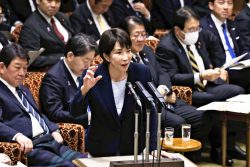
Economic security minister Sanae Takaichi told reporters at the press conference Friday, that AI development “must be balanced with the need to ensure safety and to promote the spread of AI.”
The Group of Seven nations at the end of October agreed on international guidelines and an international code of conduct for AI developers as part of the Hiroshima AI Process led by the chair, Japan. Those guidelines call for appropriate measures to be taken from the pre-market stage, illustrating risks such as the development of weapons using AI and the promotion of disinformation, prejudice and discrimination.
In line with those international guidelines, the government drafted its guidelines for domestic AI providers in November, which includes a discussion about the implementation of a third-party certification system. The government plans to proceed with the design of a detailed regulatory system. As it is unclear whether the system will serve as a deterrent to AI operators who try to develop products without due regard for safety, the government is reluctant to establish penalties for violations.
Regulations governing operators are also controversial in other countries. The European Union aims to pass an AI law by next spring that will strongly regulate operators, including with the use of penalties. However, some member countries, particularly France, Germany, and Italy, are of the opinion that self-regulation by AI developers is sufficient. These countries are concerned that the new law would hamper the activities of their domestic AI providers, and talks over AI regulation within the EU may be protracted.
In Japan, the focus is also on the state of Copyright Law, which currently permits AI to learn without the permission of copyright holders. A subcommittee of the Council for Cultural Affairs in the Cultural Affairs Agency is discussing the issue with the aim of finalizing measures by the end of March. The Japan Newspaper Publishers & Editors Association and others are calling for stronger measures, including legal reform.
The originator profile, a digital technology that clearly identifies the sender of information, is considered to be an effective countermeasure against disinformation.







Most Read
Popular articles in the past 24 hours
-

Record Snowfall in Japan Causes Serious Agricultural Damage in To...
-
Japan Police Told to Boost Security, Vigilance Around U.S., Israe...
-

Japan Traditional Puppet Performance Held at Onsen Resort in Shiz...
-

U.S. Urges Citizens to Immediately Depart over A Dozen Middle Eas...
-

Strait of Hormuz Closure Shakes Markets; Prolonged Closure Could ...
-

Japanese Firms Ban Business Trips, Cancel Vacation Tours Amid Mid...
-
2 of Japan's Opposition Parties Submit Bill to Revise Political F...
-
Joichi Ito’s Japan Government Role Uncertain Amid Fresh Epstein S...
Popular articles in the past week
-
Milano Cortina 2026: Japanese Gold Medalist Figure Skater Miura S...
-

Tokyo Spends Big on Children, Wins Over Parents
-
Japan’s Miura, Kihara Announce Withdrawal from Figure Skating Wor...
-

Exhibition Featuring Yoshiharu Tsuge’s Manga World Underway in Ch...
-

Yokohama to Test Out Renewable-Powered Offshore Floating Data Cen...
-
BOJ Keeping Eye on Economy and Takaichi's ‘Proactive Fiscal Polic...
-

Tokyo Measles Patient Traveled to Fukuoka Aboard JAL Planes; Susp...
-
Japan Seeks to Counter China's Expanding Influence in Pacific by ...
Popular articles in the past month
-

Producer Behind Pop Group XG Arrested for Cocaine Possession
-

Japan PM Takaichi’s Cabinet Resigns en Masse
-

Man Infected with Measles Reportedly Dined at Restaurant in Tokyo...
-

Israeli Ambassador to Japan Speaks about Japan’s Role in the Reco...
-

Videos Plagiarized, Reposted with False Subtitles Claiming ‘Ryuky...
-

Man Infected with Measles May Have Come in Contact with Many Peop...
-

Prudential Life Insurance Plans to Fully Compensate for Damages C...
-

Woman with Measles Visited Hospital in Tokyo Multiple Times Befor...
Top Articles in Politics
-
Japan PM Takaichi’s Cabinet Resigns en Masse
-

Sanae Takaichi Elected Prime Minister of Japan; Keeps All Cabinet Appointees from Previous Term
-
Japan’s Govt to Submit Road Map for Growth Strategy in March, PM Takaichi to Announce in Upcoming Policy Speech
-

LDP Wins Landslide Victory, Secures Single-party Majority; Ruling Coalition with JIP Poised to Secure Over 300 seats (UPDATE 1)
-

LDP Wins Historic Landslide Victory
JN ACCESS RANKING
-
Producer Behind Pop Group XG Arrested for Cocaine Possession
-
Japan PM Takaichi’s Cabinet Resigns en Masse
-
Man Infected with Measles Reportedly Dined at Restaurant in Tokyo Station
-
Israeli Ambassador to Japan Speaks about Japan’s Role in the Reconstruction of Gaza
-
Videos Plagiarized, Reposted with False Subtitles Claiming ‘Ryukyu Belongs to China’; Anti-China False Information Also Posted in Japan