
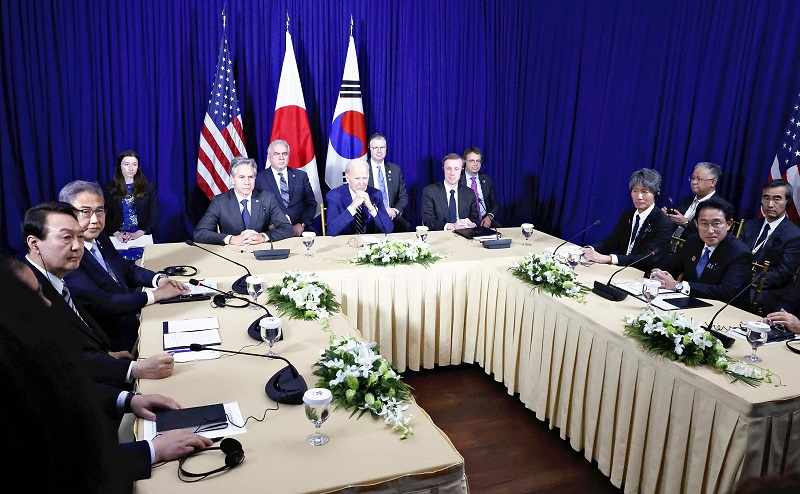
South Korean President Yoon Suk-yeol, left, U.S. President Joe Biden, center, and Japanese Prime Minister Fumio Kishida, second from right, are seen in Phnom Penh on Nov. 13, 2022.
2:00 JST, January 3, 2023
Japan and South Korea are considering the immediate sharing of information related to North Korean missile launches due to the growing seriousness of the threat of nuclear missiles. While Tokyo and Seoul have some political difficulties such as historical issues to sort through, the United States has been using its influence to push both sides to work together.
North Korea is rapidly strengthening its development of ballistic missiles and preparing to deploy nuclear missiles for actual warfare in accordance with a five-year plan presented at the 2021 congress of the Korean Workers’ Party. Pyongyang has also repeatedly conducted tests launching intercontinental ballistic missiles capable of reaching the U.S. mainland.
Washington feels a strong sense of crisis. The leaders of Japan, U.S. and South Korea held a trilateral summit in Cambodia in November last year. Their joint statement stressed that the leaders “strongly condemn DPRK’s unprecedented number of ballistic missile launches this year.” It later states that the leaders “intend to share DPRK missile warning data in real time to improve each country’s ability to detect and assess the threat posed by incoming missiles.”
Data discrepancy
Data sharing between Japan and South Korea is necessary in order to detect and respond to missile flight data as soon as possible after a launch.
When North Korea launches missiles, the data that can be ascertained differs. U.S. early warning satellites use infrared sensors to detect high heat. Aegis-equipped vessels possessed by Japan, the U.S. and South Korea along with ground-based radars in Japan and South Korea, also detect and track the missiles.
On June 5, 2022, North Korea launched ballistic missiles that fell into the Sea of Japan. South Korea announced that Pyongyang had fired eight missiles. Japan initially announced at least six, but revised it to eight a few days later. This discrepancy is due in part to the difference in what the two countries’ radars can capture.
Being next to North Korea, South Korea is able to obtain more accurate information immediately after launch and in the early stages of flight. Conversely, when missiles fall into waters close to Japan, Tokyo can more accurately determine the point of impact and other such information. For such reasons, the announcements by both countries have differed in terms of flight distance and maximum altitude as well.
Unresolved issues
The U.S.-Japan and U.S.-ROK systems are already connected. “Technically, it is not so difficult,” a source said, to connect a Japan-ROK system via the U.S.
The issue is the relations of trust between Japan and South Korea.
Last May, the conservative administration of President Yoon Suk-yeol came to power in South Korea. The government’s willingness to strengthen the U.S.-South Korea alliance and improve Japan-South Korea relations has led to the consideration of radar intelligence sharing.
Under the previous liberal administration of then President Moon Jae-in, a conciliatory line was taken toward Pyongyang in terms of diplomacy and security. Thus, there are concerns that the policy of sharing missile information may change with the change of administration.
Also remaining unresolved is the issue during the Moon administration in which a South Korean Navy vessel had radar lock on a Maritime Self-Defense Force aircraft.
Since some Japanese radars are made in Japan, if all information is shared, technical performance could also be revealed. To what extent information needs to be disclosed will also be a focus.




Most Read
Popular articles in the past 24 hours
-
Japanese Students Use Traditional Pickle to Create Novel Wagashi ...
-

My Spendthrift Mother Constantly Asks Me for Money
-

‘Dry Bonsai’ Gives New Life to Withered Trees, Allows Free Artist...
-

McDonald's Japan Raises Prices; Big Mac to Cost ¥500, Double Chee...
-

Nepal Bus Crash Kills 19 People, Injures 25 Including One Japanes...
-

Astellas Collaborates with Vir to Develop Its Experimental Prosta...
-

Japan’s Nikkei Stock Average Rises as AI-Related Stocks Shine; Co...
-

Early-Blooming Kawazu Cherry Blossoms Create Sea of Pink at Park ...
Popular articles in the past week
-

Producer Behind Pop Group XG Arrested for Cocaine Possession
-

Japan PM Takaichi’s Cabinet Resigns en Masse
-

Sanae Takaichi Elected Prime Minister of Japan; Keeps All Cabinet...
-

Japan's Govt to Submit Road Map for Growth Strategy in March, PM ...
-

Bus Carrying 40 Passengers Catches Fire on Chuo Expressway; All E...
-

U.S. Firm to Build Training Hub in Fukushima N-plant for Debris R...
-

Japan, U.S. Name 3 Inaugural Investment Projects; Reached Agreeme...
-

Riku-Ryu Pair Wins Gold Medal: Their Strong Bond Leads to Major C...
Popular articles in the past month
-
Producer Behind Pop Group XG Arrested for Cocaine Possession
-
Japan PM Takaichi’s Cabinet Resigns en Masse
-

Japan Institute to Use Domestic Commercial Optical Lattice Clock ...
-

Man Infected with Measles Reportedly Dined at Restaurant in Tokyo...
-

Israeli Ambassador to Japan Speaks about Japan’s Role in the Reco...
-

Videos Plagiarized, Reposted with False Subtitles Claiming ‘Ryuky...
-

Man Infected with Measles May Have Come in Contact with Many Peop...
-

Prudential Life Insurance Plans to Fully Compensate for Damages C...
Top Articles in Politics
-
Japan PM Takaichi’s Cabinet Resigns en Masse
-
Sanae Takaichi Elected Prime Minister of Japan; Keeps All Cabinet Appointees from Previous Term
-
Japan’s Govt to Submit Road Map for Growth Strategy in March, PM Takaichi to Announce in Upcoming Policy Speech
-

LDP Wins Historic Landslide Victory
-

LDP Wins Landslide Victory, Secures Single-party Majority; Ruling Coalition with JIP Poised to Secure Over 300 seats (UPDATE 1)
JN ACCESS RANKING
-
Producer Behind Pop Group XG Arrested for Cocaine Possession
-
Japan PM Takaichi’s Cabinet Resigns en Masse
-
Japan Institute to Use Domestic Commercial Optical Lattice Clock to Set Japan Standard Time
-
Man Infected with Measles Reportedly Dined at Restaurant in Tokyo Station
-
Israeli Ambassador to Japan Speaks about Japan’s Role in the Reconstruction of Gaza