
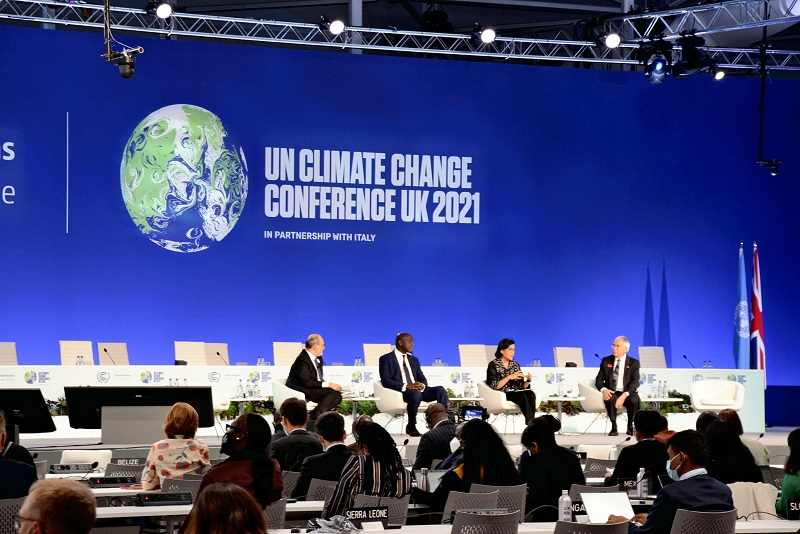
Officials speak at a COP26 meeting in Glasgow, Scotland, in 2021.
6:00 JST, October 12, 2022
A Japan-led offset credit trading framework to reduce greenhouse gas emissions will be launched at the 27th Conference of the Parties to the U.N. Framework Convention on Climate Change (COP27) in Egypt next month.
More than 30 countries and international organizations are expected to participate in the framework.
The Japanese government hopes a framework it has been working on independently will become an international standard. It also hopes to capitalize on Japan’s decarbonization technology overseas.
Under the framework, if a developed country provides a developing country with technology or financial assistance that leads to a reduction in greenhouse gas emissions, a portion of the reduction can be credited to the developed country.
The mechanism was stipulated in Article 6 of the Paris Agreement adopted at COP21 in 2015. Implementation guidelines for the article were agreed upon at COP26 last year.
Under the framework, developed countries will be able to reduce greenhouse gas emissions efficiently, and developing countries will be able to improve decarbonization technology.
Once trading gets into full swing, an estimate indicates emissions will be reduced by up to 9 billion tons a year, about 30% of global emissions, by 2030.
Japan has pioneered efforts toward such a framework. Under the Joint Crediting Mechanism established in 2013, Japan has launched more than 200 projects in 22 countries mainly in Asia, Africa and Latin America, supporting the introduction of renewable energy power generation. Many Japanese companies have participated in these projects.
In Bac Ninh Province, Vietnam, a large-scale waste-to-energy plant is being constructed by Japanese companies including JFE Engineering Corp. Instead of burning fossil fuels, the power plant will incinerate 500 tons of waste per day and use the heat from the incineration to generate electricity.
The project is expected to reduce carbon dioxide emissions by about 41,800 tons a year, part of which will be factored into Japan’s emissions reduction tally.
Ahead of the launch of the Japan-led framework, 19 nations including Britain, Germany and India, and 14 international organizations, including the World Bank and the U.N. Development Program, attended a meeting in Kanagawa Prefecture last month.
The Japanese government hopes more than 100 countries will adopt the new framework, which is aimed at helping partner countries by providing them with knowledge acquired through the Joint Crediting Mechanism, as well as positioning Japan as a leading player in global decarbonization efforts.





Most Read
Popular articles in the past 24 hours
-

3,000 Accounts Posting, Spreading Content Critical of Japan on X;...
-

Milano Cortina 2026: Sakamoto Serves as Flag Bearer; Japan Earns ...
-

My Spendthrift Mother Constantly Asks Me for Money
-

A Packed Bus Plunges off a Nepal Highway, Killing 19 and Injuring...
-
Emperor Receives Well-Wishes from Public on His 66th Birthday
-

Dozens of Jewelry, Other Items Stolen After Glass Door, Showcases...
-

1.2 Mil. Rapeseed Flowers Attract Cute Birds, People in Aichi Pre...
-

Mexican Army Kills Leader of Powerful Jalisco New Generation Cart...
Popular articles in the past week
-

Japan PM Takaichi’s Cabinet Resigns en Masse
-

Man Infected with Measles Reportedly Dined at Restaurant in Tokyo...
-

Sanae Takaichi Elected Prime Minister of Japan; Keeps All Cabinet...
-

Japan's Govt to Submit Road Map for Growth Strategy in March, PM ...
-

Bus Carrying 40 Passengers Catches Fire on Chuo Expressway; All E...
-

U.S. Firm to Build Training Hub in Fukushima N-plant for Debris R...
-

Japan, U.S. Name 3 Inaugural Investment Projects; Reached Agreeme...
-

Riku-Ryu Pair Wins Gold Medal: Their Strong Bond Leads to Major C...
Popular articles in the past month
-
Japan PM Takaichi’s Cabinet Resigns en Masse
-

Japan Institute to Use Domestic Commercial Optical Lattice Clock ...
-

Israeli Ambassador to Japan Speaks about Japan’s Role in the Reco...
-
Man Infected with Measles Reportedly Dined at Restaurant in Tokyo...
-

Videos Plagiarized, Reposted with False Subtitles Claiming ‘Ryuky...
-

Man Infected with Measles May Have Come in Contact with Many Peop...
-

Prudential Life Insurance Plans to Fully Compensate for Damages C...
-

Woman with Measles Visited Hospital in Tokyo Multiple Times Befor...
Top Articles in Politics
-
Japan PM Takaichi’s Cabinet Resigns en Masse
-
Sanae Takaichi Elected Prime Minister of Japan; Keeps All Cabinet Appointees from Previous Term
-
Japan’s Govt to Submit Road Map for Growth Strategy in March, PM Takaichi to Announce in Upcoming Policy Speech
-

LDP Wins Historic Landslide Victory
-

LDP Wins Landslide Victory, Secures Single-party Majority; Ruling Coalition with JIP Poised to Secure Over 300 seats (UPDATE 1)
JN ACCESS RANKING
-
Japan PM Takaichi’s Cabinet Resigns en Masse
-
Japan Institute to Use Domestic Commercial Optical Lattice Clock to Set Japan Standard Time
-
Israeli Ambassador to Japan Speaks about Japan’s Role in the Reconstruction of Gaza
-
Man Infected with Measles Reportedly Dined at Restaurant in Tokyo Station
-
Videos Plagiarized, Reposted with False Subtitles Claiming ‘Ryukyu Belongs to China’; Anti-China False Information Also Posted in Japan