
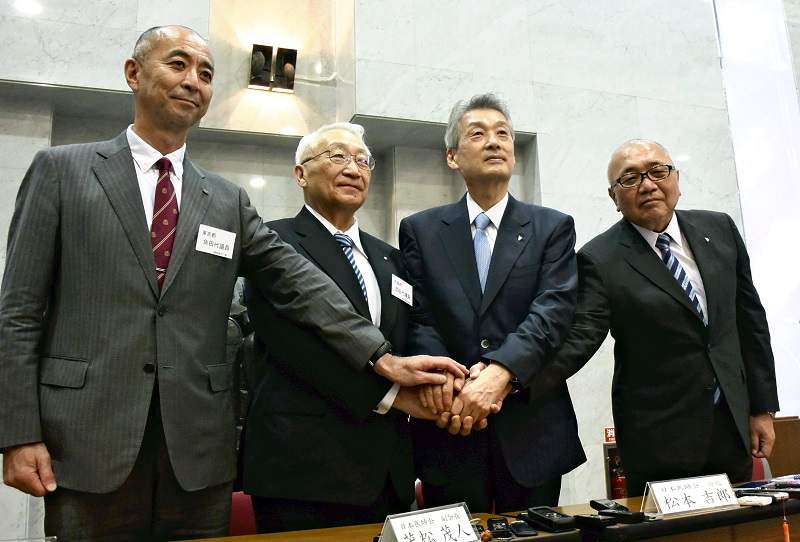
Newly elected Japan Medical Association President Kichiro Matsumoto, second from right, and other new board members attend a press conference in Bunkyo Ward, Tokyo, on Saturday.
20:00 JST, June 26, 2022
The Japan Medical Association has elected a new president, Kichiro Matsumoto, following intense scrutiny over its response to the novel coronavirus pandemic. Matsumoto faces the difficult task of repairing relations with the government and the ruling parties, as well as restoring public trust.
Successive presidents of the association have served as chairpersons of Nihon Ishi Renmei — an influential group that supports the Liberal Democratic Party — and have exerted great influence on national medical policies, including the revision of medical service fees.
Speaking at a post-election press conference on Saturday, Matsumoto said, “As an association, we want to expose our human side to the political world, too, thus helping to facilitate smooth communication with politicians.”
He emphasized he would take a different approach from that of his predecessor, Toshio Nakagawa, who had a strained relationship with the government and the ruling bloc. While in office, Nakagawa declared he would deal with the government on an issue-by-issue basis, and refrained from building relationships with the administration’s senior officials.
Nakagawa also was cautious about hosting the Tokyo Olympics and Paralympics amid the coronavirus pandemic, saying the government’s Go To Travel tourism campaign “definitely triggered a spread of infections.” His remarks drew criticism from the ruling bloc, with one member saying, “Nakagawa made his assertion without any evidence.” These tense relations continued, leading one senior Finance Ministry official to say, “There’s no need to give special consideration to Nakagawa.”
As part of this fiscal year’s medical service fees revisions, the government decided to introduce “refill prescriptions,” which allow prescriptions to be used repeatedly. The association had opposed the system. Refill prescriptions reduce the burden on patients and help curb medical costs, but the system has a negative impact on the management of medical institutions.
As a result, dissatisfaction with Nakagawa grew within the association, and he had to forgo running for office. It is unusual for a president not to run for a second term.
Matsumoto won the election with the full support of Yoshitake Yokokura, a former president of the association who has built good relationships with LDP Vice President Taro Aso and former Prime Minister Shinzo Abe.
The association is a public interest incorporated association that supports physicians across Japan. The current body was established in 1947 and as of December had 173,895 members.




Most Read
Popular articles in the past 24 hours
-
Japan Govt to Tighten Requirements to Receive Permanent Residency...
-

Tail of ANA Plane Struck Runway During Landing in Houston; No Inj...
-

Medical Care at Home and Disasters: Ensure Systems to Provide Con...
-
Samurai Japan Holds First Practice in Miami; Team Will Play again...
-

White House Takes First Step toward Permanent Fix for Illegal Tar...
-

CARTOON OF THE DAY (March 12)
-

Iran Targets Busiest International Airport as Top UN Body Demands...
-

Japan to Face Venezuela in World Baseball Classic Quarterfinals
Popular articles in the past week
-
Japan Figure Skating Legend Yuzuru Hanyu Is Proud Disaster Surviv...
-

Nippon Life Insurance's U.S. Arm Sues OpenAI Over Legal Assistanc...
-
Govt to Utilize ODA for Ensuring Economic Security; Securing Ener...
-
Massive Sewer Pipe Found Jutting Out of Highway in Osaka
-

Beckoning Cats Get Makeover to Fit Modern Lifestyles with Sleek D...
-
Japan Govt Survey Finds Just 10% of Workers Want Working Hours to...
-
Japan's 2nd Round of U.S. Investments May Be Worth Over $100 Bill...
-

Imperial Family Watches World Baseball Classic Game Against Austr...
Popular articles in the past month
-

Producer Behind Pop Group XG Arrested for Cocaine Possession
-

Japan PM Takaichi’s Cabinet Resigns en Masse
-

Man Infected with Measles Reportedly Dined at Restaurant in Tokyo...
-

Videos Plagiarized, Reposted with False Subtitles Claiming ‘Ryuky...
-
Japan Figure Skating Legend Yuzuru Hanyu Is Proud Disaster Surviv...
-

iPS Treatments Pass Key Milestone, but Broader Applications Far f...
-

Sanae Takaichi Elected Prime Minister of Japan; Keeps All Cabinet...
-

Nepal Bus Crash Kills 19 People, Injures 25 Including One Japanes...
Top Articles in Politics
-
Japan PM Takaichi’s Cabinet Resigns en Masse
-
Sanae Takaichi Elected Prime Minister of Japan; Keeps All Cabinet Appointees from Previous Term
-

Japan’s Govt to Submit Road Map for Growth Strategy in March, PM Takaichi to Announce in Upcoming Policy Speech
-
LDP Begins Training New Lawmakers to Avoid Scandal, Gaffes; Historic Victory in Latest Election Heightens Focus on Party
-
Japan PM Sanae Takaichi Welcomes Peach Ambassadors Koga Momo Musume to Official Residence
JN ACCESS RANKING
-
Producer Behind Pop Group XG Arrested for Cocaine Possession
-
Japan PM Takaichi’s Cabinet Resigns en Masse
-
Man Infected with Measles Reportedly Dined at Restaurant in Tokyo Station
-
Videos Plagiarized, Reposted with False Subtitles Claiming ‘Ryukyu Belongs to China’; Anti-China False Information Also Posted in Japan
-
Japan Figure Skating Legend Yuzuru Hanyu Is Proud Disaster Survivor and Gold Medalist, Vows to Continue Support Efforts