
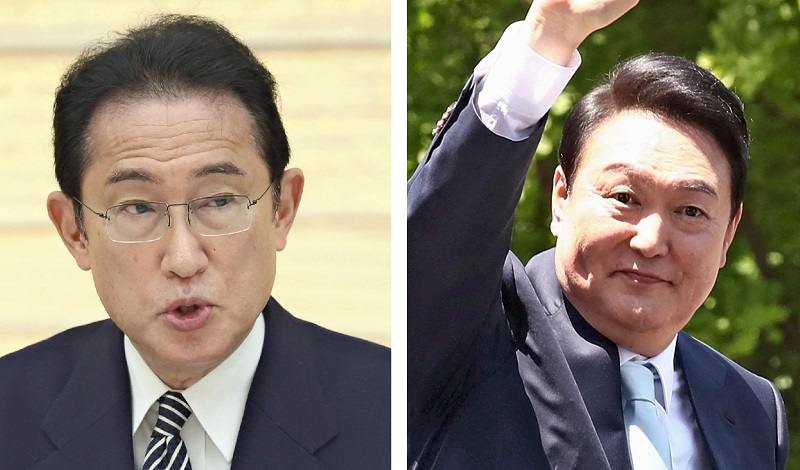
Prime Minister Fumio Kishida, left, and South Korean President Yoon Suk-yeol
16:05 JST, June 9, 2022
The percentages of respondents in Japan and South Korea who expect the bilateral relationship to “improve” in the future has surged, according to the latest joint survey conducted by The Yomiuri Shimbun and the South Korean newspaper Hankook Ilbo.
In the May 20-24 survey, 31% of respondents in Japan expected improvement, up from 14% in the previous survey in 2021, while the figure was 53% in South Korea, up from 29% in the previous survey.
The results of the latest survey indicated that respondents reacted favorably to South Korean President Yoon Suk-yeol’s eagerness to improve Japan-South Korea relations, which have been perceived as the “worst in the postwar era.” Yoon took office on May 10.
In the survey, respondents were asked about the prospects for the two countries’ relationship “under the Yoon administration.”
The percentage of respondents in Japan who said the relationship would “improve” exceeded 30% for the first time since 2011. On the South Korean side, the percentage of those with a similar view was the second highest after the 56% logged in the 2017 survey, which was conducted immediately after the launch of the previous administration, led by President Moon Jae-in. It is unusual for expectations for improvement in the bilateral relationship to rise significantly in both Japan and South Korea at the same time.
In South Korea, the percentage of pollees who expected the bilateral relationship to improve was higher than the 35% who said relations would remain unchanged, a figure that was down from 58% in the previous survey.
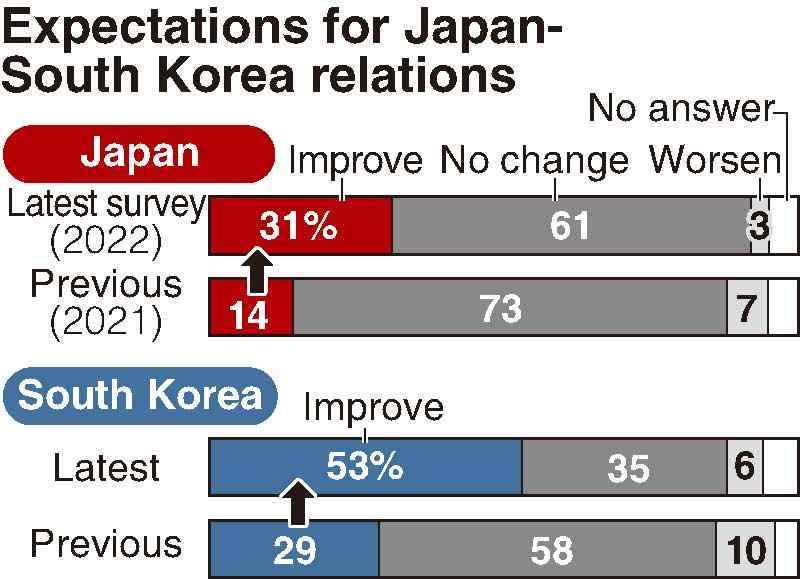
In Japan, a 61% majority of respondents still perceived that the relationship would remain unchanged, but this was a drop from the 73% who held that view in the previous survey.
When respondents were asked whether they thought their own country should move closer to the other country on historical issues, such as wartime requisitioned workers from the Korean Peninsula and former comfort women, 58% of respondents in Japan said they did not think so, down from 59% in the previous survey, while 81% in South Korea gave the same answer, up from 79%.
Following Russia’s invasion of Ukraine, 60% of respondents in Japan and 59% in South Korea think there is a possibility that their country could be attacked by another country in the near future. The percentages of those who think that China could carry out a military invasion of Taiwan reached 73% in both countries.
To counter China and Russia, 67% of respondents in Japan and 77% in South Korea said they think that their countries should work together with the United States. The survey showed that respondents in both countries shared a sense of crisis in the security environment and awareness of the importance of cooperation with Washington.
The survey was conducted by phone on voters 18 or older in the two countries, with responses given by 1,019 people in Japan and 1,000 in South Korea.





Most Read
Popular articles in the past 24 hours
-

Lady Bess: Iroha Okuda, Mayuko Kominami Discuss Performing Elizab...
-
Japan Considering Taking Part in U.S. ‘Golden Dome’ Defense Syste...
-

Japan's TEPCO Releases Footage from Fukushima N-Plant Reactor
-

Oil Reserve Releases: G7 Members Unite against Growing Threat
-
46 Evacuated from UAE, Oman on Japanese Govt-chartered Flight
-
Japan's Sanyo Shinkansen Suspended Again; Between Okayama, Aioi S...
-

Driver Dies in Collision with Express Train at Crossing in Mito; ...
-
Raise Interest Rate, Stop Yen’s Fall to Stabilize Prices
Popular articles in the past week
-
Japan Figure Skating Legend Yuzuru Hanyu Is Proud Disaster Surviv...
-

Nippon Life Insurance's U.S. Arm Sues OpenAI Over Legal Assistanc...
-
Govt to Utilize ODA for Ensuring Economic Security; Securing Ener...
-
15 Measles Patients Confirmed in Tokyo in Past 6 Days; 1 May Have...
-
Massive Sewer Pipe Found Jutting Out of Highway in Osaka
-
Japan Govt to Tighten Requirements to Receive Permanent Residency...
-

Beckoning Cats Get Makeover to Fit Modern Lifestyles with Sleek D...
-
Japan's 2nd Round of U.S. Investments May Be Worth Over $100 Bill...
Popular articles in the past month
-

Producer Behind Pop Group XG Arrested for Cocaine Possession
-

Japan PM Takaichi’s Cabinet Resigns en Masse
-

Man Infected with Measles Reportedly Dined at Restaurant in Tokyo...
-

Videos Plagiarized, Reposted with False Subtitles Claiming ‘Ryuky...
-
Japan Figure Skating Legend Yuzuru Hanyu Is Proud Disaster Surviv...
-

iPS Treatments Pass Key Milestone, but Broader Applications Far f...
-

Sanae Takaichi Elected Prime Minister of Japan; Keeps All Cabinet...
-

Nepal Bus Crash Kills 19 People, Injures 25 Including One Japanes...
Top Articles in Politics
-
Japan PM Takaichi’s Cabinet Resigns en Masse
-
Sanae Takaichi Elected Prime Minister of Japan; Keeps All Cabinet Appointees from Previous Term
-

Japan’s Govt to Submit Road Map for Growth Strategy in March, PM Takaichi to Announce in Upcoming Policy Speech
-
LDP Begins Training New Lawmakers to Avoid Scandal, Gaffes; Historic Victory in Latest Election Heightens Focus on Party
-
Japan PM Sanae Takaichi Welcomes Peach Ambassadors Koga Momo Musume to Official Residence
JN ACCESS RANKING
-
Producer Behind Pop Group XG Arrested for Cocaine Possession
-
Japan PM Takaichi’s Cabinet Resigns en Masse
-
Man Infected with Measles Reportedly Dined at Restaurant in Tokyo Station
-
Videos Plagiarized, Reposted with False Subtitles Claiming ‘Ryukyu Belongs to China’; Anti-China False Information Also Posted in Japan
-
Japan Figure Skating Legend Yuzuru Hanyu Is Proud Disaster Survivor and Gold Medalist, Vows to Continue Support Efforts